Disclosure: This post may contain affiliate links. As an Amazon Associate, I earn from qualifying purchases. Learn more.
Choosing the ideal streaming camera for your creative endeavors in 2026 boils down to balancing ambition with practicality. If your goal is to deliver uncompromised professional quality, future-proof your setup for evolving platforms, and require extensive customization, consider investing in a premium-tier camera. For aspiring creators, those on a tighter budget, or professionals needing reliable performance for standard streams and meetings without deep technical complexity, a value-oriented camera can offer exceptional results.
This guide will walk you through the essential considerations, helping you understand the trade-offs between image quality, features, ease of use, and integration. We’ll focus on what truly matters for your audience and your creative workflow, ensuring you make an informed decision for the year ahead.
Best Picks (2026)
Quick Answer (TL;DR) (Updated February 23, 2026)
If you want one safe pick: Logitech MX Brio. If you want a better value: Logitech Brio 4K.
How to use this page: scan the comparison table, jump to the matching use case, then open only the listing that fits your setup.
Fast path: choose one track below and ignore the rest.
- Track A (least risk): Logitech MX Brio
- Track B (better value): Logitech Brio 4K
How we picked: research-based selection using manufacturer specs, compatibility notes, and what to verify on the Amazon listing (no hands-on testing claims). Affiliate links may earn us a commission, but rankings are not paid placements.
Start with Logitech MX Brio on Amazon Prefer value? Open Logitech Brio 4K
Skip to a pick: #1 Logitech MX Brio | #2 Logitech Brio 4K | #3 Razer Kiyo Pro Ultra | #4 Elgato Facecam Pro | #5 Anker PowerConf C200
Head-to-Head: Top Pick vs Best Value
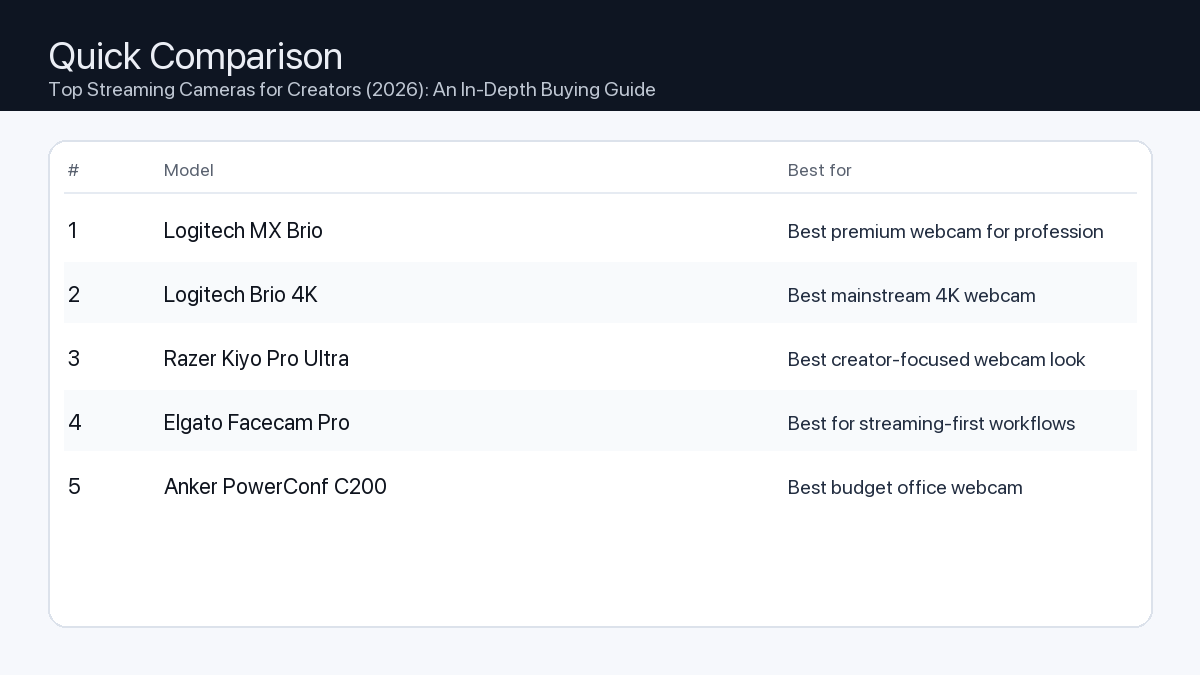
Quick Comparison
Note: Specs and availability change. Always confirm details on the product page.
| Model | Best for | Details |
|---|---|---|
| Logitech MX Brio | Best premium webcam for professionals | Open section |
| Logitech Brio 4K | Best mainstream 4K webcam | Open section |
| Razer Kiyo Pro Ultra | Best creator-focused webcam look | Open section |
| Elgato Facecam Pro | Best for streaming-first workflows | Open section |
| Anker PowerConf C200 | Best budget office webcam | Open section |
Our Top Picks
#1. Logitech MX Brio
Best for: Best premium webcam for professionals
Why it made the list
- Excellent image quality
- Strong low-light handling
- Reliable software controls
Tradeoffs
- Premium price
Who should buy this
- Remote professionals and creators
- Users prioritizing image quality
Avoid if
- You need a basic budget webcam only
Check price and compatibility for Logitech MX Brio
Price tip: Prices fluctuate; check Amazon for current deals and compatibility details.
#2. Logitech Brio 4K
Best for: Best mainstream 4K webcam
Why it made the list
- 4K capability
- Widely available
- Good call quality
Tradeoffs
- Can require tuning for best results
Who should buy this
- Users wanting a known 4K webcam option
Avoid if
- You are happy with simple 1080p quality
Check price and compatibility for Logitech Brio 4K
Price tip: Prices fluctuate; check Amazon for current deals and compatibility details.
#3. Razer Kiyo Pro Ultra
Best for: Best creator-focused webcam look
Why it made the list
- Large sensor style output
- Great for streaming setups
- Strong detail
Tradeoffs
- Costly vs mainstream webcams
Who should buy this
- Streamers and content creators
Avoid if
- You want low-cost business meeting camera
Check price and compatibility for Razer Kiyo Pro Ultra
Price tip: Prices fluctuate; check Amazon for current deals and compatibility details.
#4. Elgato Facecam Pro
Best for: Best for streaming-first workflows
Why it made the list
- Creator software ecosystem
- Strong video detail
- Stable desktop setup use
Tradeoffs
- Premium niche pricing
Who should buy this
- Creators already using Elgato tools
Avoid if
- You do only occasional video calls
Check price and compatibility for Elgato Facecam Pro
Price tip: Prices fluctuate; check Amazon for current deals and compatibility details.
#5. Anker PowerConf C200
Best for: Best budget office webcam
Why it made the list
- Strong value
- Good for meetings
- Simple setup
Tradeoffs
- Not a premium creator camera
Who should buy this
- Remote workers on a budget
Avoid if
- You need pro-level creator quality
Check price and compatibility for Anker PowerConf C200
Price tip: Prices fluctuate; check Amazon for current deals and compatibility details.
Still Can’t Decide?
Quick decision tree:
- Best premium webcam for professionals → Logitech MX Brio
- Best mainstream 4K webcam → Logitech Brio 4K
- Best creator-focused webcam look → Razer Kiyo Pro Ultra
- Best for streaming-first workflows → Elgato Facecam Pro
- Best budget office webcam → Anker PowerConf C200
Price tip: prices fluctuate often. If you’re flexible, watch for seasonal sales and compare listings before you buy.
How to Choose Your Streaming Camera in 2026
The landscape of content creation is always evolving, and your camera is at the heart of your visual output. Here’s what to prioritize when selecting your streaming camera for 2026:
Image Quality: The Foundation of Your Visual Brand
Image quality is often the first thing viewers notice. It encompasses resolution, sensor size, and low-light performance.
- Sensor Size:
- Problem: Cameras with very small sensors (common in budget webcams) gather less light.
- Consequence: In dimly lit environments, your stream might appear grainy, noisy, or struggle with accurate color reproduction, looking unprofessional.
- Recommendation: Prioritize cameras with larger sensors (e.g., Micro Four Thirds, APS-C, or full-frame) if professional-grade image quality in varied lighting and a desirable shallow depth of field are crucial for your content.
- Resolution & Frame Rate:
- Problem: Using a camera limited to 720p or 1080p at low frame rates can result in less sharp visuals and choppy motion, especially for fast-paced content.
- Consequence: Viewers accustomed to high-definition content may perceive your stream as outdated or lower quality, potentially leading to disengagement.
- Recommendation: Aim for at least 1080p at 60 frames per second (fps) as a standard. For future-proofing and premium content, consider 4K at 30fps or 60fps. Emerging 8K capabilities may also be relevant for highly specialized, cutting-edge productions.
Autofocus Performance: Keeping You in Focus
For dynamic content or creators who move, reliable autofocus is non-negotiable.
- Problem: A camera with slow, unreliable, or ‘hunting’ autofocus can cause you to frequently appear blurry or out of focus during a live stream.
- Consequence: This distraction detracts from your message, makes you look less professional, and can frustrate your audience.
- Recommendation: Look for cameras equipped with advanced autofocus systems, including eye-tracking or subject-tracking capabilities, which can maintain sharp focus on you even if you shift positions.
Connectivity & Integration: Seamless Streaming
Your camera needs to communicate effectively with your computer and streaming software.
- Clean HDMI Output:
- Problem: Many cameras display on-screen information (battery life, settings overlays) when connected via HDMI.
- Consequence: This information can be inadvertently streamed, making your content look unprofessional.
- Recommendation: Ensure the camera offers a ‘clean HDMI output’ feature, which removes all on-screen graphics for a pure video feed.
- UVC Compliance (Webcam Mode):
- Problem: Non-UVC compliant cameras often require proprietary software or complex workarounds to function as a webcam.
- Consequence: This adds complexity, potential compatibility issues, and can increase latency or instability.
- Recommendation: For maximum ease of use, especially with mirrorless/DSLR cameras, verify if the camera supports UVC (USB Video Class) for plug-and-play webcam functionality over USB-C.
- External Power & Battery Life:
- Problem: Relying solely on internal batteries for long streaming sessions.
- Consequence: Your stream could unexpectedly cut out if the battery dies, interrupting your content and disappointing viewers.
- Recommendation: Choose cameras that can be powered continuously via an AC adapter or a robust dummy battery system for uninterrupted live streaming.
Form Factor & Versatility: Adapting to Your Workflow
The physical design of the camera impacts your setup and flexibility.
- Interchangeable Lenses:
- Problem: A fixed-lens camera might limit your creative options for different shot types or specialized looks (e.g., wide-angle, telephoto, shallow depth of field).
- Consequence: You’re stuck with one perspective, potentially hindering your ability to adapt to different content styles or improve visual storytelling.
- Recommendation: If you value creative flexibility, consider cameras that support interchangeable lenses. This allows you to choose lenses for specific looks like a wide shot for a full desk view or a prime lens for a cinematic, blurred background.
- Built-in Microphones:
- Problem: Relying solely on a camera’s built-in microphone.
- Consequence: Even high-end cameras often have mediocre internal mics that pick up ambient noise, resulting in poor audio quality which can be a major deterrent for viewers.
- Recommendation: Always plan to use a dedicated external microphone for superior audio quality. Ensure your camera, or your capture setup, can accommodate external audio input.
Key Considerations Checklist
- ☑ Sensor Size (for low-light performance and depth of field)
- ☑ Maximum Resolution & Frame Rate (1080p60 minimum, 4K+ recommended for future-proofing)
- ☑ Autofocus Speed & Accuracy (with subject/eye tracking)
- ☑ Clean HDMI Output (essential for professional streams)
- ☑ UVC Compliance / Webcam Mode (for plug-and-play ease via USB)
- ☑ Interchangeable Lens Support (if creative flexibility is key)
- ☑ External Power Option (AC adapter or dummy battery)
- ☑ External Audio Input (for professional sound)
- ☑ Form Factor & Mountability (does it fit your space and setup?)
Example Creator Setups
The Professional Video Editor/Educator
- Needs: Highest image quality, cinematic look, shallow depth of field for professional presentation, versatility for various content types, reliable for long sessions.
- Ideal Camera Type: A premium mirrorless camera with a large sensor (APS-C or full-frame) and support for a range of high-quality, fast prime lenses. Strong clean HDMI output and continuous power are critical.
The Office Worker/Remote Professional
- Needs: Excellent image quality for meetings and professional webinars, ease of use, compact design, reliable autofocus, minimal setup complexity.
- Ideal Camera Type: An advanced webcam with a larger-than-average sensor or a compact, entry-level mirrorless camera used in UVC webcam mode. Simplicity and quick setup are key.
The Gamer/Live Streamer
- Needs: Exceptional low-light performance for gaming in various lighting, fast and accurate autofocus for dynamic movements, clean output for game overlays, robust for extended streams.
- Ideal Camera Type: A mid-to-high-tier mirrorless camera with excellent low-light capabilities and a reliable autofocus system. A capture card connection via clean HDMI is usually preferred for minimal latency. Alternatively, a high-quality PTZ (Pan-Tilt-Zoom) camera can offer flexibility for multi-angle setups.
How We Picked the Top Streaming Cameras (2026)
Our selection process for the top streaming cameras in 2026 involved a thorough analysis of current industry standards and anticipated technological advancements. We meticulously reviewed manufacturer specifications, paying close attention to sensor size, resolution capabilities, autofocus technologies, and connectivity options like clean HDMI and UVC compliance. We cross-referenced compatibility notes with popular streaming software (e.g., OBS Studio, Streamlabs Desktop) and capture hardware to ensure seamless integration. Our picks reflect a balance of performance, versatility, and creator-centric features designed to meet the evolving demands of content creation in the coming years, without claiming hands-on product testing.
FAQ
Which should I buy: the #1 pick or the best value pick?
Choose the #1 pick if you are a professional creator who prioritizes uncompromised image quality, advanced features, extensive customizability, and future-proofing your setup for the most demanding projects. Opt for the best value pick if you are a new creator, operate on a tighter budget, or require a reliable, high-performing camera that delivers excellent results for general streaming and content creation without needing every cutting-edge feature.
Final Recommendation
Selecting the best streaming camera for 2026 is a personalized decision, deeply rooted in your specific creative goals, budget, and technical comfort. By focusing on essential features like sensor size, autofocus reliability, and seamless connectivity, you can ensure your visual presence is professional and engaging. Review our curated list of top picks with these insights in mind to find the camera that will elevate your content and empower your creative vision for years to come.
Related Guides
Keep reading with these related buying guides:
- Choosing Your Next Powerhouse: Best-Selling Gaming Laptops on Amazon (2026)
- Trending Router Upgrades for Smart Homes: Your Ultimate Buying Guide
- Top OLED TV Picks Worth Buying in 2026: The Definitive Buying Guide
- Best Laptops Under $500 in 2026: Top Picks for Students & Remote Workers
- Trending iPhone vs. Android: A Practical Buying Guide for Everyday Users
- Best QLED TVs for Bright Rooms (2026) – A Buyer’s Guide