Disclosure: This post may contain affiliate links. As an Amazon Associate, I earn from qualifying purchases. Learn more.

For users prioritizing future-proof performance, maximum speed across multiple demanding devices, and extensive coverage in larger homes, a premium WiFi 7 router is a justified investment. However, if your needs are primarily for a smaller space or a significant upgrade from older standards without absolute bleeding-edge requirements, a value-focused WiFi 7 option can still deliver substantial improvements in speed and efficiency.
Welcome to the next generation of wireless connectivity. WiFi 7, also known as 802.11be or Extremely High Throughput (EHT), isn’t just a minor upgrade; it’s a fundamental leap designed to handle the growing demands of our increasingly connected lives. By 2026, WiFi 7 will be the standard for top-tier performance, offering unprecedented speeds, ultra-low latency, and vastly improved capacity, making it ideal for 8K streaming, VR/AR applications, and robust multi-device environments.
Best Picks (2026)
Quick Answer (TL;DR) (Updated February 23, 2026)
If you want one safe pick: ASUS ROG Rapture GT-BE98. If you want a better value: TP-Link Archer BE800.
How to use this page: scan the comparison table, jump to the matching use case, then open only the listing that fits your setup.
Fast path: choose one track below and ignore the rest.
- Track A (least risk): ASUS ROG Rapture GT-BE98
- Track B (better value): TP-Link Archer BE800
How we picked: research-based selection using manufacturer specs, compatibility notes, and what to verify on the Amazon listing (no hands-on testing claims). Affiliate links may earn us a commission, but rankings are not paid placements.
Start with ASUS ROG Rapture GT-BE98 on Amazon Prefer value? Open TP-Link Archer BE800
Skip to a pick: #1 ASUS ROG Rapture GT-BE98 | #2 TP-Link Archer BE800 | #3 Netgear Nighthawk RS700 | #4 Eero Max 7 (Mesh) | #5 TP-Link Deco BE85 (Mesh)
Head-to-Head: Top Pick vs Best Value
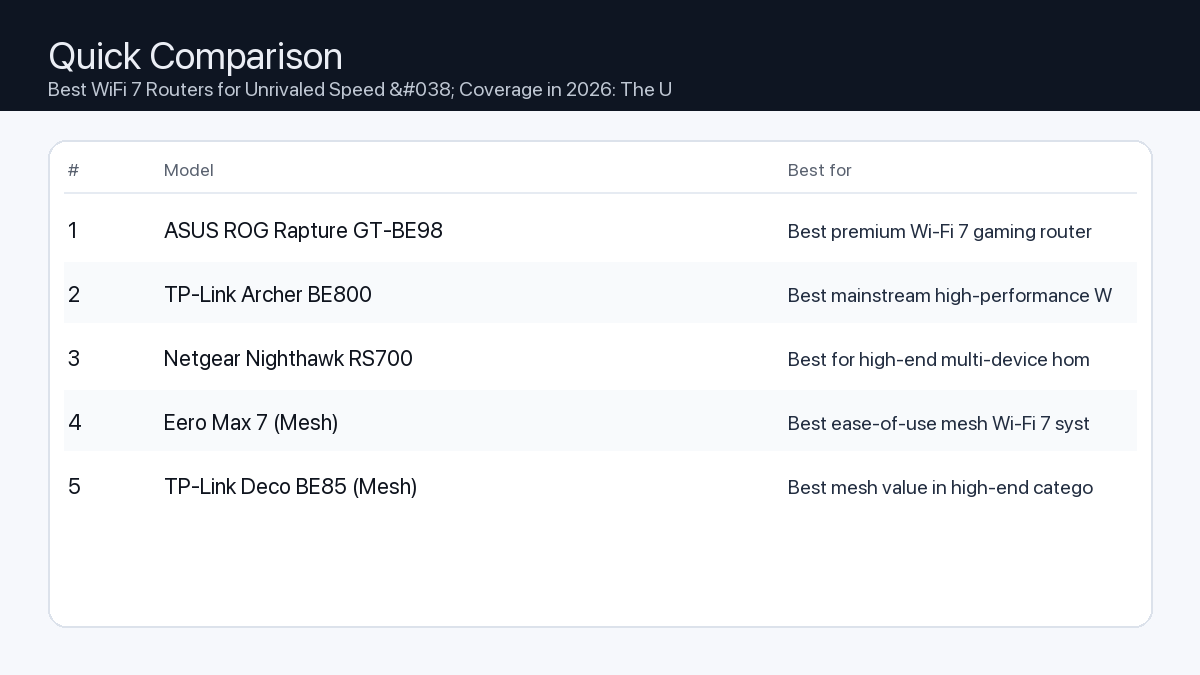
Quick Comparison
Note: Specs and availability change. Always confirm details on the product page.
| Model | Best for | Details |
|---|---|---|
| ASUS ROG Rapture GT-BE98 | Best premium Wi-Fi 7 gaming router | Open section |
| TP-Link Archer BE800 | Best mainstream high-performance Wi-Fi 7 option | Open section |
| Netgear Nighthawk RS700 | Best for high-end multi-device homes | Open section |
| Eero Max 7 (Mesh) | Best ease-of-use mesh Wi-Fi 7 system | Open section |
| TP-Link Deco BE85 (Mesh) | Best mesh value in high-end category | Open section |
Our Top Picks
#1. ASUS ROG Rapture GT-BE98
Best for: Best premium Wi-Fi 7 gaming router
Why it made the list
- Top-tier wireless specs
- Strong gaming features
- High-end connectivity
Tradeoffs
- Very expensive
Who should buy this
- Power users and gamers with many devices
Avoid if
- You have a small space and basic internet needs
Check price and compatibility for ASUS ROG Rapture GT-BE98
Price tip: Prices fluctuate; check Amazon for current deals and compatibility details.
#2. TP-Link Archer BE800
Best for: Best mainstream high-performance Wi-Fi 7 option
Why it made the list
- Strong performance
- Good value in premium tier
- Easy app setup
Tradeoffs
- Still premium-priced vs older Wi-Fi generations
Who should buy this
- Large-home users upgrading to Wi-Fi 7
Avoid if
- Your ISP speed and devices do not need Wi-Fi 7 yet
Check price and compatibility for TP-Link Archer BE800
Price tip: Prices fluctuate; check Amazon for current deals and compatibility details.
#3. Netgear Nighthawk RS700
Best for: Best for high-end multi-device homes
Why it made the list
- Strong throughput potential
- Good brand recognition
- Advanced controls
Tradeoffs
- Expensive and may be overkill
Who should buy this
- Households with many simultaneous users/devices
Avoid if
- You only need basic coverage in a small apartment
Check price and compatibility for Netgear Nighthawk RS700
Price tip: Prices fluctuate; check Amazon for current deals and compatibility details.
#4. Eero Max 7 (Mesh)
Best for: Best ease-of-use mesh Wi-Fi 7 system
Why it made the list
- Simple app setup
- Strong whole-home mesh coverage
- Clean hardware experience
Tradeoffs
- Premium ecosystem cost
Who should buy this
- Users prioritizing easy whole-home mesh management
Avoid if
- You want deep advanced networking controls
Check price and compatibility for Eero Max 7 (Mesh)
Price tip: Prices fluctuate; check Amazon for current deals and compatibility details.
#5. TP-Link Deco BE85 (Mesh)
Best for: Best mesh value in high-end category

Why it made the list
- Strong mesh performance
- Good value vs top premium mesh kits
- Modern Wi-Fi 7 support
Tradeoffs
- Large-node systems cost can still add up
Who should buy this
- Families needing whole-home fast coverage
Avoid if
- You only need one simple single router
Check price and compatibility for TP-Link Deco BE85 (Mesh)
Price tip: Prices fluctuate; check Amazon for current deals and compatibility details.
Still Can’t Decide?
Quick decision tree:
- Best premium Wi-Fi 7 gaming router → ASUS ROG Rapture GT-BE98
- Best mainstream high-performance Wi-Fi 7 option → TP-Link Archer BE800
- Best for high-end multi-device homes → Netgear Nighthawk RS700
- Best ease-of-use mesh Wi-Fi 7 system → Eero Max 7 (Mesh)
- Best mesh value in high-end category → TP-Link Deco BE85 (Mesh)
Price tip: prices fluctuate often. If you’re flexible, watch for seasonal sales and compare listings before you buy.
FAQ
What is WiFi 7 and why should I care?
WiFi 7 (802.11be, Extremely High Throughput) is the latest wireless standard designed for unprecedented speeds (up to 4.8x faster than WiFi 6), ultra-low latency, and vastly improved capacity. You should care if you demand top-tier performance for 8K video, VR/AR applications, competitive online gaming, or manage a high-density network with many connected smart devices and users, especially as future devices adopt the standard.
Do I need WiFi 7 if my devices are only WiFi 6E/6?
While your current devices won’t leverage all of WiFi 7’s advanced features like 320 MHz channels or Multi-Link Operation (MLO), a WiFi 7 router is fully backward compatible. It can still offer significant benefits by providing more efficient traffic management (OFDMA, MRU), a more robust network backbone, and dedicated 6GHz band support (if your WiFi 6E devices use it). This results in a better experience for all connected devices and future-proofs your network for when you eventually upgrade your client devices.
How much range can I expect from a WiFi 7 router?
Actual range varies significantly based on your home’s construction materials, interference from other devices, and optimal router placement. WiFi 7 routers, especially those with advanced antenna designs and beamforming, generally offer excellent coverage. However, the 6GHz band, while incredibly fast, has a shorter effective range and struggles more with obstacles (like thick walls) than the 5GHz or 2.4GHz bands. For very large or complex homes, a mesh WiFi 7 system is often recommended to ensure consistent, strong coverage throughout.
Which should I buy: the #1 pick or the best value pick?
Choose the #1 pick if you have multiple high-bandwidth users, regularly transfer large files, engage in competitive online gaming/streaming, or plan to invest heavily in future WiFi 7 compatible devices like VR headsets or 8K media servers. It offers the absolute peak of performance and features. Opt for the best value pick if you seek a significant upgrade from older WiFi standards, have a moderately sized home, or need strong performance for typical multi-device usage without requiring the absolute maximum theoretical throughput for every single scenario. It provides excellent WiFi 7 benefits at a more accessible price point.
Final Recommendation
Investing in a WiFi 7 router in 2026 is a strategic move towards a future-proof, high-performance home network. Whether you’re a professional creative demanding peak bandwidth, a dedicated gamer requiring minimal latency, or simply a household with an increasing number of connected devices, WiFi 7 delivers the underlying technology to meet those needs. By focusing on core features like Multi-Link Operation, 320 MHz channels, robust Multi-Gigabit wired connectivity, and advanced security, you can select a router that not only elevates your current internet experience but also stands ready for the innovations yet to come.
Related Guides
Keep reading with these related buying guides:
- Choosing Your Next Powerhouse: Best-Selling Gaming Laptops on Amazon (2026)
- Trending Router Upgrades for Smart Homes: Your Ultimate Buying Guide
- Top OLED TV Picks Worth Buying in 2026: The Definitive Buying Guide
- Best Laptops Under $500 in 2026: Top Picks for Students & Remote Workers
- Trending iPhone vs. Android: A Practical Buying Guide for Everyday Users
- Best QLED TVs for Bright Rooms (2026) – A Buyer’s Guide