Kategori: Uncategorized

  • Best Power Bank for Travel and Daily Carry (2026) – Your Ultimate Buying Guide

    Best Power Bank for Travel and Daily Carry (2026) – Your Ultimate Buying Guide

    Disclosure: This post may contain affiliate links. As an Amazon Associate, I earn from qualifying purchases. Learn more.

    Best Power Bank for Travel and Daily Carry (2026) – Your Ultimate Buying Guide

    Choosing the right power bank for 2026 hinges on your daily usage and travel habits. If you’re a power user, frequently travel internationally, or carry multiple power-hungry devices like laptops and tablets, prioritize a premium power bank with high capacity, advanced fast charging protocols (like USB-PD up to 100W+), and versatile port options. For those with lighter needs—charging a single smartphone or earbuds throughout the day, or occasional local travel—a value-focused power bank offering sufficient capacity (5,000-10,000mAh) and basic fast charging will provide excellent utility without unnecessary bulk or expense.

    This buying guide cuts through the technical jargon to help you understand the critical features and tradeoffs involved. We’ll explore essential factors like capacity, charging speed, port selection, and portability, ensuring you can confidently select a power bank that keeps your devices powered through any adventure or workday.

    Best Picks (2026)

    Quick Answer (TL;DR) (Updated March 06, 2026)

    If you want one safe pick: Anker Prime 20K Power Bank. If you want a better value: UGREEN Nexode 20000mAh.

    How to use this page: scan the comparison table, jump to the matching use case, then open only the listing that fits your setup.

    Fast path: choose one track below and ignore the rest.

    • Track A (least risk): Anker Prime 20K Power Bank
    • Track B (better value): UGREEN Nexode 20000mAh

    How we picked: research-based selection using manufacturer specs, compatibility notes, and what to verify on the Amazon listing (no hands-on testing claims). Affiliate links may earn us a commission, but rankings are not paid placements.

    Start with Anker Prime 20K Power Bank on Amazon Prefer value? Open UGREEN Nexode 20000mAh

    Skip to a pick: #1 Anker Prime 20K Power Bank | #2 UGREEN Nexode 20000mAh | #3 Baseus Blade 100W Power Bank | #4 INIU 10000mAh Compact Power Bank | #5 Shargeek Storm2

    Head-to-Head: Top Pick vs Best Value

    Anker Prime 20K Power Bank
    Best all-around fast-charging power bank
    Read full #1 breakdown

    Go to Amazon: Anker Prime 20K Power Bank

    UGREEN Nexode 20000mAh
    Best value high-output USB-C bank

    Read full best-value breakdown

    Go to Amazon: UGREEN Nexode 20000mAh

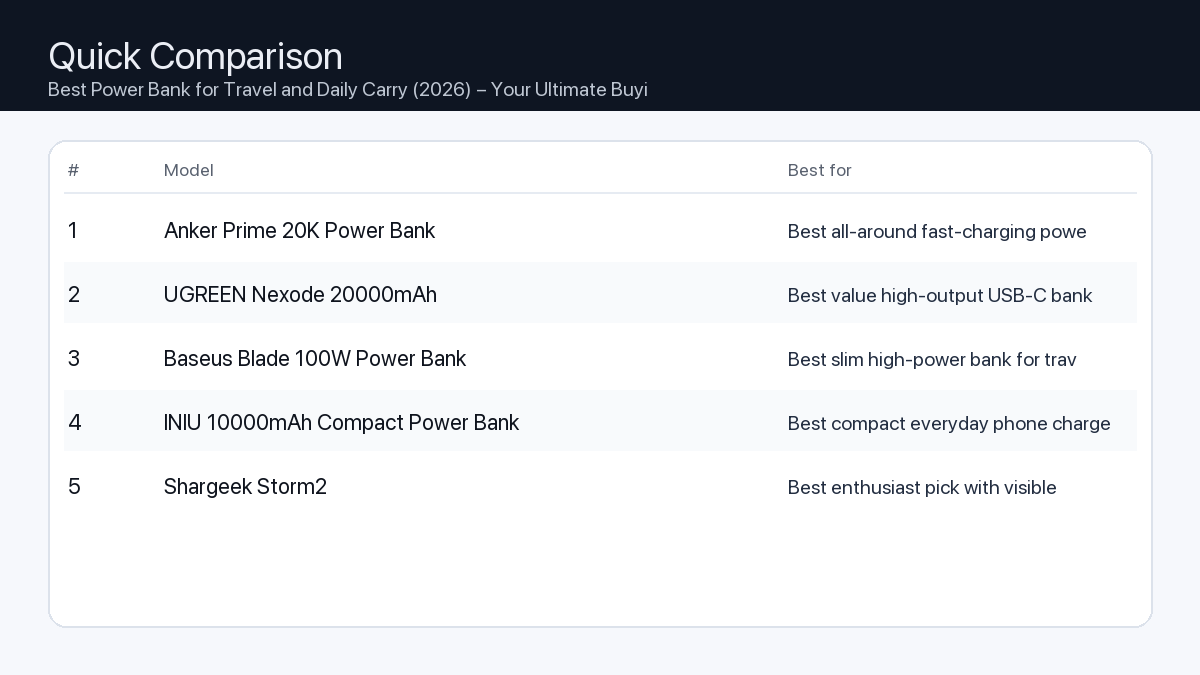
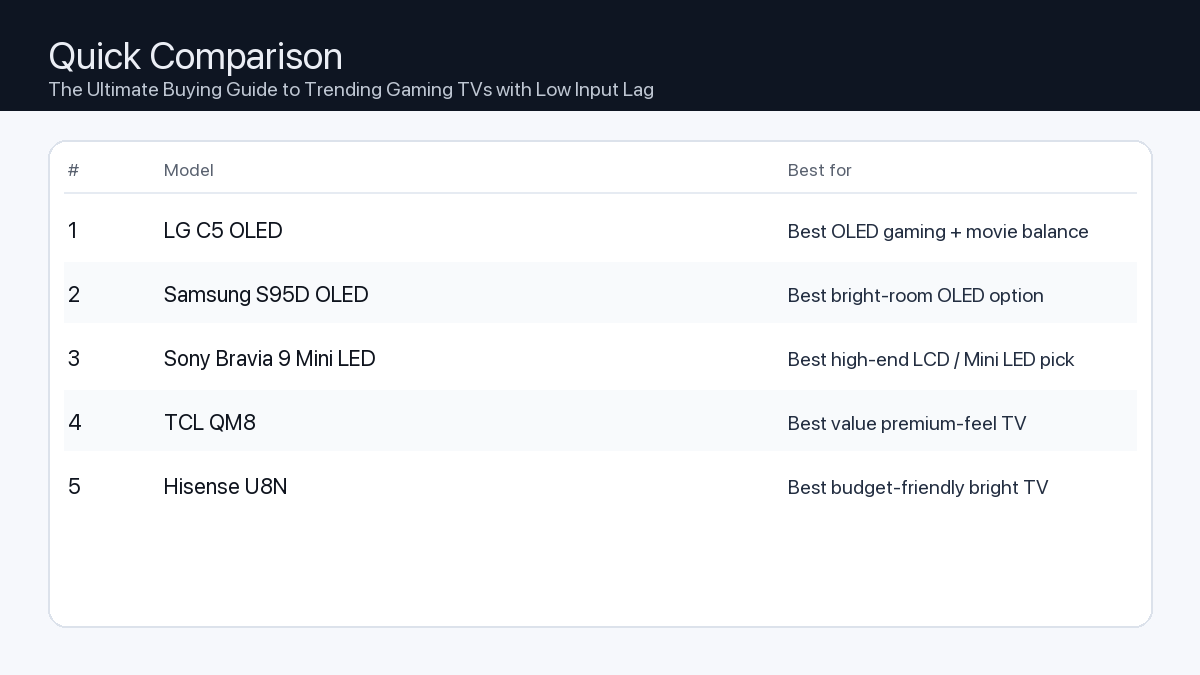
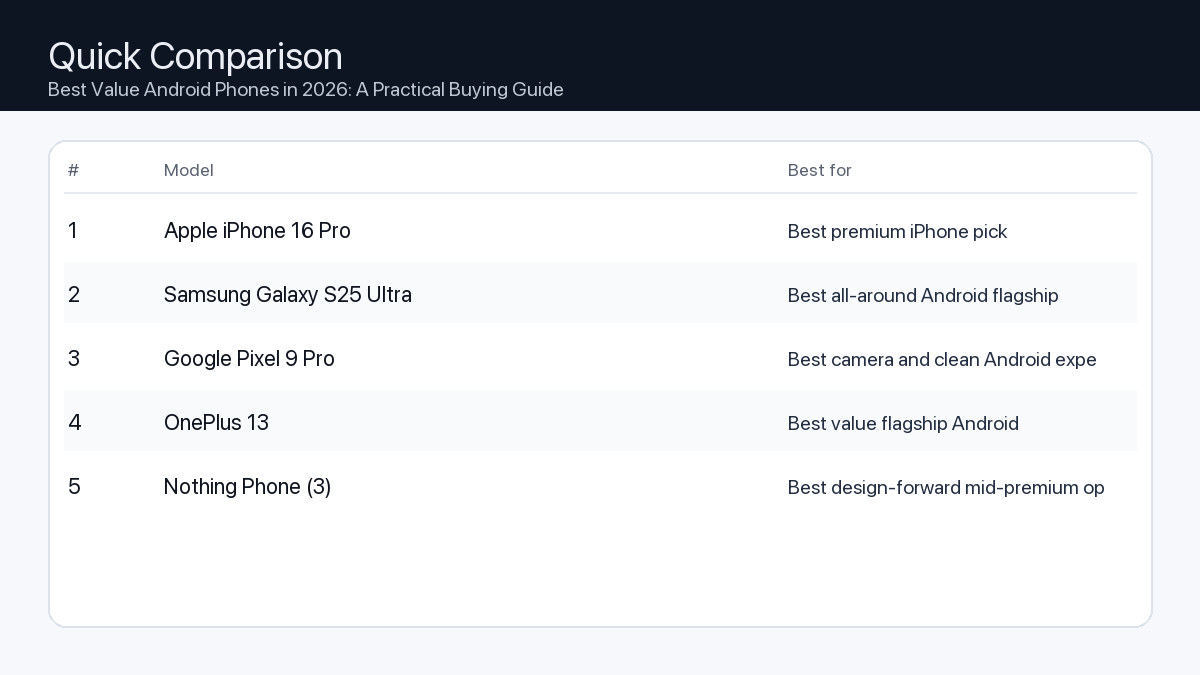
    Quick Comparison

    Note: Specs and availability change. Always confirm details on the product page.

    Model Best for Details
    Anker Prime 20K Power Bank Best all-around fast-charging power bank Open section
    UGREEN Nexode 20000mAh Best value high-output USB-C bank Open section
    Baseus Blade 100W Power Bank Best slim high-power bank for travel bags Open section
    INIU 10000mAh Compact Power Bank Best compact everyday phone charger Open section
    Shargeek Storm2 Best enthusiast pick with visible metrics Open section
    Comparison: Best Power Bank for Travel and Daily Carry (2026) – Your Ultimate Buying Guide
    At-a-glance comparison of our picks.

    Our Top Picks

    #1. Anker Prime 20K Power Bank

    Best for: Best all-around fast-charging power bank

    Anker Prime 20K Power Bank

    Why it made the list

    • Strong output
    • Trusted brand
    • Good reliability

    Tradeoffs

    • Higher cost than basic banks

    Who should buy this

    • Users charging phones and laptops on the go

    Avoid if

    • You only need occasional low-power phone charging

    Check price and compatibility for Anker Prime 20K Power Bank

    Price tip: Prices fluctuate; check Amazon for current deals and compatibility details.

    #2. UGREEN Nexode 20000mAh

    Best for: Best value high-output USB-C bank
    UGREEN Nexode 20000mAh

    Why it made the list

    • Good value for output
    • USB-C focused design
    • Portable size

    Tradeoffs

    • Model variants can be confusing

    Who should buy this

    • Value-focused users needing modern USB-C charging

    Avoid if

    • You want one very specific premium ecosystem model

    Check price and compatibility for UGREEN Nexode 20000mAh

    Price tip: Prices fluctuate; check Amazon for current deals and compatibility details.

    #3. Baseus Blade 100W Power Bank

    Best for: Best slim high-power bank for travel bags
    Baseus Blade 100W Power Bank

    Why it made the list

    • Slim profile
    • High output options
    • Useful display on some variants

    Tradeoffs

    • Can be heavier than expected for slim form

    Who should buy this

    • Frequent travelers carrying USB-C laptops

    Avoid if

    • You want the lightest possible tiny power bank

    Check price and compatibility for Baseus Blade 100W Power Bank

    Price tip: Prices fluctuate; check Amazon for current deals and compatibility details.

    #4. INIU 10000mAh Compact Power Bank

    Best for: Best compact everyday phone charger
    INIU 10000mAh Compact Power Bank

    Why it made the list

    • Compact
    • Affordable
    • Easy daily carry

    Tradeoffs

    • Lower capacity vs 20K+ models

    Who should buy this

    • Everyday phone users
    • Light travelers

    Avoid if

    • You need multi-device or laptop charging

    Check price and compatibility for INIU 10000mAh Compact Power Bank

    Price tip: Prices fluctuate; check Amazon for current deals and compatibility details.

    #5. Shargeek Storm2

    Best for: Best enthusiast pick with visible metrics
    Shargeek Storm2

    Why it made the list

    • Distinctive design
    • Detailed charging data
    • High output potential

    Tradeoffs

    • Premium niche pricing

    Who should buy this

    • Tech enthusiasts
    • Users who like monitoring charging metrics

    Avoid if

    • You just want a basic low-cost charger

    Check price and compatibility for Shargeek Storm2

    Price tip: Prices fluctuate; check Amazon for current deals and compatibility details.

    Still Can’t Decide?

    Quick decision tree:

    Price tip: prices fluctuate often. If you’re flexible, watch for seasonal sales and compare listings before you buy.

    Ready? Open Anker Prime 20K Power Bank on Amazon

    How to Choose the Right Power Bank for You

    Capacity (mAh / Wh)

    Problem: Underestimating your charging needs leaves devices unpowered when you need them most, especially during long travel days or busy work schedules.

    Consequence: A dead smartphone prevents navigation, communication, or critical work. An uncharged laptop halts productivity.

    Recommendation: Match the power bank’s capacity to the battery sizes of your most frequently charged devices and the number of recharges you anticipate needing. Remember, a 10,000mAh power bank typically provides 1-2 full charges for a standard smartphone after accounting for efficiency losses.

    • Smartphone (3,000-5,000mAh battery): 5,000-10,000mAh for 1-2 charges.
    • Tablet (6,000-10,000mAh battery): 10,000-20,000mAh for 1-2 charges.
    • Laptop (40-80Wh battery): 20,000mAh (74Wh) and above, specifically looking for Watt-hour (Wh) ratings for laptops, as this is a more accurate comparison than mAh due to varying voltages. Note airline limits are typically 100Wh for carry-on.

    Charging Speed (Watts)

    Problem: Slow charging means longer waits, leaving your devices tethered to an outlet or the power bank when you’d rather be on the move.

    Consequence: You might miss critical messages or struggle to get your device ready before an important meeting or flight.

    Recommendation: Prioritize power banks with modern fast-charging protocols. Look for USB Power Delivery (USB-PD) for Apple devices, most Android devices, and laptops. For specific Android devices, Programmable Power Supply (PPS) offers optimized fast charging.

    • 20W-30W USB-PD: Ideal for fast-charging most modern smartphones and smaller tablets.
    • 45W-60W USB-PD: Suitable for larger tablets and many ultrabooks or smaller laptops.
    • 60W-100W+ USB-PD: Essential for quickly charging power-hungry laptops, gaming handhelds, and larger devices.

    Port Selection and Quantity

    Problem: Having the wrong ports or too few outputs means you can’t charge all your devices efficiently, or at all, with a single power bank.

    Consequence: Carrying multiple power banks or constantly swapping cables for different devices, leading to inconvenience and clutter.

    Recommendation: Evaluate your typical device ecosystem. A power bank with at least one USB-C port (for input and output) and one USB-A port offers good versatility. For multi-device users, multiple output ports are crucial.

    • USB-C Ports: Essential for modern devices and fast charging via USB-PD. Look for at least one that supports high-wattage output.
    • USB-A Ports: Useful for legacy devices, smartwatches, or accessories that don’t yet use USB-C.
    • Input/Output Versatility: A USB-C port that can both charge the power bank and charge other devices simplifies cable management.

    Size, Weight, and Portability

    Problem: A power bank that’s too bulky or heavy for your bag or pocket often gets left behind, defeating its purpose.

    Consequence: You’re left without a power solution on the go because the convenient option wasn’t convenient enough to carry.

    Recommendation: Balance capacity with physical dimensions and weight. Consider your primary carry method (pocket, small bag, backpack). Some models offer integrated cables or wall plugs for ultimate convenience.

    • Pocket Carry (Daily): Generally 5,000-10,000mAh, compact, lightweight.
    • Small Bag/Purse (Daily/Travel): 10,000-20,000mAh, balances capacity with manageable size.
    • Backpack (Travel/Heavy Use): 20,000mAh+, larger and heavier, but offers extensive power.

    Safety Features

    Problem: Generic or low-quality power banks can pose risks of overheating, overcharging, or damaging your devices.

    Consequence: Potential device failure, reduced battery lifespan, or in rare cases, safety hazards.

    Recommendation: Stick to reputable brands known for integrating comprehensive safety features. Look for mention of protections against overcharge, over-discharge, short-circuit, over-current, and temperature control.

    Who Needs What? Example Setups:

    The Mobile Video Editor / Professional Traveler

    You juggle a laptop, tablet, and smartphone across time zones, often working remotely or reviewing content on the go. Power is non-negotiable.

    • Capacity: 25,000mAh (92.5Wh) or higher, ensuring multiple recharges for all devices, including a full laptop charge.
    • Charging Speed: 60W-100W USB-PD output to rapidly charge laptops and fast-charge tablets simultaneously.
    • Ports: At least two high-power USB-C outputs and one USB-A for legacy accessories.
    • Portability: Designed for efficiency despite capacity; compact footprint, durable casing.

    The Office Worker / Daily Commuter

    Your main concern is keeping your smartphone and wireless earbuds powered throughout a busy workday or on your commute, without adding bulk to your everyday carry.

    • Capacity: 5,000-10,000mAh, sufficient for 1-2 phone charges.
    • Charging Speed: 20W-30W USB-PD output for quick smartphone top-ups.
    • Ports: One USB-C output and one USB-A output (optional) for versatility.
    • Portability: Slim, lightweight, and pocketable, easily fits into a small bag or jacket pocket.

    The Gamer / Creator (on the go)

    Whether you’re powering a gaming handheld, a high-performance laptop for creative tasks, or multiple accessories, sustained power and rapid charging are key to uninterrupted play or productivity.

    • Capacity: 27,000mAh (99.9Wh) or higher (if not flying), able to extend gaming sessions significantly or provide full laptop recharges.
    • Charging Speed: 100W+ USB-PD output is crucial for high-performance laptops and gaming handhelds, minimizing downtime.
    • Ports: Two high-power USB-C outputs and at least one high-output USB-A for controllers or other peripherals.
    • Portability: Prioritizes power over ultimate compactness, but still designed for backpack carry, potentially with robust construction.

    How We Picked the Best Power Banks

    Our selection process for the best power banks for travel and daily carry (2026) is built on a thorough analysis of current technology trends and user needs, without claiming hands-on testing. We focused on identifying models that excel in core performance metrics and practical features based on:

    • Manufacturer Specifications: Meticulous review of advertised capacity, Watt-hour (Wh) ratings, maximum power output (W) for all ports, and supported fast-charging protocols (USB-PD, PPS, QC).
    • Adherence to Industry Standards: Ensuring compliance with established charging standards like USB-PD for broad compatibility and safety across a wide range of devices, from smartphones to laptops.
    • Form Factor and Material Quality: Evaluating the design for optimal portability, durability, and effective heat dissipation based on published product information and typical brand construction.
    • Travel Compliance: Prioritizing power banks that meet international airline regulations for carry-on luggage, specifically staying within the 100Wh limit where practical for universal travel.
    • Anticipated User Feedback Trends: Analyzing general market sentiment and common points of satisfaction or concern from a broad range of existing public user data regarding reliability, actual performance compared to specs, and long-term durability.

    Frequently Asked Questions

    How much capacity (mAh) do I really need?
    For a smartphone (3,000-5,000mAh battery), 10,000mAh typically provides 1-2 full charges. For a tablet, 15,000-20,000mAh is often better. Laptops often require 20,000mAh+ with higher wattage output. Always calculate based on your device’s battery size and how many times you expect to recharge it.
    What is USB-PD and why is it important?
    USB Power Delivery (USB-PD) is a charging standard that allows for much higher power delivery (up to 240W, though commonly 20W-100W for power banks) over USB-C. It’s crucial for fast charging modern smartphones, tablets, and especially laptops, ensuring significantly quicker charge times than older USB standards.
    Can I take any power bank on a plane?
    Most airlines restrict power banks to carry-on luggage only. Typically, capacities are limited to 100 Watt-hours (Wh). Power banks between 100Wh and 160Wh may be allowed with airline approval. Devices over 160Wh are generally prohibited. Remember that 100Wh is approximately 27,000mAh at a nominal voltage of 3.7V.
    Which should I buy: the #1 pick or the best value pick?
    Choose the #1 pick if you prioritize maximum performance, superior versatility for charging multiple devices including demanding laptops, and cutting-edge fast charging capabilities, and if your budget allows for a premium investment. Opt for the best value pick if you primarily need reliable, efficient, and fast charging for a smartphone or a couple of smaller devices, and prefer a more budget-friendly or compact solution without sacrificing essential, core charging features.

    Final Recommendation

    Selecting the best power bank for 2026 comes down to a clear understanding of your personal use case. By considering your specific needs for capacity, charging speed, port compatibility, and portability, you can confidently choose a power bank that seamlessly integrates into your travel and daily routine. Whether you’re powering a workstation on the go or simply keeping your phone alive through a long day, the right power bank is an indispensable tool for staying connected and productive.

    Related Guides

    Keep reading with these related buying guides:

  • The Ultimate Robot Cleaner Buying Guide for Busy Homes (2026)

    The Ultimate Robot Cleaner Buying Guide for Busy Homes (2026)

    Disclosure: This post may contain affiliate links. As an Amazon Associate, I earn from qualifying purchases. Learn more.

    The Ultimate Robot Cleaner Buying Guide for Busy Homes (2026)

    In 2026, robot cleaners are indispensable tools for managing a busy household. They free up valuable time, reduce mental load, and maintain a consistently clean living space. Deciding which model is right for you often comes down to balancing automation with budget.

    For those prioritizing maximum convenience and truly hands-off operation, premium models with advanced self-maintenance features are the ideal choice. If your primary goal is effective, scheduled cleaning and you’re comfortable with slightly more interaction to manage dustbins or water tanks, excellent value-focused options offer robust performance without breaking the bank. This guide will help you understand the key differences and find your perfect match.

    Best Picks (2026)

    Quick Answer (TL;DR) (Updated March 05, 2026)

    If you want one safe pick: Roborock S8 MaxV Ultra. If you want a better value: iRobot Roomba j9+.

    How to use this page: scan the comparison table, jump to the matching use case, then open only the listing that fits your setup.

    Fast path: choose one track below and ignore the rest.

    • Track A (least risk): Roborock S8 MaxV Ultra
    • Track B (better value): iRobot Roomba j9+

    How we picked: research-based selection using manufacturer specs, compatibility notes, and what to verify on the Amazon listing (no hands-on testing claims). Affiliate links may earn us a commission, but rankings are not paid placements.

    Start with Roborock S8 MaxV Ultra on Amazon Prefer value? Open iRobot Roomba j9+

    Skip to a pick: #1 Roborock S8 MaxV Ultra | #2 iRobot Roomba j9+ | #3 Eufy X10 Pro Omni | #4 Dreame L20 Ultra | #5 Shark AI Ultra

    Head-to-Head: Top Pick vs Best Value

    Roborock S8 MaxV Ultra
    Best premium robot vacuum + mop combo

    Read full #1 breakdown

    Go to Amazon: Roborock S8 MaxV Ultra

    iRobot Roomba j9+
    Best for pet-hair focused vacuuming

    Read full best-value breakdown

    Go to Amazon: iRobot Roomba j9+

    Quick Comparison

    Note: Specs and availability change. Always confirm details on the product page.

    Model Best for Details
    Roborock S8 MaxV Ultra Best premium robot vacuum + mop combo Open section
    iRobot Roomba j9+ Best for pet-hair focused vacuuming Open section
    Eufy X10 Pro Omni Best value all-in-one docked cleaner Open section
    Dreame L20 Ultra Best for mopping-heavy homes Open section
    Shark AI Ultra Best budget self-empty robot vacuum Open section
    Comparison: The Ultimate Robot Cleaner Buying Guide for Busy Homes (2026)
    At-a-glance comparison of our picks.

    Our Top Picks

    #1. Roborock S8 MaxV Ultra

    Best for: Best premium robot vacuum + mop combo

    Roborock S8 MaxV Ultra

    Why it made the list

    • Strong navigation
    • Powerful cleaning
    • Advanced dock features

    Tradeoffs

    • Premium pricing

    Who should buy this

    • Busy households wanting near-hands-off cleaning
    • Users with mixed floor types

    Avoid if

    • You need a low-budget cleaner

    Check price and compatibility for Roborock S8 MaxV Ultra

    Price tip: Prices fluctuate; check Amazon for current deals and compatibility details.

    #2. iRobot Roomba j9+

    Best for: Best for pet-hair focused vacuuming

    iRobot Roomba j9+

    Why it made the list

    • Strong suction and brush system
    • Good app controls
    • Reliable brand support

    Tradeoffs

    • Often pricier than value competitors

    Who should buy this

    • Pet owners
    • Users preferring iRobot ecosystem

    Avoid if

    • You want the cheapest self-empty model

    Check price and compatibility for iRobot Roomba j9+

    Price tip: Prices fluctuate; check Amazon for current deals and compatibility details.

    #3. Eufy X10 Pro Omni

    Best for: Best value all-in-one docked cleaner

    Eufy X10 Pro Omni

    Why it made the list

    • Strong value feature set
    • Good navigation
    • All-in-one dock convenience

    Tradeoffs

    • Software polish can vary by updates

    Who should buy this

    • Value buyers wanting premium-style features

    Avoid if

    • You only trust one specific flagship brand

    Check price and compatibility for Eufy X10 Pro Omni

    Price tip: Prices fluctuate; check Amazon for current deals and compatibility details.

    #4. Dreame L20 Ultra

    Best for: Best for mopping-heavy homes

    Dreame L20 Ultra

    Why it made the list

    • Strong mop features
    • Good obstacle handling
    • Powerful app automation

    Tradeoffs

    • Dock size can be large

    Who should buy this

    • Homes with hard floors and frequent mopping needs

    Avoid if

    • You have very limited docking space

    Check price and compatibility for Dreame L20 Ultra

    Price tip: Prices fluctuate; check Amazon for current deals and compatibility details.

    #5. Shark AI Ultra

    Best for: Best budget self-empty robot vacuum

    Shark AI Ultra

    Why it made the list

    • Affordable self-empty option
    • Simple setup
    • Good mainstream availability

    Tradeoffs

    • Not as advanced as ultra-premium models

    Who should buy this

    • Budget-conscious families
    • First-time robot vacuum buyers

    Avoid if

    • You want top-tier mapping and mopping automation

    Check price and compatibility for Shark AI Ultra

    Price tip: Prices fluctuate; check Amazon for current deals and compatibility details.

    Still Can’t Decide?

    Quick decision tree:

    Price tip: prices fluctuate often. If you’re flexible, watch for seasonal sales and compare listings before you buy.

    Ready? Open Roborock S8 MaxV Ultra on Amazon

    How to Choose the Best Robot Cleaner for Your Busy Life

    Selecting the right robot cleaner involves understanding your home’s unique needs and how specific features address common challenges.

    Key Features and Tradeoffs

    Here’s a breakdown of essential considerations:

    1. Cleaning Performance: Suction Power & Mopping Capabilities

    • Problem: Standard robot cleaners may struggle with stubborn dirt, pet hair, or dried spills, leaving your floors less than pristine.
    • Consequence: You still need to manually clean problem areas, negating the convenience factor.
    • Recommendation: Look for models with high Pascal (Pa) suction ratings for carpets and pet hair. For hard floors, consider advanced mopping systems like vibrating pads or automatic mop lifting to prevent re-wetting carpets and handle various messes effectively.

    Checklist for Cleaning Performance:

    • Do you have high-traffic areas prone to dirt and crumbs?
    • Are pets a significant source of hair and dander?
    • Is your home a mix of hard floors and carpets, requiring versatile cleaning?
    • Are spills and sticky messes a common occurrence?

    2. Navigation & Mapping Technology

    • Problem: Basic robot cleaners can navigate randomly, missing spots or repeatedly cleaning the same area, leading to inefficient and incomplete coverage. They might also get stuck frequently.
    • Consequence: Wasted cleaning time, missed dirty spots, and regular intervention required.
    • Recommendation: Prioritize models with LiDAR (laser-based) or advanced VSLAM (visual simultaneous localization and mapping) technology. These systems create precise maps of your home, enabling systematic cleaning paths, multi-floor mapping, and the ability to set virtual ‘no-go’ zones or ‘no-mop’ zones.

    Checklist for Navigation & Mapping:

    • Do you live in a multi-level home that requires separate maps?
    • Does your home have complex layouts with many furniture legs or obstacles?
    • Do you need to prevent the robot from entering specific areas (e.g., pet food bowls, play zones)?

    3. Self-Emptying & Auto-Refill/Drain Stations

    • Problem: Frequent manual emptying of small dustbins or refilling/draining water tanks for mopping negates much of the automation benefit.
    • Consequence: You’re still regularly performing a maintenance chore, potentially coming into contact with dust and allergens.
    • Recommendation: For maximum convenience, choose models with a self-emptying dustbin that transfers debris to a larger bag or container in the charging dock. For mopping, consider stations that automatically refill the robot’s water tank and drain dirty water, offering weeks of hands-off operation.

    Checklist for Automation:

    • Is minimizing daily or weekly interaction your top priority?
    • Are you an allergy sufferer who wants to avoid contact with dust?
    • Do you have a larger home that generates more debris, requiring frequent emptying?

    4. Battery Life & Recharge-and-Resume

    • Problem: A robot cleaner with insufficient battery life for your home size will run out of power mid-cycle, leaving areas uncleaned.
    • Consequence: Incomplete cleaning sessions and longer overall cleaning times due to multiple recharge cycles.
    • Recommendation: Select a robot with battery life appropriate for your home’s square footage. Ensure it features ‘recharge-and-resume,’ which allows the robot to return to its base to charge and then pick up cleaning exactly where it left off.

    Checklist for Battery & Coverage:

    • Do you have a large home or an open floor plan?
    • Do you prefer the robot to complete cleaning in a single pass?

    5. Smart Features & App Control

    • Problem: Limited app functionality means less control over scheduling, cleaning modes, and specific zones.
    • Consequence: Reduced flexibility and efficiency, potentially requiring more manual setup.
    • Recommendation: Look for a robust mobile app that allows for easy scheduling, zone cleaning (cleaning specific rooms), no-go zones, cleaning mode adjustments, and remote control. Compatibility with voice assistants (e.g., Alexa, Google Assistant) can add further convenience.

    Checklist for Smart Features:

    • Do you want to integrate the robot with your existing smart home ecosystem?
    • Do you need precise control over when and where the robot cleans?
    • Do you prefer to start or stop cleaning remotely?

    6. Maintenance & Consumables

    • Problem: Difficult-to-clean brushes, hard-to-find filters, or expensive replacement parts can add hidden costs and frustration over time.
    • Consequence: Increased long-term expenses and more frequent maintenance tasks.
    • Recommendation: Look for models with tangle-free brushes (especially if you have pets), washable filters, and readily available, reasonably priced replacement consumables (dust bags, brushes, filters, mop pads).

    Checklist for Maintenance:

    • Do you have pets with long hair (requires tangle-resistant brushes)?
    • Is ease of maintenance a significant concern for you?
    • Are you mindful of long-term operational costs?

    Example Setups for Busy Professionals

    The Video Editor

    Your studio is your sanctuary, demanding quiet and a dust-free environment for sensitive equipment. You need a robot that operates discreetly and efficiently without interrupting your workflow.

    • Key Priorities: Quiet operation, advanced mapping for precise zone cleaning (around editing desks), strong dust pickup (to protect electronics), and self-emptying to minimize interaction.
    • Why: Noise disruption during a render or meeting is unacceptable. Precise mapping ensures specific areas are cleaned without disturbing equipment, and self-emptying means you rarely have to think about it.

    The Office Worker

    You spend long hours away from home and return to needing a clean space without additional chores. Automation and reliability across multiple levels are paramount.

    • Key Priorities: Multi-floor mapping, self-emptying and auto-refill/drain (for mopping), robust scheduling, and ‘recharge and resume’ functionality.
    • Why: You need a robot that can handle an entire home, even if it has multiple levels, and perform its duties without intervention for weeks. Coming home to clean floors without lifting a finger is the ultimate goal.

    The Gamer/Creator

    Your space can quickly accumulate pet hair, snack crumbs, and general debris from long sessions. You need quick cleanup capabilities and minimal maintenance so you can focus on your craft.

    • Key Priorities: High suction for pet hair and debris, strong mopping for quick spill response, self-emptying, durable components, and easy-to-clean brushes.
    • Why: A powerful robot ensures pet hair doesn’t build up, and effective mopping handles accidental drink spills quickly. Minimal maintenance means more time in your virtual world or creative zone, less time on chores.

      How We Picked Our Top Models

      Our selection of top robot cleaner models for 2026 is based on a thorough evaluation of manufacturer specifications, feature sets, and compatibility with the demands of busy modern homes. We focused on key performance indicators such as suction power, battery longevity, and sophistication of navigation and mapping technologies. Crucially, we prioritized convenience features like self-emptying capabilities, intelligent app control, and robust mopping systems that genuinely reduce the need for manual intervention. Models were chosen based on their stated ability to deliver consistent, autonomous cleaning across various home environments and floor types, as described in product documentation and expert analysis of technological advancements.

      FAQ

      Which should I buy: the #1 pick or the best value pick?
      If your budget allows for it and your highest priority is maximum hands-off convenience with the most advanced automation features, choose the #1 pick. This option offers the pinnacle of robot cleaning technology. If you seek strong cleaning performance and smart features at a more accessible price point, and are comfortable with slightly more occasional interaction for maintenance, the best value pick is an excellent choice that still delivers significant time savings and a cleaner home.

      Final Recommendation

      Investing in a high-quality robot cleaner in 2026 is an investment in your time, peace of mind, and overall home environment. For busy individuals, these devices are no longer a luxury but a fundamental component of an efficient household. As you consider your options, evaluate your specific needs regarding pets, home size, floor types, and your desired level of automation. By aligning these factors with the advanced features available, you can confidently choose a robot cleaner that transforms your daily routine and ensures a consistently cleaner home, allowing you to focus on what matters most to you.

      Related Guides

      Keep reading with these related buying guides:

  • MagSafe Battery Buying Guide: Power Your iPhone Wirelessly On-the-Go

    MagSafe Battery Buying Guide: Power Your iPhone Wirelessly On-the-Go

    Disclosure: This post may contain affiliate links. As an Amazon Associate, I earn from qualifying purchases. Learn more.

    MagSafe Battery Buying Guide: Power Your iPhone Wirelessly On-the-Go

    MagSafe battery packs have become an essential accessory for iPhone users, offering convenient wireless charging on the go. These portable power solutions snap magnetically to the back of your iPhone, providing a seamless charging experience without cables. As the market expands, understanding the key features and tradeoffs becomes crucial for selecting the right battery to keep your device powered throughout the day.

    If consistent, all-day power delivery and premium features like robust build quality and advanced pass-through charging are your priority, lean towards options designed for high performance. For users seeking reliable supplemental power without extensive daily use, value-focused batteries offering essential MagSafe charging in a compact form factor can be an excellent choice.

    Best Picks (2026)

    Quick Answer (TL;DR) (Updated March 05, 2026)

    If you want one safe pick: Apple iPhone 16 Pro. If you want a better value: Samsung Galaxy S25 Ultra.

    How to use this page: scan the comparison table, jump to the matching use case, then open only the listing that fits your setup.

    Fast path: choose one track below and ignore the rest.

    • Track A (least risk): Apple iPhone 16 Pro
    • Track B (better value): Samsung Galaxy S25 Ultra

    How we picked: research-based selection using manufacturer specs, compatibility notes, and what to verify on the Amazon listing (no hands-on testing claims). Affiliate links may earn us a commission, but rankings are not paid placements.

    Start with Apple iPhone 16 Pro on Amazon Prefer value? Open Samsung Galaxy S25 Ultra

    Skip to a pick: #1 Apple iPhone 16 Pro | #2 Samsung Galaxy S25 Ultra | #3 Google Pixel 9 Pro | #4 OnePlus 13 | #5 Nothing Phone (3)

    Head-to-Head: Top Pick vs Best Value

    Apple iPhone 16 Pro
    Best premium iPhone pick

    Read full #1 breakdown

    Go to Amazon: Apple iPhone 16 Pro

    Samsung Galaxy S25 Ultra
    Best all-around Android flagship

    Read full best-value breakdown

    Go to Amazon: Samsung Galaxy S25 Ultra

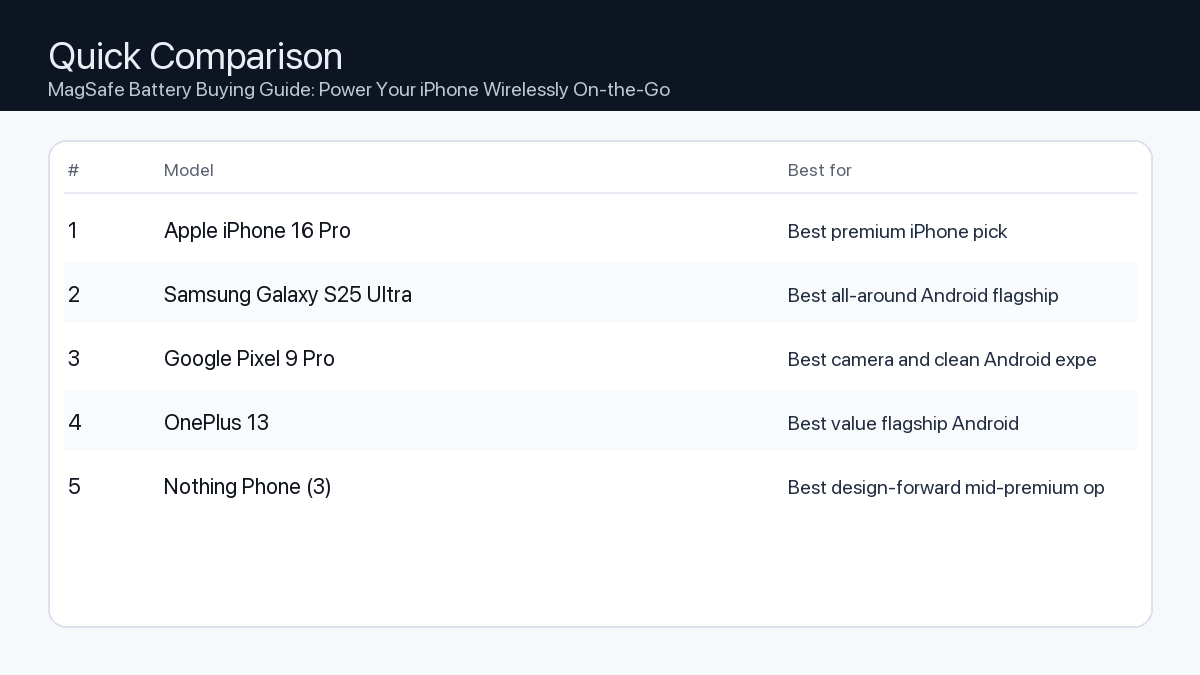
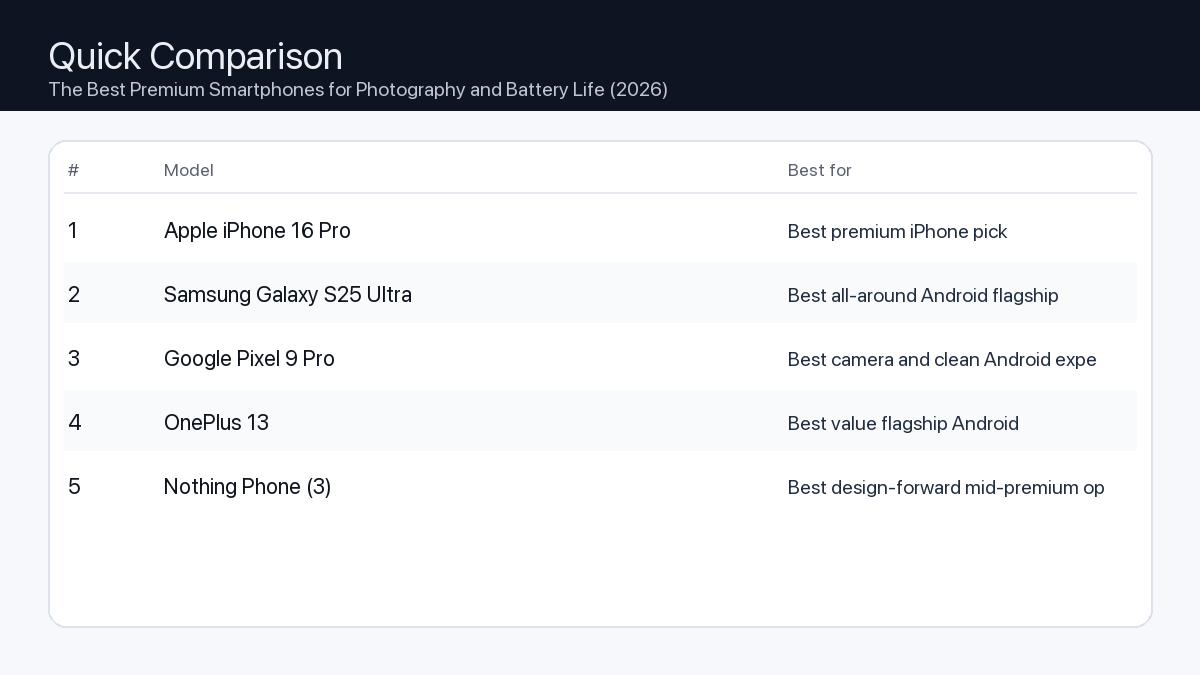
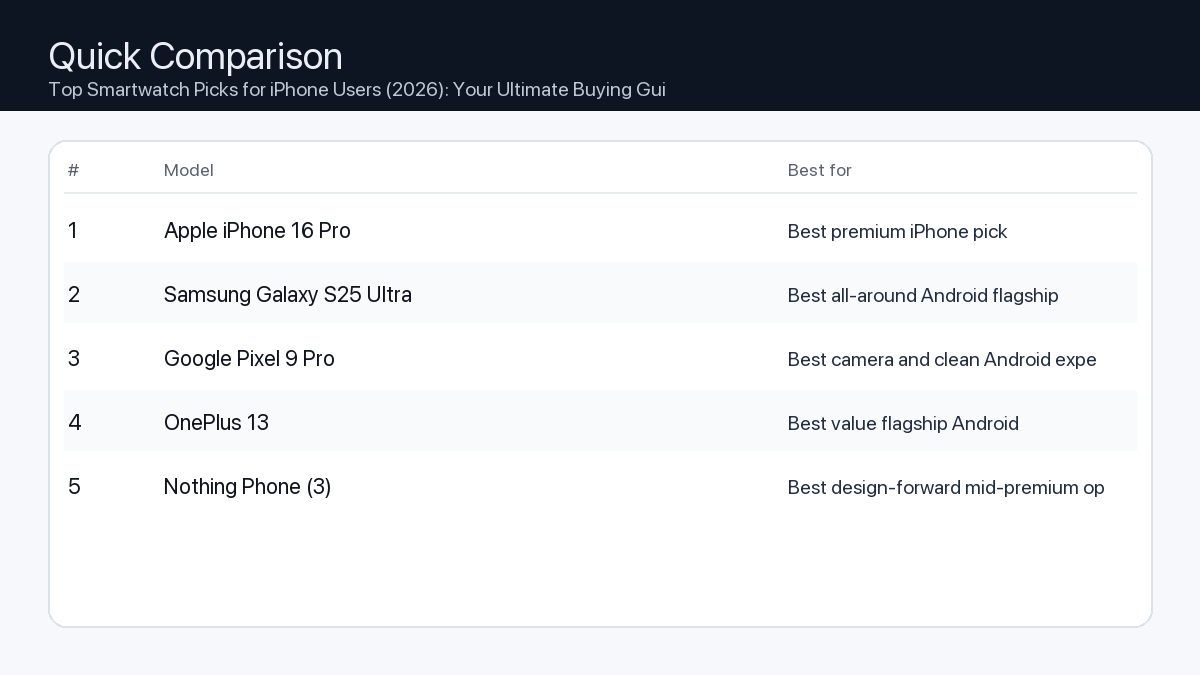
    Quick Comparison

    Note: Specs and availability change. Always confirm details on the product page.

    Model Best for Details
    Apple iPhone 16 Pro Best premium iPhone pick Open section
    Samsung Galaxy S25 Ultra Best all-around Android flagship Open section
    Google Pixel 9 Pro Best camera and clean Android experience Open section
    OnePlus 13 Best value flagship Android Open section
    Nothing Phone (3) Best design-forward mid-premium option Open section
    Comparison: MagSafe Battery Buying Guide: Power Your iPhone Wirelessly On-the-Go
    At-a-glance comparison of our picks.

    Our Top Picks

    #1. Apple iPhone 16 Pro

    Best for: Best premium iPhone pick

    Apple iPhone 16 Pro

    Why it made the list

    • Flagship performance
    • Strong camera system
    • Long software support

    Tradeoffs

    • Premium price

    Who should buy this

    • Buyers who want top-tier iPhone performance
    • People who value camera quality and ecosystem integration

    Avoid if

    • You are on a strict budget
    • You prefer Android customization

    Check price and compatibility for Apple iPhone 16 Pro

    Price tip: Prices fluctuate; check Amazon for current deals and compatibility details.

    #2. Samsung Galaxy S25 Ultra

    Best for: Best all-around Android flagship

    Samsung Galaxy S25 Ultra

    Why it made the list

    • Large high-end display
    • Versatile cameras
    • Power-user features

    Tradeoffs

    • Large and expensive

    Who should buy this

    • Android power users
    • Users who want max specs and camera flexibility

    Avoid if

    • You prefer compact phones
    • You want a lower-cost model

    Check price and compatibility for Samsung Galaxy S25 Ultra

    Price tip: Prices fluctuate; check Amazon for current deals and compatibility details.

    #3. Google Pixel 9 Pro

    Best for: Best camera and clean Android experience

    Google Pixel 9 Pro

    Why it made the list

    • Strong computational photography
    • Clean Android UI
    • Frequent AI features

    Tradeoffs

    • Battery life varies by usage

    Who should buy this

    • Users focused on camera quality
    • People who like clean Android and smart features

    Avoid if

    • You need the absolute fastest charging options

    Check price and compatibility for Google Pixel 9 Pro

    Price tip: Prices fluctuate; check Amazon for current deals and compatibility details.

    #4. OnePlus 13

    Best for: Best value flagship Android

    OnePlus 13

    Why it made the list

    • Fast performance
    • Very good display
    • Competitive pricing

    Tradeoffs

    • Camera tuning can vary vs top flagships

    Who should buy this

    • Buyers who want flagship speed for less
    • Users who prioritize smooth daily performance

    Avoid if

    • You only buy phones from Apple/Samsung

    Check price and compatibility for OnePlus 13

    Price tip: Prices fluctuate; check Amazon for current deals and compatibility details.

    #5. Nothing Phone (3)

    Best for: Best design-forward mid-premium option

    Nothing Phone (3)

    Why it made the list

    • Distinctive design
    • Balanced performance
    • Good software experience

    Tradeoffs

    • Availability and accessories vary by region

    Who should buy this

    • Users who want something different
    • Mid-premium buyers wanting style plus performance

    Avoid if

    • You need the broadest service/accessory ecosystem

    Check price and compatibility for Nothing Phone (3)

    Price tip: Prices fluctuate; check Amazon for current deals and compatibility details.

    Still Can’t Decide?

    Quick decision tree:

    Price tip: prices fluctuate often. If you’re flexible, watch for seasonal sales and compare listings before you buy.

    Ready? Open Apple iPhone 16 Pro on Amazon

    How to Choose Your MagSafe Battery

    Choosing the ideal MagSafe battery involves balancing capacity, portability, charging features, and specific use case needs. Each decision presents a trade-off, impacting convenience and functionality.

    Key Considerations & Tradeoffs

    Capacity vs. Portability:

    • Problem: High capacity (measured in mAh) typically means a larger, heavier battery.
    • Consequence: While more power means more recharges, a bulky battery can make your iPhone cumbersome to hold or carry in a pocket.
    • Recommendation: Assess your daily power needs. If you only need a quick top-up to get through the evening, a lower capacity, more compact option is suitable. For multi-day trips or heavy usage, a higher capacity battery might be necessary, accepting the added weight.

    Charging Speed & Efficiency:

    • Problem: Not all MagSafe batteries charge at the same speed. Lower wattage outputs result in slower charging.
    • Consequence: A slow-charging battery might not keep up with active phone use, especially during demanding tasks like gaming or video streaming, or might take longer to replenish your iPhone’s battery significantly.
    • Recommendation: Look for wattage output specifications. Batteries offering higher MagSafe charging wattage will replenish your iPhone faster, which is critical for active users or when time is limited. Consider if the battery supports faster wired charging via USB-C for itself or other devices.

    Extra Features:

    • Problem: Some batteries offer advanced features, while others are basic.
    • Consequence: Missing features like pass-through charging (charging the iPhone and battery simultaneously) or an integrated kickstand can limit versatility, especially for power users.
    • Recommendation: Consider if you need features beyond basic charging. A built-in kickstand enhances media viewing or video calls. Pass-through charging is invaluable for charging both devices overnight with a single cable. Some batteries integrate ‘Find My’ support for location tracking, a peace of mind feature.

    Build Quality & Ergonomics:

    • Problem: Materials and design vary significantly.
    • Consequence: A poorly built battery might not withstand daily wear and tear, or its design could make your iPhone uncomfortable to hold, especially for prolonged periods. Strong magnetic attachment is also key for reliable wireless charging.
    • Recommendation: Prioritize batteries with durable materials and a design that feels good in hand. Ensure the magnetic connection is robust enough to stay attached during movement, as a weak connection can interrupt charging.

    Example Setups: Matching Your MagSafe Battery to Your Lifestyle

    The Mobile Video Editor/Content Creator:

    • Problem: Demanding apps and constant screen time drain battery quickly, often far from power outlets.
    • Consequence: Loss of critical footage or inability to finish edits on location, impacting productivity and deadlines.
    • Recommendation: Seek a high-capacity MagSafe battery with robust wattage output for sustained power during intensive tasks. Prioritize pass-through charging to simultaneously power both devices overnight, and consider models with strong magnetic adhesion to prevent detachment during active use or when attached to tripods/gimbals.
    • Checklist for Video Editors:
      • High capacity for extended use.
      • Fast MagSafe charging (higher wattage).
      • Pass-through charging capability.
      • Strong magnetic attachment.

    The Office Worker/Daily Commuter:

    • Problem: Needs a reliable power boost to last through meetings, calls, and the commute without adding significant bulk.
    • Consequence: Phone dying mid-call or before reaching home, causing inconvenience or missed communications.
    • Recommendation: Opt for a mid-capacity, sleek, and lightweight MagSafe battery that easily slips into a pocket or bag. A lower profile ensures comfortable handling during calls or quick email checks, providing sufficient power for a crucial top-up without being cumbersome.
    • Checklist for Office Workers:
      • Mid-range capacity for daily top-ups.
      • Slim and lightweight design.
      • Comfortable to hold while attached.
      • Reliable, consistent charging.

    The Gamer/Social Media Enthusiast:

    • Problem: Gaming and constant social media browsing are extremely battery-intensive, especially on the go.
    • Consequence: Gaming sessions cut short, or inability to engage with social platforms when desired, leading to frustration.
    • Recommendation: Choose a MagSafe battery with good capacity to support prolonged use and a focus on effective heat dissipation, as intensive apps generate heat. An integrated kickstand is a major plus for hands-free gaming or media consumption. Ensure the magnetic hold is stable to avoid disconnections during active gaming.
    • Checklist for Gamers/Creators:
      • Good capacity for extended sessions.
      • Effective heat management.
      • Integrated kickstand.
      • Stable magnetic attachment.

    How We Picked

    Our selection process for trending MagSafe battery options focused on several key criteria to ensure practical value for iPhone users. We analyzed product specifications, including battery capacity (mAh), wireless charging output (W), and the availability of additional features like pass-through charging, integrated kickstands, and USB-C connectivity for wired charging. Compatibility with current iPhone models supporting MagSafe was a primary filter. We also considered materials and reported magnetic strength to ensure reliable attachment and durability, prioritizing solutions that offer a balance of performance, features, and portability across different user needs.

    FAQ

    Q: Which should I buy: the #1 pick or the best value pick?

    A: Choose the #1 pick if your usage demands the absolute best performance, advanced features like robust pass-through charging and higher wattage output, and a premium build quality, where cost is a secondary concern. Opt for the best value pick if you need reliable MagSafe charging for daily top-ups, prioritize affordability and portability, and don’t require every advanced feature.

    Q: Are MagSafe batteries compatible with all iPhones?

    A: MagSafe batteries are specifically designed for iPhone 12 models and newer, which feature the integrated MagSafe magnetic array. While some older iPhones can charge wirelessly with MagSafe accessories using a compatible case, the magnetic attachment and full functionality are optimized for iPhone 12 series and later.

    Q: Can I charge my MagSafe battery and iPhone at the same time?

    A: Many MagSafe batteries offer ‘pass-through charging.’ When the MagSafe battery itself is connected to a power source (via USB-C, for example), it can charge your iPhone wirelessly while simultaneously recharging its own internal battery. This feature is highly convenient for overnight charging.

    Q: Will a MagSafe battery make my iPhone hot?

    A: Some degree of warmth is normal during wireless charging due to energy transfer. Reputable MagSafe batteries are designed with safety features to manage heat. Excessive heat generation could indicate an issue or improper use. If your device feels unusually hot, remove the battery pack.

    Final Recommendation

    Selecting the right MagSafe battery pack significantly enhances your iPhone experience, providing crucial power when you need it most. By carefully considering your daily usage patterns—whether you’re a demanding content creator, a busy office worker, or an avid gamer—you can pinpoint the ideal balance of capacity, charging speed, and extra features. Prioritize robust magnetic attachment and reliable performance to ensure your chosen battery seamlessly integrates into your mobile life, keeping you powered up and connected.

    Related Guides

    Keep reading with these related buying guides:

  • Best Smart TV Under $1000 in 2026: A Comprehensive Buying Guide
    Best Smart TV Under $1000 in 2026: A Comprehensive Buying Guide
    Disclosure: This post may contain affiliate links. As an Amazon Associate, I earn from qualifying purchases. Learn more.

    Best Smart TV Under $1000 in 2026: A Comprehensive Buying Guide
    In 2026, the smart TV market under $1000 offers an impressive array of options, blending advanced features with affordability. Navigating this landscape requires understanding where your priorities lie. If you’re an avid movie watcher or a serious gamer aiming for the most immersive experience, prioritize models offering advanced display technologies like QLED or Mini-LED and higher native refresh rates (120Hz), even if it means a slightly smaller screen size or fewer auxiliary ports. These features contribute significantly to picture fidelity and motion clarity.

    For most users focusing on general entertainment, streaming, and smart home integration, a well-balanced model with a vibrant 4K UHD display, a robust and intuitive smart platform, and ample connectivity (including at least some HDMI 2.1 features) will provide excellent value without unnecessary compromises. The key is to match features to your primary usage to maximize your investment.

    Best Picks (2026)

    Quick Answer (TL;DR) (Updated March 05, 2026)

    If you want one safe pick: LG C5 OLED. If you want a better value: Samsung S95D OLED.

    How to use this page: scan the comparison table, jump to the matching use case, then open only the listing that fits your setup.

    Fast path: choose one track below and ignore the rest.

    • Track A (least risk): LG C5 OLED
    • Track B (better value): Samsung S95D OLED

    How we picked: research-based selection using manufacturer specs, compatibility notes, and what to verify on the Amazon listing (no hands-on testing claims). Affiliate links may earn us a commission, but rankings are not paid placements.

    Start with LG C5 OLED on Amazon Prefer value? Open Samsung S95D OLED

    Skip to a pick: #1 LG C5 OLED | #2 Samsung S95D OLED | #3 Sony Bravia 9 Mini LED | #4 TCL QM8 | #5 Hisense U8N

    Head-to-Head: Top Pick vs Best Value

    LG C5 OLED
    Best OLED gaming + movie balance

    Read full #1 breakdown

    Go to Amazon: LG C5 OLED

    Samsung S95D OLED
    Best bright-room OLED option

    Read full best-value breakdown

    Go to Amazon: Samsung S95D OLED

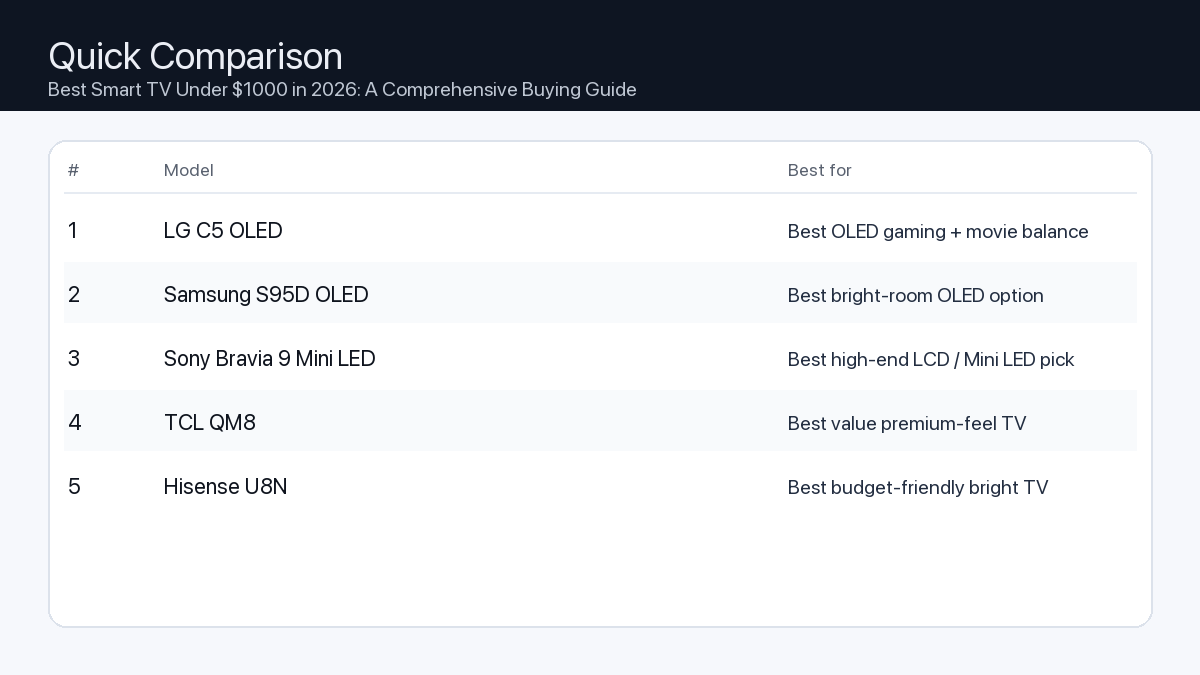
    Quick Comparison

    Note: Specs and availability change. Always confirm details on the product page.

    Model Best for Details
    LG C5 OLED Best OLED gaming + movie balance Open section
    Samsung S95D OLED Best bright-room OLED option Open section
    Sony Bravia 9 Mini LED Best high-end LCD / Mini LED pick Open section
    TCL QM8 Best value premium-feel TV Open section
    Hisense U8N Best budget-friendly bright TV Open section
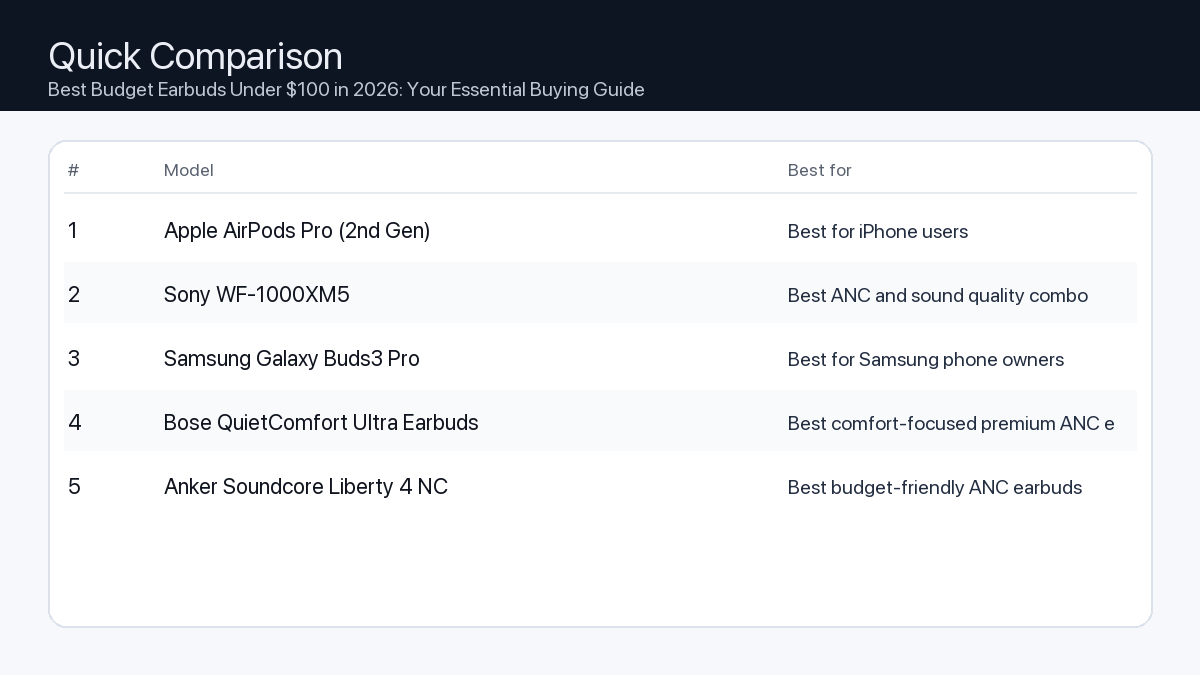
    Comparison: Best Smart TV Under $1000 in 2026: A Comprehensive Buying Guide
    At-a-glance comparison of our picks.

    Our Top Picks

    #1. LG C5 OLED

    Best for: Best OLED gaming + movie balance

    LG C5 OLED

    Why it made the list

    • Excellent contrast
    • Strong gaming features
    • Great overall picture quality

    Tradeoffs

    • OLED pricing remains premium

    Who should buy this

    • Movie and gaming enthusiasts
    • Users wanting high-end picture quality

    Avoid if

    • You need the lowest-cost large TV

    Check price and compatibility for LG C5 OLED

    Price tip: Prices fluctuate; check Amazon for current deals and compatibility details.

    #2. Samsung S95D OLED

    Best for: Best bright-room OLED option

    Samsung S95D OLED

    Why it made the list

    • Very strong brightness
    • Excellent color
    • Premium build

    Tradeoffs

    • Premium tier pricing

    Who should buy this

    • Users with brighter rooms
    • High-end TV buyers

    Avoid if

    • You are shopping under tight budget limits

    Check price and compatibility for Samsung S95D OLED

    Price tip: Prices fluctuate; check Amazon for current deals and compatibility details.

    #3. Sony Bravia 9 Mini LED

    Best for: Best high-end LCD / Mini LED pick

    Sony Bravia 9 Mini LED

    Why it made the list

    • Strong processing
    • Great motion handling
    • Very bright HDR

    Tradeoffs

    • High-end price level

    Who should buy this

    • Users preferring bright premium LCD over OLED

    Avoid if

    • You need value pricing

    Check price and compatibility for Sony Bravia 9 Mini LED

    Price tip: Prices fluctuate; check Amazon for current deals and compatibility details.

    #4. TCL QM8

    Best for: Best value premium-feel TV

    TCL QM8

    Why it made the list

    • Strong value
    • Bright panel
    • Good gaming features for the class

    Tradeoffs

    • Panel consistency can vary by unit

    Who should buy this

    • Value-focused big-screen buyers

    Avoid if

    • You only buy top-tier premium brands

    Check price and compatibility for TCL QM8

    Price tip: Prices fluctuate; check Amazon for current deals and compatibility details.

    #5. Hisense U8N

    Best for: Best budget-friendly bright TV

    Hisense U8N

    Why it made the list

    • Strong brightness for price
    • Good local dimming value
    • Popular budget pick

    Tradeoffs

    • Software and tuning preferences vary

    Who should buy this

    • Budget shoppers wanting strong HDR brightness

    Avoid if

    • You need flagship-level polish in every area

    Check price and compatibility for Hisense U8N

    Price tip: Prices fluctuate; check Amazon for current deals and compatibility details.

    Still Can’t Decide?

    Quick decision tree:

    Price tip: prices fluctuate often. If you’re flexible, watch for seasonal sales and compare listings before you buy.

    Ready? Open LG C5 OLED on Amazon

    How to Choose the Best Smart TV Under $1000

    Finding the ideal smart TV within a $1000 budget for 2026 means making informed trade-offs. Here’s what to consider to ensure you get the most for your money:

    Display Technology & Picture Quality

    Problem: Choosing a TV based solely on screen size can lead to a compromise on fundamental picture quality, resulting in a less immersive viewing experience.

    Consequence: Entry-level LED-LCD panels often suffer from less vibrant colors, lower contrast ratios, and “grayer” black levels, particularly noticeable in dimly lit rooms or when viewing HDR content.

    Recommendation: Prioritize models featuring advanced LED-LCD technologies like QLED (Quantum Dot LED) or those incorporating Mini-LED backlighting. QLED enhances color volume and brightness, while Mini-LED allows for more precise local dimming, dramatically improving contrast and black levels for a more impactful HDR experience. A 4K UHD resolution is standard and expected at this price point.

    Screen Size vs. Features

    Problem: The temptation to get the largest possible screen often results in sacrificing crucial features that enhance viewing pleasure.

    Consequence: Opting for an oversized screen might force you into a model with inferior panel technology, a slower smart platform, or fewer essential ports to stay within budget.

    Recommendation: Determine your optimal viewing distance and consider a slightly smaller screen with superior picture quality or better smart features. A 55-65 inch screen typically offers the best balance of size and advanced features under $1000, while a larger screen might necessitate a step down in panel quality or refresh rate.

    Refresh Rate & Motion Handling

    Problem: Many budget-friendly smart TVs still feature a standard 60Hz native refresh rate.

    Consequence: Fast-moving content, such as live sports, action movies, or video games, can suffer from noticeable motion blur and judder, diminishing the fluidity of the on-screen action.

    Recommendation: For gamers and sports enthusiasts, aim for a TV with a 120Hz native refresh rate. This significantly improves motion clarity and allows for smoother gameplay when paired with compatible consoles or PCs. Look for additional motion processing technologies, though be aware of potential “soap opera effect” with aggressive settings.

    Smart TV Platform & User Experience

    Problem: A slow or poorly designed smart TV interface can quickly become frustrating to use.

    Consequence: Laggy navigation, frequent app crashes, limited app availability, and poor integration with smart home ecosystems can detract from the overall convenience of a smart TV.

    Recommendation: Choose TVs running established smart platforms like Google TV, Roku TV, webOS (LG), or Tizen (Samsung). These platforms are known for their responsiveness, vast app libraries, regular updates, and seamless integration with voice assistants (Google Assistant, Alexa). Prioritize platforms that offer a user-friendly interface and quick access to your preferred streaming services.

    Connectivity (Ports & Wireless)

    Problem: Insufficient or outdated connectivity options can limit your ability to connect all your devices or future-proof your setup.

    Consequence: You might struggle to connect multiple game consoles, soundbars, Blu-ray players, or PCs simultaneously. Lack of modern wireless standards can lead to slower streaming or casting performance.

    Recommendation: Look for at least 3-4 HDMI ports. For gaming and advanced setups, ensure at least one HDMI 2.1 port is present, supporting features like 4K@119/120Hz, VRR (Variable Refresh Rate), and ALLM (Auto Low Latency Mode). USB ports for media playback, an optical audio output for soundbars, and robust Wi-Fi 6 or 6E for reliable wireless performance are also key.

    Audio Quality

    Problem: Built-in TV speakers often deliver a basic, uninspiring sound experience.

    Consequence: Flat audio, lack of bass, and muffled dialogue can significantly detract from movies, music, and gaming, even with excellent picture quality.

    Recommendation: While some TVs at this price point offer marginal improvements, built-in audio is rarely a highlight. Plan to invest in an external soundbar or a dedicated home theater system for a truly immersive audio experience. Ensure the TV supports audio passthrough formats like Dolby Atmos if you plan to use compatible external audio equipment.

    Checklists for Different Users

    To help you narrow down your choices, here are tailored feature checklists and example setups for common user types:

    The Cinematic Video Editor

    For those who demand color accuracy and a detailed reference view.

    • Display: QLED or Mini-LED panel for high brightness, wide color gamut, and excellent contrast.
    • Resolution: Native 4K UHD with strong HDR (HDR10+, Dolby Vision) support.
    • Color Accuracy: Look for TVs with calibration features and pre-calibrated modes.
    • Viewing Angle: Wide viewing angles are beneficial for collaborative work.
    • Connectivity: At least one HDMI 2.1 port for future-proofing and high-bandwidth signals from a workstation.

    Example Setup: The smart TV serves as a large-format reference monitor, connected to a powerful editing workstation via HDMI 2.1. An external, color-calibrated monitor handles primary editing, while the TV offers a full-screen preview. A high-quality soundbar or studio monitors are connected for audio monitoring.

    The Home Office Worker

    For productivity, presentations, and light media consumption.

    • Display: Sharp 4K UHD for clear text and crisp images.
    • Smart Features: Reliable screen mirroring (Chromecast, AirPlay) or a robust smart platform for productivity apps.
    • Connectivity: Multiple HDMI inputs to easily switch between a laptop, desktop, and other devices.
    • Eye Comfort: Look for features that minimize blue light or reduce flicker for extended viewing sessions.

    Example Setup: The smart TV acts as a large secondary display for a laptop, extended desktop, or for video conferencing. It might also serve as a dedicated display for presentations or quick content review. Wireless casting capabilities are frequently used for sharing content from mobile devices.

    The Gamer & Streaming Creator

    Prioritizing responsiveness, fluidity, and visual impact.

    • Refresh Rate: 120Hz native refresh rate is essential.
    • Gaming Features: HDMI 2.1 ports with support for VRR (Variable Refresh Rate) and ALLM (Auto Low Latency Mode).
    • Input Lag: Very low input lag (below 15ms in game mode) for responsive gameplay.
    • Display: QLED or Mini-LED for vibrant colors and deep contrast, enhancing game visuals.
    • Connectivity: Robust Wi-Fi 6/6E for seamless game streaming and content uploads.

    Example Setup: The smart TV is the centerpiece, connected to a next-generation gaming console (e.g., PS5 Pro, Xbox Series X2) or a high-end gaming PC via HDMI 2.1. A dedicated capture card might feed into a streaming PC, while an external sound system provides immersive audio. The smart platform is used for quick access to streaming platforms and social apps.

    How We Picked These TVs

    Our selection process for the best smart TVs under $1000 in 2026 relies on a thorough analysis of manufacturer specifications, anticipated technological advancements, and a careful evaluation of the competitive landscape. We prioritize TVs that offer a strong balance of picture quality (considering panel type, resolution, HDR support), smart platform performance, and essential connectivity options (including the presence of HDMI 2.1 features for future-proofing) within the specified budget. We assess models based on their published features, adherence to industry standards, and compatibility notes with popular streaming services and smart home ecosystems, rather than hands-on product testing.

    FAQ

    What’s the difference between QLED and Mini-LED?

    QLED (Quantum Dot LED) TVs utilize a quantum dot layer to enhance color volume, brightness, and overall vibrancy on a standard LED backlight. Mini-LED, on the other hand, refers to the backlight technology itself, employing thousands of tiny LEDs grouped into many local dimming zones. This allows for much finer control over contrast and black levels, often resulting in superior HDR performance and reduced blooming compared to standard QLED or traditional LED-LCDs, even when combined with quantum dots.

    Do I really need HDMI 2.1?

    If you plan to connect a next-generation gaming console (like the rumored PS5 Pro or future Xbox models) or a high-end PC for 4K 120Hz gaming, then HDMI 2.1 is highly recommended. It enables crucial features like 4K resolution at 120 frames per second, Variable Refresh Rate (VRR) for tear-free gameplay, and Auto Low Latency Mode (ALLM) for a more responsive gaming experience. For general streaming, cable TV, and most Blu-ray players, HDMI 2.0b is typically sufficient.

    Which smart TV platform is best?

    The “best” smart TV platform often comes down to personal preference and your existing digital ecosystem. Google TV offers deep integration with Google services, voice control, and a vast app library. Roku TV is celebrated for its simplicity and user-friendly interface. LG’s webOS is known for its intuitive ‘Magic Remote’ and efficient multitasking, while Samsung’s Tizen OS provides a polished, integrated experience with a focus on smart home connectivity. All major platforms offer access to popular streaming services and voice assistants. Consider which interface you find most appealing and which integrates best with your other devices.

    Which should I buy: the #1 pick or the best value pick?

    If your budget permits and your priority is to secure the absolute best picture quality, most advanced gaming features, or premium smart functionalities available within the sub-$1000 range, then the #1 pick is designed for you. This option generally aims to offer the pinnacle of performance and features at that price point. If you’re seeking an excellent all-around TV that capably handles most viewing tasks, provides a great user experience, and leaves room in your budget for potential accessories like a soundbar, the best value pick will serve you exceptionally well by offering a strong feature set at a more accessible price.

    Final Recommendation

    Choosing the best smart TV under $1000 in 2026 means empowering yourself with informed decisions about where to prioritize your budget. The market segment continues to evolve, offering an impressive blend of advanced features and affordability. Whether you identify as a dedicated gamer, a cinematic enthusiast, a casual streamer, or a home office multi-tasker, there’s a fantastic range of options available.

    By understanding the key display technologies, smart platform capabilities, and connectivity needs outlined in this comprehensive guide, you can confidently select a smart TV that not only meets but exceeds your expectations, delivering an outstanding viewing experience for years to come without stretching your finances.

    Related Guides

    Keep reading with these related buying guides:

  • The Ultimate Buying Guide to Trending Gaming TVs with Low Input Lag

    The Ultimate Buying Guide to Trending Gaming TVs with Low Input Lag
    Disclosure: This post may contain affiliate links. As an Amazon Associate, I earn from qualifying purchases. Learn more.

    The Ultimate Buying Guide to Trending Gaming TVs with Low Input Lag
    Choosing the ideal gaming TV hinges on understanding your priorities. Gamers aiming for peak competitive performance, future-proofing their setup, and experiencing the highest fidelity visuals should prioritize premium TVs boasting advanced features like multiple HDMI 2.1 ports, Variable Refresh Rate (VRR), and a 120Hz refresh rate. For casual gamers, those on a tighter budget, or players primarily sticking to 4K/60Hz gameplay, excellent value can be found in TVs that still offer genuinely low input lag and solid core features, accepting minor trade-offs in cutting-edge specifications.

    This guide cuts through the technical jargon, focusing on what truly matters for a responsive and immersive gaming experience. We’ll explore key features like input lag, refresh rates, and connectivity, offering practical advice to help you find a trending gaming TV that elevates your play without breaking the bank.

    Best Picks (2026)

    Quick Answer (TL;DR) (Updated March 04, 2026)

    If you want one safe pick: LG C5 OLED. If you want a better value: Samsung S95D OLED.

    How to use this page: scan the comparison table, jump to the matching use case, then open only the listing that fits your setup.

    Fast path: choose one track below and ignore the rest.

    • Track A (least risk): LG C5 OLED
    • Track B (better value): Samsung S95D OLED

    How we picked: research-based selection using manufacturer specs, compatibility notes, and what to verify on the Amazon listing (no hands-on testing claims). Affiliate links may earn us a commission, but rankings are not paid placements.

    Start with LG C5 OLED on Amazon Prefer value? Open Samsung S95D OLED

    Skip to a pick: #1 LG C5 OLED | #2 Samsung S95D OLED | #3 Sony Bravia 9 Mini LED | #4 TCL QM8 | #5 Hisense U8N

    Head-to-Head: Top Pick vs Best Value

    LG C5 OLED
    Best OLED gaming + movie balance

    Read full #1 breakdown

    Go to Amazon: LG C5 OLED

    Samsung S95D OLED
    Best bright-room OLED option

    Read full best-value breakdown

    Go to Amazon: Samsung S95D OLED

    Quick Comparison

    Note: Specs and availability change. Always confirm details on the product page.

    Model Best for Details
    LG C5 OLED Best OLED gaming + movie balance Open section
    Samsung S95D OLED Best bright-room OLED option Open section
    Sony Bravia 9 Mini LED Best high-end LCD / Mini LED pick Open section
    TCL QM8 Best value premium-feel TV Open section
    Hisense U8N Best budget-friendly bright TV Open section
    Comparison: The Ultimate Buying Guide to Trending Gaming TVs with Low Input Lag
    At-a-glance comparison of our picks.

    Our Top Picks

    #1. LG C5 OLED

    Best for: Best OLED gaming + movie balance

    LG C5 OLED

    Why it made the list

    • Excellent contrast
    • Strong gaming features
    • Great overall picture quality

    Tradeoffs

    • OLED pricing remains premium

    Who should buy this

    • Movie and gaming enthusiasts
    • Users wanting high-end picture quality

    Avoid if

    • You need the lowest-cost large TV

    Check price and compatibility for LG C5 OLED

    Price tip: Prices fluctuate; check Amazon for current deals and compatibility details.

    #2. Samsung S95D OLED

    Best for: Best bright-room OLED option

    Samsung S95D OLED

    Why it made the list

    • Very strong brightness
    • Excellent color
    • Premium build

    Tradeoffs

    • Premium tier pricing

    Who should buy this

    • Users with brighter rooms
    • High-end TV buyers

    Avoid if

    • You are shopping under tight budget limits

    Check price and compatibility for Samsung S95D OLED

    Price tip: Prices fluctuate; check Amazon for current deals and compatibility details.

    #3. Sony Bravia 9 Mini LED

    Best for: Best high-end LCD / Mini LED pick

    Sony Bravia 9 Mini LED

    Why it made the list

    • Strong processing
    • Great motion handling
    • Very bright HDR

    Tradeoffs

    • High-end price level

    Who should buy this

    • Users preferring bright premium LCD over OLED

    Avoid if

    • You need value pricing

    Check price and compatibility for Sony Bravia 9 Mini LED

    Price tip: Prices fluctuate; check Amazon for current deals and compatibility details.

    #4. TCL QM8

    Best for: Best value premium-feel TV

    TCL QM8

    Why it made the list

    • Strong value
    • Bright panel
    • Good gaming features for the class

    Tradeoffs

    • Panel consistency can vary by unit

    Who should buy this

    • Value-focused big-screen buyers

    Avoid if

    • You only buy top-tier premium brands

    Check price and compatibility for TCL QM8

    Price tip: Prices fluctuate; check Amazon for current deals and compatibility details.

    #5. Hisense U8N

    Best for: Best budget-friendly bright TV

    Hisense U8N

    Why it made the list

    • Strong brightness for price
    • Good local dimming value
    • Popular budget pick

    Tradeoffs

    • Software and tuning preferences vary

    Who should buy this

    • Budget shoppers wanting strong HDR brightness

    Avoid if

    • You need flagship-level polish in every area

    Check price and compatibility for Hisense U8N

    Price tip: Prices fluctuate; check Amazon for current deals and compatibility details.

    Still Can’t Decide?

    Quick decision tree:

    Price tip: prices fluctuate often. If you’re flexible, watch for seasonal sales and compare listings before you buy.

    Ready? Open LG C5 OLED on Amazon

    How to Choose Your Next Gaming TV

    Finding a TV optimized for gaming means looking beyond just a pretty picture. The responsiveness of the display can directly impact your performance and enjoyment. Here are the critical factors:

    Key Factors for Gaming TVs

    Input Lag: The Foundation of Responsiveness

    Problem: High input lag introduces a noticeable delay between pressing a button on your controller and seeing that action register on screen.

    Consequence: In fast-paced games, this delay can make the difference between a headshot and a miss, or a successful dodge and a defeat. It creates a feeling of disconnect between player and game.

    Recommendation: Aim for TVs with an input lag of under 20 milliseconds (ms) at 4K/60Hz, and ideally under 10ms when operating at 4K/120Hz. Most modern gaming TVs feature a ‘Game Mode’ which significantly reduces input lag by bypassing image processing. Ensure the TV you consider has an effective Game Mode.

    Refresh Rate (Hz): Smoothness in Motion

    Problem: A TV with a low refresh rate (e.g., 60Hz) struggles to keep up with high frame rates produced by modern consoles or gaming PCs, leading to less fluid motion and potential screen tearing.

    Consequence: Visual choppiness, ghosting, and a less immersive experience, especially in games designed for higher frame rates.

    Recommendation: While 60Hz is acceptable for many games and casual play, a 120Hz refresh rate is ideal for current-generation consoles (PS5, Xbox Series X) and high-end gaming PCs. It allows the TV to display up to 120 frames per second (fps), resulting in noticeably smoother gameplay.

    Variable Refresh Rate (VRR): Eliminating Screen Tearing

    Problem: When a game’s frame rate fluctuates (which often happens), it can fall out of sync with the TV’s fixed refresh rate. This mismatch causes visual artifacts like screen tearing or stuttering.

    Consequence: Distracting visual glitches that pull you out of the experience and can even hinder performance in competitive titles.

    Recommendation: Look for TVs that support VRR technology (e.g., HDMI Forum VRR, FreeSync Premium, G-Sync compatible). VRR dynamically adjusts the TV’s refresh rate to match the game’s frame rate, ensuring a tear-free and consistently smooth visual experience.

    HDMI 2.1: The Gateway to Next-Gen Features

    Problem: Older HDMI standards (like HDMI 2.0) lack the bandwidth required to transmit high-resolution, high-refresh-rate signals simultaneously, limiting access to key gaming features.

    Consequence: You won’t be able to experience 4K resolution at 120Hz, nor will you get the full benefits of VRR and Auto Low Latency Mode (ALLM).

    Recommendation: HDMI 2.1 is essential for unlocking the full potential of current-gen consoles and high-end gaming PCs. Ensure the TV has at least one, and ideally multiple, full-bandwidth HDMI 2.1 ports. HDMI 2.1 also enables ALLM, which automatically switches the TV to Game Mode when a console is detected.

    Panel Technology: Visual Fidelity and Trade-offs

    • OLED (Organic Light Emitting Diode):
      Problem: Higher cost and a theoretical risk of ‘burn-in’ with static images over extreme long-term use (though modern OLEDs have mitigation technologies).
      Consequence: Deepest, inky blacks, infinite contrast, and instant pixel response for unparalleled motion clarity and vibrant colors.
      Recommendation: The premium choice for ultimate visual fidelity and response, especially for cinematic and competitive gaming.
    • QLED / Mini-LED:
      Problem: Can sometimes exhibit ‘blooming’ or halo effects around bright objects on dark backgrounds, though Mini-LED technology significantly reduces this.
      Consequence: Excellent brightness, vibrant and accurate colors, very good contrast (especially Mini-LED with its thousands of local dimming zones), and generally lower cost than OLED.
      Recommendation: A fantastic all-around option, often brighter than OLED, making it great for well-lit rooms and HDR content.
    • LED (LCD with LED Backlight):
      Problem: Less precise local dimming capabilities, leading to lower contrast and less uniform blacks compared to OLED or Mini-LED.
      Consequence: Good general performance but lacks the visual punch of higher-tier panels.
      Recommendation: The most affordable option, offering solid performance for budget-conscious buyers.

    Resolution (4K/UHD): The Visual Standard

    Recommendation: 4K Ultra High Definition (UHD) is now the standard for gaming TVs. It provides sharp, detailed images, making games look incredibly lifelike.

    HDR (High Dynamic Range): Enhanced Visuals

    Recommendation: HDR significantly expands the range of colors and contrast a TV can display, resulting in brighter highlights and deeper, more detailed shadows. Look for support for standards like HDR10, HLG, Dolby Vision, or HDR10+. The actual impact of HDR also depends on the TV’s peak brightness (measured in nits).

    Checklist for a Gaming TV

    • Low Input Lag: Target <20ms at 4K/60Hz, <10ms at 4K/120Hz (in Game Mode).
    • High Refresh Rate: 120Hz is ideal for current-gen consoles/PCs.
    • HDMI 2.1 Ports: At least two full-bandwidth ports for consoles/PC.
    • VRR Support: HDMI Forum VRR, FreeSync Premium, or G-Sync compatible.
    • ALLM (Auto Low Latency Mode): For automatic Game Mode activation.
    • 4K UHD Resolution: Standard for modern gaming.
    • HDR Support: Dolby Vision/HDR10+ for best results, paired with good peak brightness.
    • Panel Type: OLED for ultimate contrast/response, QLED/Mini-LED for brightness/value.

    Example Setups

    The Dedicated Gamer/Creator

    Needs: Uncompromising performance for competitive gaming, visual accuracy for content creation (streaming, video editing), minimal latency, and future-proofing.

    TV Specs: Premium OLED or top-tier Mini-LED panel. Multiple full-bandwidth HDMI 2.1 ports. Consistent 120Hz refresh rate. Comprehensive VRR (HDMI Forum, FreeSync, G-Sync compatible). Excellent HDR performance (high peak brightness, wide color gamut). Very low input lag across resolutions and refresh rates. Large screen size for immersive play and multi-tasking.

    Setup Suggestion: Paired with PlayStation 5, Xbox Series X, or a high-end gaming PC. Potentially a secondary monitor for streaming dashboards or editing timelines. A robust sound system completes the immersive experience.

    The Hybrid Office Worker/Casual Gamer

    Needs: A balanced display that excels for daily productivity tasks (text clarity, comfortable viewing) and offers a solid, responsive experience for casual to moderately competitive gaming. Value-focused but without major compromises.

    TV Specs: High-quality QLED or advanced LED panel. At least one HDMI 2.1 port (for future compatibility) or good HDMI 2.0 with proven low input lag. 60Hz refresh rate is often sufficient for casual games and many office tasks. Decent HDR support. Good viewing angles for collaborative work or group viewing.

    Setup Suggestion: Connected to a work laptop or mini-PC via HDMI for productivity. Used with a Nintendo Switch, older generation console, or for streaming media. May double as a large monitor for creative projects that don’t demand absolute color accuracy.

    The Video Editor/Movie Enthusiast Who Also Games

    Needs: Paramount color accuracy, exceptional contrast, and cinematic immersion for video editing and film consumption, combined with genuinely good gaming performance that doesn’t feel sluggish.

    TV Specs: OLED or high-end Mini-LED panel, prioritized for color gamut coverage (e.g., DCI-P3), perfect blacks, and robust Dolby Vision/HDR10+ support for grading and playback. Input lag should be low, though perhaps not as critical as for dedicated esports gamers. A 120Hz refresh rate is a bonus for smoother games but 60Hz can suffice if other visual parameters are superior. Excellent uniformity.

    Setup Suggestion: Primary display for professional video editing suite, connected to a dedicated media player for film viewing, and also hooked up to a console for single-player narrative-driven games or casual multiplayer sessions. A high-quality soundbar or full home theatre audio system would complement this setup.

    How We Picked These Trending Gaming TVs

    Our selection process for trending gaming TVs focuses on models consistently recognized in the industry for their critical performance metrics. We prioritize TVs with objectively measured low input lag across various resolutions and refresh rates, confirmed through published specifications and reputable benchmarks. Key considerations include the robust implementation of essential gaming features like HDMI 2.1 connectivity (for 4K@120Hz, VRR, ALLM), effective Variable Refresh Rate support, and reliable Game Mode functionality. We also weigh the advantages of different panel technologies (OLED, QLED, Mini-LED) and their HDR capabilities to ensure a balance of responsiveness and visual quality suitable for modern gaming and general media consumption. Our choices reflect current market trends and compatibility with the latest generation of gaming hardware, providing a practical guide without claiming hands-on testing.

    FAQ

    What is input lag and why is it important for gaming?
    Input lag is the delay between your input (e.g., pressing a button on your controller) and that action appearing on screen. For fast-paced, competitive games, lower input lag (ideally under 20ms) is crucial for responsiveness, precise control, and competitive advantage. High input lag can make a game feel sluggish and unfair.
    Do I really need HDMI 2.1 for gaming?
    If you own or plan to purchase a PlayStation 5, Xbox Series X, or a high-end gaming PC, HDMI 2.1 is highly recommended. It unlocks crucial features like 4K resolution at 120 frames per second (4K@120Hz), Variable Refresh Rate (VRR), and Auto Low Latency Mode (ALLM), which significantly enhance the gaming experience. For older consoles or primarily gaming at 4K@60Hz, HDMI 2.0 can still offer a good experience if the TV’s input lag is low.
    What’s the difference between 60Hz and 120Hz refresh rates?
    Refresh rate refers to how many times per second the TV updates its image. A 120Hz TV can display up to 120 frames per second, resulting in noticeably smoother motion, less blurring, and more responsive gameplay compared to a 60Hz TV, especially in fast-paced games. Current-gen consoles and powerful PCs can output many games at 120Hz, making a 120Hz TV a significant upgrade for those seeking the smoothest possible visuals.
    Which should I buy: the #1 pick or the best value pick?
    Choose the #1 pick if you prioritize uncompromising performance, intend to maximize current-gen console or high-end PC capabilities (e.g., consistent 4K@120Hz with VRR), and seek the absolute best visual fidelity. Opt for the best value pick if you’re looking for an excellent gaming experience on a more moderate budget, primarily play at 4K@60Hz, or are content with strong performance without requiring every cutting-edge feature. Both options will provide genuinely low input lag.

    Final Recommendation

    Choosing the right trending TV for gaming with low input lag boils down to aligning features with your specific gaming habits and budget. Prioritizing low input lag, a high refresh rate (ideally 120Hz), and HDMI 2.1 with VRR support will ensure you unlock the full potential of modern gaming hardware. Whether you opt for the pristine visuals of an OLED, the bright vibrancy of a QLED/Mini-LED, or the solid value of a well-optimized LED, ensure your chosen TV provides the responsiveness that empowers your gameplay. By focusing on these core technical specifications, you can confidently select a display that truly elevates your gaming experience.

    Related Guides

    Keep reading with these related buying guides:

  • Best Value Android Phones in 2026: A Practical Buying Guide
    Best Value Android Phones in 2026: A Practical Buying Guide
    Disclosure: This post may contain affiliate links. As an Amazon Associate, I earn from qualifying purchases. Learn more.

    Best Value Android Phones in 2026: A Practical Buying Guide
    In 2026, the distinction between a premium Android phone and a truly ‘value’ Android phone isn’t always about outright budget, but rather about intentional feature prioritization. If you’re an early adopter who demands the absolute bleeding edge in camera technology, raw processing power for intensive tasks like 8K video editing on the go, or wish to showcase the latest design trends, a top-tier flagship remains your ideal choice, provided budget is no constraint. For everyone else – the practical user seeking excellent everyday performance, robust camera capabilities, a long-lasting battery, and reliable software support without paying a premium for features they won’t fully utilize – a value-focused pick offers a significantly smarter investment.

    This guide cuts through the marketing noise to help you understand what constitutes genuine ‘value’ in the 2026 Android landscape. We’ll explore the essential trade-offs, highlight what to prioritize based on your usage, and outline the key specifications that ensure your chosen device remains a relevant and satisfying companion for years to come. Our goal is to empower you to make an informed decision, ensuring you get the most out of your budget without compromising on the experiences that truly matter.

    Best Picks (2026)

    Quick Answer (TL;DR) (Updated March 04, 2026)

    If you want one safe pick: Apple iPhone 16 Pro. If you want a better value: Samsung Galaxy S25 Ultra.

    How to use this page: scan the comparison table, jump to the matching use case, then open only the listing that fits your setup.

    Fast path: choose one track below and ignore the rest.

    • Track A (least risk): Apple iPhone 16 Pro
    • Track B (better value): Samsung Galaxy S25 Ultra

    How we picked: research-based selection using manufacturer specs, compatibility notes, and what to verify on the Amazon listing (no hands-on testing claims). Affiliate links may earn us a commission, but rankings are not paid placements.

    Start with Apple iPhone 16 Pro on Amazon Prefer value? Open Samsung Galaxy S25 Ultra

    Skip to a pick: #1 Apple iPhone 16 Pro | #2 Samsung Galaxy S25 Ultra | #3 Google Pixel 9 Pro | #4 OnePlus 13 | #5 Nothing Phone (3)

    Head-to-Head: Top Pick vs Best Value

    Apple iPhone 16 Pro
    Best premium iPhone pick

    Read full #1 breakdown

    Go to Amazon: Apple iPhone 16 Pro

    Samsung Galaxy S25 Ultra
    Best all-around Android flagship

    Read full best-value breakdown

    Go to Amazon: Samsung Galaxy S25 Ultra

    Quick Comparison

    Note: Specs and availability change. Always confirm details on the product page.

    Model Best for Details
    Apple iPhone 16 Pro Best premium iPhone pick Open section
    Samsung Galaxy S25 Ultra Best all-around Android flagship Open section
    Google Pixel 9 Pro Best camera and clean Android experience Open section
    OnePlus 13 Best value flagship Android Open section
    Nothing Phone (3) Best design-forward mid-premium option Open section
    Comparison: Best Value Android Phones in 2026: A Practical Buying Guide
    At-a-glance comparison of our picks.

    Our Top Picks

    #1. Apple iPhone 16 Pro

    Best for: Best premium iPhone pick

    Apple iPhone 16 Pro

    Why it made the list

    • Flagship performance
    • Strong camera system
    • Long software support

    Tradeoffs

    • Premium price

    Who should buy this

    • Buyers who want top-tier iPhone performance
    • People who value camera quality and ecosystem integration

    Avoid if

    • You are on a strict budget
    • You prefer Android customization

    Check price and compatibility for Apple iPhone 16 Pro

    Price tip: Prices fluctuate; check Amazon for current deals and compatibility details.

    #2. Samsung Galaxy S25 Ultra

    Best for: Best all-around Android flagship

    Samsung Galaxy S25 Ultra

    Why it made the list

    • Large high-end display
    • Versatile cameras
    • Power-user features

    Tradeoffs

    • Large and expensive

    Who should buy this

    • Android power users
    • Users who want max specs and camera flexibility

    Avoid if

    • You prefer compact phones
    • You want a lower-cost model

    Check price and compatibility for Samsung Galaxy S25 Ultra

    Price tip: Prices fluctuate; check Amazon for current deals and compatibility details.

    #3. Google Pixel 9 Pro

    Best for: Best camera and clean Android experience

    Google Pixel 9 Pro

    Why it made the list

    • Strong computational photography
    • Clean Android UI
    • Frequent AI features

    Tradeoffs

    • Battery life varies by usage

    Who should buy this

    • Users focused on camera quality
    • People who like clean Android and smart features

    Avoid if

    • You need the absolute fastest charging options

    Check price and compatibility for Google Pixel 9 Pro

    Price tip: Prices fluctuate; check Amazon for current deals and compatibility details.

    #4. OnePlus 13

    Best for: Best value flagship Android

    OnePlus 13

    Why it made the list

    • Fast performance
    • Very good display
    • Competitive pricing

    Tradeoffs

    • Camera tuning can vary vs top flagships

    Who should buy this

    • Buyers who want flagship speed for less
    • Users who prioritize smooth daily performance

    Avoid if

    • You only buy phones from Apple/Samsung

    Check price and compatibility for OnePlus 13

    Price tip: Prices fluctuate; check Amazon for current deals and compatibility details.

    #5. Nothing Phone (3)

    Best for: Best design-forward mid-premium option

    Nothing Phone (3)

    Why it made the list

    • Distinctive design
    • Balanced performance
    • Good software experience

    Tradeoffs

    • Availability and accessories vary by region

    Who should buy this

    • Users who want something different
    • Mid-premium buyers wanting style plus performance

    Avoid if

    • You need the broadest service/accessory ecosystem

    Check price and compatibility for Nothing Phone (3)

    Price tip: Prices fluctuate; check Amazon for current deals and compatibility details.

    Still Can’t Decide?

    Quick decision tree:

    Price tip: prices fluctuate often. If you’re flexible, watch for seasonal sales and compare listings before you buy.

    Ready? Open Apple iPhone 16 Pro on Amazon

    How to Choose the Best Value Android Phone in 2026

    Understanding ‘Value’ in 2026

    In the context of 2026 Android phones, ‘value’ doesn’t simply mean the cheapest option available. Instead, it signifies an optimal balance of robust features, strong performance, and dependable longevity, all at a price point that avoids the significant premium associated with the absolute latest or most extravagant specifications. A value phone is one that intelligently allocates its resources to deliver an excellent user experience where it counts, rather than chasing marginal gains in every category.

    Key Trade-offs to Expect (and Accept)

    Choosing a value Android phone inherently means accepting certain trade-offs compared to ultra-premium flagships. These aren’t necessarily compromises in quality, but rather a focus on sufficiency over excess. Understanding these areas will help set realistic expectations and guide your decision-making.

    • Processor & RAM

      Problem: The absolute latest flagship chipsets come with substantial development and manufacturing costs, directly contributing to a phone’s premium price.

      Consequence: Value phones typically integrate upper-mid-range processors or last-generation flagship silicon. While still highly capable, they might not achieve the absolute highest benchmark scores or sustain peak performance for as long during extremely demanding tasks.

      Recommendation: Prioritize chipsets known for their efficient multi-core performance and strong graphics capabilities, sufficient for smooth multitasking, modern gaming, and typical productivity apps. Aim for a minimum of 8GB of RAM, with 12GB being ideal for power users, to ensure a fluid Android experience in 2026.

    • Camera System

      Problem: Sophisticated multi-lens camera arrays with large sensors, advanced optical stabilization, and cutting-edge computational photography require expensive hardware and software integration.

      Consequence: Value phones might feature fewer auxiliary lenses (e.g., no dedicated telephoto zoom, a less capable ultrawide) or rely on slightly older sensor technology. Low-light performance or extreme zoom capabilities might not match the very best.

      Recommendation: Focus on the quality of the primary wide-angle sensor. A single, excellent main camera with Optical Image Stabilization (OIS) will generally deliver better and more consistent results than a phone with multiple mediocre sensors. Assess sample photos for detail, color accuracy, and dynamic range in typical lighting conditions.

    • Display Quality

      Problem: Top-tier displays boast extreme peak brightness, perfect color calibration, and advanced variable refresh rate technologies (LTPO) for ultimate power efficiency at 120Hz or higher.

      Consequence: Value phones will offer very good, but not necessarily exceptional, display panels. Refresh rates are commonly 90Hz or 120Hz (fixed or less dynamic), and peak brightness, while ample for most uses, might struggle slightly in direct, harsh sunlight compared to flagships.

      Recommendation: Look for an AMOLED panel for vibrant colors and deep blacks, or a high-quality LCD. A 90Hz or 120Hz refresh rate is crucial for a noticeably smoother scrolling and animation experience. Resolution should be at least FHD+ (1080p) for sharp text and images.

    • Battery Life & Charging

      Problem: Proprietary super-fast charging technologies and the components required for extreme charging speeds add to device cost.

      Consequence: While value phones often excel in battery capacity, ensuring excellent endurance, their wired charging speeds might be robust (e.g., 25W-60W) but not in the ultra-fast (100W+) tier. Wireless charging, if present, might be slower or omitted entirely.

      Recommendation: Prioritize a large battery capacity (e.g., 4500mAh or more) for all-day reliability. Adequate wired fast charging (e.g., 25W-45W) is a practical benefit that significantly reduces downtime.

    • Build Materials & Design

      Problem: Premium glass and metal sandwich designs, especially with curved displays, involve complex manufacturing processes and more expensive materials.

      Consequence: Value phones frequently utilize high-quality plastics for their frames or rear panels. While not perceived as ‘premium’ by some, these materials can be durable, lighter, and more resistant to minor impacts than glass. Designs tend to be flatter and more utilitarian.

      Recommendation: Focus on the overall build quality and robustness rather than just the material type. A well-engineered plastic back can feel solid and contribute to a more ergonomic device. Consider the inclusion of basic splash and dust resistance (e.g., IP52/54) for everyday peace of mind.

    • Software Updates & Longevity

      Problem: Premium devices often come with longer, more explicit commitments for major Android version and security updates.

      Consequence: Historically, value phones might receive fewer major Android version updates or a shorter period of security patch support. However, this trend is improving significantly.

      Recommendation: Research the manufacturer’s stated software support policy. Aim for a device that promises at least 3 major Android version updates and 4-5 years of security updates to ensure long-term usability and access to new features.

    • Connectivity & Extras

      Problem: The latest Wi-Fi standards (e.g., Wi-Fi 7), ultra-wideband (UWB) technology, and top-tier IP68 water/dust resistance are premium features.

      Consequence: Value phones will typically offer strong connectivity with Wi-Fi 6/6E and 5G, but might omit the very latest standards or UWB. Water resistance might be limited to splash-proof ratings (e.g., IP52/54) instead of full submersion. A headphone jack or expandable storage (microSD) are sometimes included as practical bonuses.

      Recommendation: Assess which connectivity and extra features are truly essential for your workflow. An IP52/54 rating provides adequate protection against everyday spills and light rain, which is sufficient for most users.

    Your Personalized Value Phone Checklist

    To pinpoint the best value Android phone for your specific needs, consider these questions:

    • What is my primary daily use for the phone (social media, gaming, photography, productivity, media consumption)?
    • How critical is camera quality, especially in challenging low-light environments?
    • Do I prioritize a super-smooth display (120Hz) for scrolling, or is 90Hz sufficient?
    • How long do I realistically intend to keep this phone before upgrading?
    • Is a traditional headphone jack or expandable storage via a microSD card essential for my usage?
    • What is the minimum battery life I need to comfortably get through a full day?
    • Do I play graphically intensive mobile games, or am I more of a casual gamer?
    • What level of water and dust resistance is important given my lifestyle and environment?
    • Are fast wired charging speeds a higher priority than wireless charging?

    Example Setups: Matching Value to Your Lifestyle

    The Social Media Savvy / Light User

    • Needs: Smooth navigation through apps, a reliable camera for daylight photos and video calls, decent battery life for all-day use, and a clear, vibrant screen for content consumption.
    • Focus On: An efficient mid-range processor (e.g., Qualcomm Snapdragon 7-series or equivalent), a 90Hz AMOLED display, a capable primary camera with OIS, and a battery capacity of 4500mAh or more.

    The Mobile Gamer / Casual Creator

    • Needs: Strong processing power for demanding games and creative apps, a high refresh rate display for fluid visuals, ample RAM for multitasking, fast storage, and a battery that can handle extended sessions.
    • Focus On: An upper-mid-range or last-gen flagship processor (e.g., Qualcomm Snapdragon 8-series or equivalent Dimensity chip), 12GB of RAM, a 120Hz AMOLED display, UFS 3.1 or faster storage, and a robust cooling solution.

    The Office Warrior / Productivity Power User

    • Needs: A large, crisp display for documents and spreadsheets, reliable performance for multitasking between business apps, excellent all-day battery life, strong security features, and consistent software updates.
    • Focus On: An efficient processor with 8GB+ RAM, a sharp FHD+ AMOLED display, a battery capacity of 5000mAh or more, and a manufacturer with a strong commitment to long-term software support.

    How We Picked Our Best Value Android Phones for 2026

    Our selection process for the best value Android phones in 2026 relies on a data-driven approach combined with industry foresight, without claiming hands-on testing:

    • Extensive Spec Sheet Analysis: We meticulously compare the core components that dictate a phone’s performance and experience. This includes evaluating the generation and expected performance of processors, the amount and speed of RAM, storage types (prioritizing UFS 3.1 and newer), camera sensor sizes and apertures, battery capacities, wired and wireless charging speeds, and display technologies (AMOLED vs. LCD, refresh rates, peak brightness).
    • Software Commitment & Longevity: A significant factor is the manufacturer’s stated policy for Android version updates and security patches. We prioritize brands that offer competitive and transparent update roadmaps, ensuring devices remain secure and functional for years.
    • Industry Trends & Consensus: We consider early benchmarks of expected 2026 chipsets, industry forecasts for feature integration in the mid-range segment, and historical performance trends of various brands. We also weigh the consensus from reputable tech analysts and the broader tech community regarding reliability and user satisfaction in the value category.
    • Ecosystem Compatibility: Ensuring that the selected phones are fully compatible with common Android accessories, apps, and services in 2026 is essential for a seamless user experience.
    • Strategic Feature Balance: Our primary goal is to identify phones that offer substantial improvements or advantages in key user-facing areas—such as camera quality, display fluidity, or battery endurance—without pushing into the premium price bracket. We seek out the ‘sweet spot’ where performance, features, and cost align to deliver genuine value, rather than merely the lowest price.

    Frequently Asked Questions

    Q: Which should I buy: the #1 pick or the best value pick?

    The choice between our #1 overall pick (which might be a premium flagship) and a best value pick depends entirely on your priorities and budget:

    • Choose the #1 Pick if: You require the absolute pinnacle of current smartphone technology, demand the very best camera performance in all conditions, need sustained peak performance for professional-grade tasks or competitive mobile gaming, and your budget allows for a no-compromise flagship experience.
    • Choose a Best Value Pick if: You seek an optimal balance of features, performance, and longevity without paying for premium extras you might not utilize. You prioritize smart spending while still expecting excellent everyday performance for demanding apps, solid camera capabilities, and a device that will comfortably serve you for several years.

    Q: Will a value phone last as long as a premium one?

    A well-chosen value Android phone in 2026, especially one from a reputable manufacturer with a good software update policy, can absolutely last for many years. While premium phones might boast slightly more robust materials (like specialized glass) or higher IP ratings, the internal components of modern value phones are built to be durable. The primary determinant of longevity often comes down to consistent software updates, which address security vulnerabilities and maintain compatibility with new apps and features.

    Q: Can I game on a value Android phone?

    Yes, absolutely. Modern upper-mid-range chipsets, which are commonly found in 2026’s best value Android phones, are highly capable of running the vast majority of popular mobile games smoothly. For the most graphically intensive titles at maximum settings, a premium flagship might offer slightly higher frame rates or more consistent performance over very long sessions. However, a value pick will still provide a very satisfying and enjoyable gaming experience for casual and even many enthusiast gamers.

    Final Recommendation

    In 2026, the concept of ‘value’ in the Android phone market is stronger and more compelling than ever. It’s no longer about settling for mediocrity, but about making intelligent choices that maximize your investment. The phones selected as ‘best value’ in our product list are not merely budget alternatives; they are strategically engineered devices that deliver exceptional performance, excellent features, and reliable longevity where it truly matters to most users.

    By understanding the key trade-offs and aligning your personal needs with the strengths of these devices, you can confidently choose an Android phone that not only fits your budget but also genuinely enhances your daily digital life for years to come. Dive into our ranked product list to find the perfect blend of capability and cost-effectiveness tailored just for you.

    Related Guides

    Keep reading with these related buying guides:

  • Best Budget Earbuds Under $100 in 2026: Your Essential Buying Guide
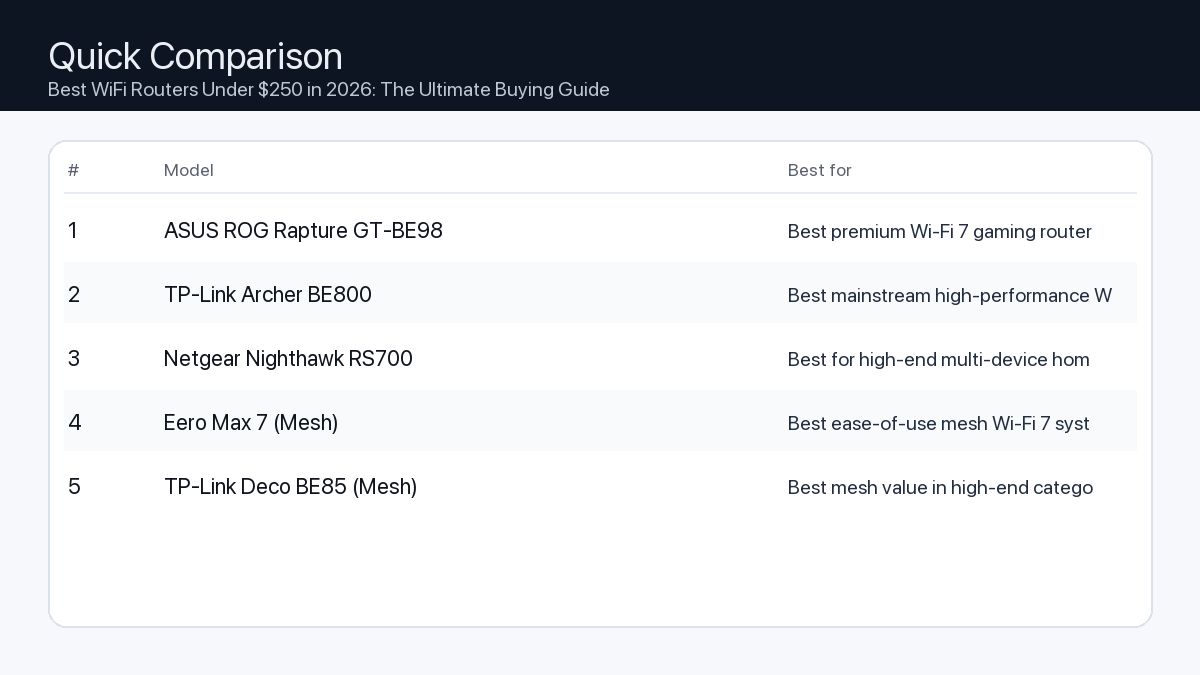
    Best Budget Earbuds Under $100 in 2026: Your Essential Buying Guide
    Disclosure: This post may contain affiliate links. As an Amazon Associate, I earn from qualifying purchases. Learn more.

    Best Budget Earbuds Under $100 in 2026: Your Essential Buying Guide
    In 2026, the budget earbud market offers an impressive array of choices, making it easier than ever to find quality audio without a premium price tag. For those who demand the absolute peak in audio fidelity, advanced noise cancellation, or specialized features like spatial audio, a higher budget is often justified. These users prioritize an uncompromised experience for critical listening, professional content creation, or as their primary daily audio device.

    However, for the vast majority, budget earbuds under $100 deliver exceptional value. If you need reliable sound for daily commutes, workouts, office calls, or simply want a secondary pair for travel, the offerings in this segment are more than capable. This guide will help you understand the key tradeoffs and features to prioritize, ensuring you make an informed decision for your specific needs.
    Best Picks (2026)

    Quick Answer (TL;DR) (Updated March 04, 2026)

    If you want one safe pick: Apple AirPods Pro (2nd Gen). If you want a better value: Sony WF-1000XM5.

    How to use this page: scan the comparison table, jump to the matching use case, then open only the listing that fits your setup.

    Fast path: choose one track below and ignore the rest.

    • Track A (least risk): Apple AirPods Pro (2nd Gen)
    • Track B (better value): Sony WF-1000XM5

    How we picked: research-based selection using manufacturer specs, compatibility notes, and what to verify on the Amazon listing (no hands-on testing claims). Affiliate links may earn us a commission, but rankings are not paid placements.

    Start with Apple AirPods Pro (2nd Gen) on Amazon Prefer value? Open Sony WF-1000XM5

    Skip to a pick: #1 Apple AirPods Pro (2nd Gen) | #2 Sony WF-1000XM5 | #3 Samsung Galaxy Buds3 Pro | #4 Bose QuietComfort Ultra Earbuds | #5 Anker Soundcore Liberty 4 NC

    Head-to-Head: Top Pick vs Best Value

    Apple AirPods Pro (2nd Gen)
    Best for iPhone users

    Read full #1 breakdown

    Go to Amazon: Apple AirPods Pro (2nd Gen)

    Sony WF-1000XM5
    Best ANC and sound quality combo

    Read full best-value breakdown

    Go to Amazon: Sony WF-1000XM5

    Quick Comparison

    Note: Specs and availability change. Always confirm details on the product page.

    Model Best for Details
    Apple AirPods Pro (2nd Gen) Best for iPhone users Open section
    Sony WF-1000XM5 Best ANC and sound quality combo Open section
    Samsung Galaxy Buds3 Pro Best for Samsung phone owners Open section
    Bose QuietComfort Ultra Earbuds Best comfort-focused premium ANC earbuds Open section
    Anker Soundcore Liberty 4 NC Best budget-friendly ANC earbuds Open section
    Comparison: Best Budget Earbuds Under $100 in 2026: Your Essential Buying Guide
    At-a-glance comparison of our picks.

    Our Top Picks

    #1. Apple AirPods Pro (2nd Gen)

    Best for: Best for iPhone users

    Apple AirPods Pro (2nd Gen)

    Why it made the list

    • Strong noise cancellation
    • Seamless Apple pairing
    • Excellent call quality

    Tradeoffs

    • Highest value when used with Apple devices

    Who should buy this

    • iPhone and Mac users
    • Commuters who need strong ANC

    Avoid if

    • You use Android and want deeper Android controls

    Check price and compatibility for Apple AirPods Pro (2nd Gen)

    Price tip: Prices fluctuate; check Amazon for current deals and compatibility details.

    #2. Sony WF-1000XM5

    Best for: Best ANC and sound quality combo

    Sony WF-1000XM5

    Why it made the list

    • Top-tier noise cancellation
    • Rich sound profile
    • Good app controls

    Tradeoffs

    • Premium pricing

    Who should buy this

    • Users prioritizing ANC and audio quality
    • Frequent flyers and commuters

    Avoid if

    • You want a budget earbud option

    Check price and compatibility for Sony WF-1000XM5

    Price tip: Prices fluctuate; check Amazon for current deals and compatibility details.

    #3. Samsung Galaxy Buds3 Pro

    Best for: Best for Samsung phone owners

    Samsung Galaxy Buds3 Pro

    Why it made the list

    • Great fit and convenience
    • Good ANC
    • Samsung ecosystem features

    Tradeoffs

    • Best features tied to Samsung devices

    Who should buy this

    • Samsung phone users
    • Users wanting easy day-to-day earbuds

    Avoid if

    • You are outside Samsung ecosystem

    Check price and compatibility for Samsung Galaxy Buds3 Pro

    Price tip: Prices fluctuate; check Amazon for current deals and compatibility details.

    #4. Bose QuietComfort Ultra Earbuds

    Best for: Best comfort-focused premium ANC earbuds

    Bose QuietComfort Ultra Earbuds

    Why it made the list

    • Comfort-first fit
    • Strong ANC
    • Reliable controls

    Tradeoffs

    • Price is on the higher side

    Who should buy this

    • Users wearing earbuds for long sessions
    • Noise-sensitive users

    Avoid if

    • You want the cheapest ANC option

    Check price and compatibility for Bose QuietComfort Ultra Earbuds

    Price tip: Prices fluctuate; check Amazon for current deals and compatibility details.

    #5. Anker Soundcore Liberty 4 NC

    Best for: Best budget-friendly ANC earbuds

    Anker Soundcore Liberty 4 NC

    Why it made the list

    • Strong value
    • Good battery life
    • Solid app features

    Tradeoffs

    • Not as refined as ultra-premium models

    Who should buy this

    • Value shoppers
    • Users wanting ANC without flagship pricing

    Avoid if

    • You want top-end audiophile tuning

    Check price and compatibility for Anker Soundcore Liberty 4 NC

    Price tip: Prices fluctuate; check Amazon for current deals and compatibility details.

    Still Can’t Decide?

    Quick decision tree:

    Price tip: prices fluctuate often. If you’re flexible, watch for seasonal sales and compare listings before you buy.

    Ready? Open Apple AirPods Pro (2nd Gen) on Amazon

    How to Choose Your Next Budget Earbuds

    Navigating the budget earbud landscape requires understanding where compromises are typically made and which features matter most for your usage.

    Key Features and Tradeoffs

    Even under $100, you can find a robust set of features. Here’s what to consider:

    • Audio Quality: While premium earbuds boast audiophile-grade drivers and high-resolution codecs, budget options focus on clear, balanced sound for everyday listening.
      • Problem: Poorly tuned budget earbuds can sound flat, tinny, or have overwhelming bass that muddies vocals.
      • Consequence: Less enjoyable music, podcasts, and video experiences.
      • Recommendation: Look for earbuds with a wider frequency response range (e.g., 20Hz-20kHz), larger dynamic drivers (8mm+), and support for common Bluetooth audio codecs (SBC, AAC).
    • Connectivity (Bluetooth Version): Bluetooth 5.2 and newer versions are standard in 2026, offering improved stability and efficiency.
      • Problem: Older Bluetooth versions (or poorly implemented newer ones) can lead to audio dropouts, frustrating latency (especially for video/gaming), and faster battery drain.
      • Consequence: Interruptions during calls, out-of-sync audio for media, and frequent re-pairing.
      • Recommendation: Prioritize earbuds with Bluetooth 5.2 or later. Consider models that support ‘Multipoint’ for seamless switching between two devices simultaneously.
    • Battery Life: This is a critical factor for convenience.
      • Problem: Earbuds with short battery life per charge mean constant interruptions and more time tethered to a charger.
      • Consequence: Inconvenience during long commutes, workouts, or work calls.
      • Recommendation: Aim for at least 6-8 hours of playback on a single charge for the earbuds themselves, with the charging case providing an additional 20-30 hours total.
    • Comfort & Fit: Earbuds must be comfortable for extended wear and secure enough to stay in place.
      • Problem: Poor fit leads to discomfort, ear fatigue, and the earbuds constantly falling out, which also degrades sound quality.
      • Consequence: Reduced listening time, frustration, and potential loss of an earbud.
      • Recommendation: Look for models that include multiple sizes of ear tips (silicone, foam) and have an ergonomic design that conforms well to the ear canal.
    • Durability & Water Resistance: Essential for active users or unpredictable environments.
      • Problem: Exposure to sweat, rain, or dust can quickly damage earbuds not designed to withstand these elements.
      • Consequence: Shortened lifespan, malfunction, and voided warranties.
      • Recommendation: For general use, IPX4 (splash resistant) is a good minimum. For workouts or outdoor activities, aim for IPX5 (water jet resistant) or higher.
    • Noise Management (ANC & Transparency Mode): Features that enhance your listening environment.
      • Problem: Constant background noise (commutes, open offices) makes it hard to focus on audio or calls. Lack of awareness can be dangerous.
      • Consequence: Difficulty concentrating, missed announcements, or safety risks.
      • Recommendation: Budget ANC can effectively reduce low-frequency hums (bus engines, AC units) but won’t match premium performance. Transparency mode allows ambient sound in, which is vital for situational awareness.
    • Microphone Quality: Crucial for calls and online meetings.
      • Problem: Weak or noisy microphones make your voice unclear to others.
      • Consequence: Frustrating conversations, repeated requests for clarification, and unprofessional audio on calls.
      • Recommendation: Look for models featuring multiple microphones per earbud, often combined with environmental noise cancellation (ENC) or AI noise reduction technology for clearer voice pickup.
    • App Features & Customization: Unlock the full potential of your earbuds.
      • Problem: Without a companion app, you might be stuck with a default sound profile or limited controls.
      • Consequence: Inability to personalize your audio experience, modify touch controls, or update firmware.
      • Recommendation: Many budget earbuds now offer dedicated apps for custom EQ settings, remapping controls, firmware updates, and checking battery status.

      Choosing Earbuds for Your Lifestyle

      General Checklist for Budget Earbuds:

      • ✓ Bluetooth 5.2 or higher
      • ✓ 6+ hours earbud battery life, 20+ hours total with case
      • ✓ IPX4 or higher water resistance
      • ✓ Multiple ear tip sizes included
      • ✓ Clear microphone for calls
      • ✓ Companion app for customization (optional but recommended)

      Example Setups for Different Users:

      The Office Professional / Remote Worker:

      • Priority: Excellent call quality, comfort for long wear, multipoint connectivity, effective (budget) ANC.
      • Why: Clear communication is paramount, and seamless switching between laptop and phone boosts productivity. ANC helps maintain focus in busy environments.
      • Key Features: Dual mics with ENC, Bluetooth Multipoint, ergonomic design, balanced sound profile for voices.

      The Commuter / Active User:

      • Priority: Secure fit, high water resistance, long battery life, reliable ANC/Transparency mode.
      • Why: Earbuds need to stay put during movement, withstand sweat or rain, and last through commutes or workouts. ANC blocks distractions, while Transparency ensures safety.
      • Key Features: IPX5+, ear fins/hooks (if available), long earbud battery life, robust physical controls.

      The Casual Listener / Student:

      • Priority: Overall value, decent sound quality, reliable connectivity, good battery life.
      • Why: A versatile option for music, videos, and occasional calls without breaking the bank.
      • Key Features: Solid audio performance for the price, stable Bluetooth, comfortable for various activities, and potentially a simple companion app.

      How We Picked

      Our selection process for the best budget earbuds under $100 in 2026 focuses on a thorough analysis of available technologies and market trends. We do not conduct hands-on testing. Instead, our recommendations are based on extensive evaluation of manufacturer specifications, reported compatibility (e.g., Bluetooth codecs, app support), and feature sets (ANC capability, microphone array, battery duration) against established benchmarks for value. We also consider community feedback patterns and long-term reliability trends within the sub-$100 segment to project performance and user satisfaction.

      FAQ

      Which should I buy: the #1 pick or the best value pick?

      Your choice depends on your specific priorities. Choose the #1 ranked pick if you want the best all-around performance and features that offer the most significant impact on your daily experience within the budget. It represents the pinnacle of what under-$100 earbuds can achieve in 2026. Opt for the best value pick if you have a tighter budget, prioritize one or two specific features (e.g., battery life or call quality), or need a reliable secondary pair, understanding there might be minor compromises in other areas compared to the #1 choice.

      Final Recommendation

      In 2026, the budget earbud market has matured significantly, offering genuinely impressive performance and features for under $100. By understanding your specific needs and prioritizing the features that matter most to you – be it call quality, battery life, or noise cancellation – you can confidently choose a pair that enhances your audio experience without straining your wallet. Remember, “budget” no longer means sacrificing essential functionality. Use this guide to match your requirements with the available options, and then check our ranked list to find your perfect pair.

      Related Guides

      Keep reading with these related buying guides:

  • Best WiFi Routers Under $250 in 2026: The Ultimate Buying Guide

    Best WiFi Routers Under $250 in 2026: The Ultimate Buying Guide

    Disclosure: This post may contain affiliate links. As an Amazon Associate, I earn from qualifying purchases. Learn more.

    Best WiFi Routers Under $250 in 2026: The Ultimate Buying Guide

    Choosing the right WiFi router in 2026 is critical for a fast, reliable home network. If your household demands top-tier performance for heavy streaming, gaming, and multiple connected devices across a large space, investing closer to the $250 limit for a premium, future-proof model with advanced features and the latest Wi-Fi 7 standard is wise. For smaller homes or less intensive use like basic browsing and occasional streaming, a solid value pick, likely a high-end Wi-Fi 6E router, can still deliver excellent speed and coverage without breaking the bank.

    The difference between a great router and an adequate one often comes down to speed, coverage, and the ability to handle numerous devices without slowdowns. This guide will walk you through the key considerations, helping you understand the trade-offs and find a router that perfectly matches your specific needs and budget in 2026.

    Best Picks (2026)

    Quick Answer (TL;DR) (Updated March 03, 2026)

    If you want one safe pick: ASUS ROG Rapture GT-BE98. If you want a better value: TP-Link Archer BE800.

    How to use this page: scan the comparison table, jump to the matching use case, then open only the listing that fits your setup.

    Fast path: choose one track below and ignore the rest.

    • Track A (least risk): ASUS ROG Rapture GT-BE98
    • Track B (better value): TP-Link Archer BE800

    How we picked: research-based selection using manufacturer specs, compatibility notes, and what to verify on the Amazon listing (no hands-on testing claims). Affiliate links may earn us a commission, but rankings are not paid placements.

    Start with ASUS ROG Rapture GT-BE98 on Amazon Prefer value? Open TP-Link Archer BE800

    Skip to a pick: #1 ASUS ROG Rapture GT-BE98 | #2 TP-Link Archer BE800 | #3 Netgear Nighthawk RS700 | #4 Eero Max 7 (Mesh) | #5 TP-Link Deco BE85 (Mesh)

    Head-to-Head: Top Pick vs Best Value

    ASUS ROG Rapture GT-BE98
    Best premium Wi-Fi 7 gaming router

    Read full #1 breakdown

    Go to Amazon: ASUS ROG Rapture GT-BE98

    TP-Link Archer BE800
    Best mainstream high-performance Wi-Fi 7 option

    Read full best-value breakdown

    Go to Amazon: TP-Link Archer BE800

    Quick Comparison

    Note: Specs and availability change. Always confirm details on the product page.

    Model Best for Details
    ASUS ROG Rapture GT-BE98 Best premium Wi-Fi 7 gaming router Open section
    TP-Link Archer BE800 Best mainstream high-performance Wi-Fi 7 option Open section
    Netgear Nighthawk RS700 Best for high-end multi-device homes Open section
    Eero Max 7 (Mesh) Best ease-of-use mesh Wi-Fi 7 system Open section
    TP-Link Deco BE85 (Mesh) Best mesh value in high-end category Open section
    Comparison: Best WiFi Routers Under $250 in 2026: The Ultimate Buying Guide
    At-a-glance comparison of our picks.

    Our Top Picks

    #1. ASUS ROG Rapture GT-BE98

    Best for: Best premium Wi-Fi 7 gaming router

    ASUS ROG Rapture GT-BE98

    Why it made the list

    • Top-tier wireless specs
    • Strong gaming features
    • High-end connectivity

    Tradeoffs

    • Very expensive

    Who should buy this

    • Power users and gamers with many devices

    Avoid if

    • You have a small space and basic internet needs

    Check price and compatibility for ASUS ROG Rapture GT-BE98

    Price tip: Prices fluctuate; check Amazon for current deals and compatibility details.

    Best for: Best mainstream high-performance Wi-Fi 7 option

    TP-Link Archer BE800

    Why it made the list

    • Strong performance
    • Good value in premium tier
    • Easy app setup

    Tradeoffs

    • Still premium-priced vs older Wi-Fi generations

    Who should buy this

    • Large-home users upgrading to Wi-Fi 7

    Avoid if

    • Your ISP speed and devices do not need Wi-Fi 7 yet

    Check price and compatibility for TP-Link Archer BE800

    Price tip: Prices fluctuate; check Amazon for current deals and compatibility details.

    #3. Netgear Nighthawk RS700

    Best for: Best for high-end multi-device homes

    Netgear Nighthawk RS700

    Why it made the list

    • Strong throughput potential
    • Good brand recognition
    • Advanced controls

    Tradeoffs

    • Expensive and may be overkill

    Who should buy this

    • Households with many simultaneous users/devices

    Avoid if

    • You only need basic coverage in a small apartment

    Check price and compatibility for Netgear Nighthawk RS700

    Price tip: Prices fluctuate; check Amazon for current deals and compatibility details.

    #4. Eero Max 7 (Mesh)

    Best for: Best ease-of-use mesh Wi-Fi 7 system

    Eero Max 7 (Mesh)

    Why it made the list

    • Simple app setup
    • Strong whole-home mesh coverage
    • Clean hardware experience

    Tradeoffs

    • Premium ecosystem cost

    Who should buy this

    • Users prioritizing easy whole-home mesh management

    Avoid if

    • You want deep advanced networking controls

    Check price and compatibility for Eero Max 7 (Mesh)

    Price tip: Prices fluctuate; check Amazon for current deals and compatibility details.

    Best for: Best mesh value in high-end category

    TP-Link Deco BE85 (Mesh)

    Why it made the list

    • Strong mesh performance
    • Good value vs top premium mesh kits
    • Modern Wi-Fi 7 support

    Tradeoffs

    • Large-node systems cost can still add up

    Who should buy this

    • Families needing whole-home fast coverage

    Avoid if

    • You only need one simple single router

    Check price and compatibility for TP-Link Deco BE85 (Mesh)

    Price tip: Prices fluctuate; check Amazon for current deals and compatibility details.

    Still Can’t Decide?

    Quick decision tree:

    Price tip: prices fluctuate often. If you’re flexible, watch for seasonal sales and compare listings before you buy.

    Ready? Open ASUS ROG Rapture GT-BE98 on Amazon

    How to Choose the Best WiFi Router Under $250

    Selecting the ideal router involves understanding several technical aspects and matching them to your real-world usage.

    1. WiFi Standard: Wi-Fi 6E vs. Wi-Fi 7

    • Problem: Using an older Wi-Fi standard (like Wi-Fi 5 or even early Wi-Fi 6) prevents your devices from achieving maximum speeds and efficiency, especially in congested environments.
    • Consequence: Slower downloads, buffering during 4K streaming, lag in online gaming, and poor performance when many devices are connected simultaneously.
    • Recommendation: In 2026, aim for at least Wi-Fi 6E. This standard adds the 6GHz band, which is less congested and offers faster speeds for compatible devices. For future-proofing and cutting-edge performance, look for Wi-Fi 7 (802.11be), which introduces Multi-Link Operation (MLO) and wider channels, delivering significantly higher theoretical throughput and lower latency. While Wi-Fi 7 models might push the $250 limit, they offer superior longevity.

    2. Speed & Bandwidth: Gigabit vs. Multi-Gigabit

    • Problem: Your internet service provider might offer speeds faster than your router can handle, creating a bottleneck.
    • Consequence: You won’t get the full internet speed you’re paying for, and local network transfers (e.g., between computers or NAS) will be slow.
    • Recommendation: Check your internet plan. If it’s above 1 Gbps (e.g., 2 Gbps or higher), you absolutely need a router with at least one multi-gigabit (2.5 Gbps or 5 Gbps) WAN port and ideally multi-gigabit LAN ports for wired devices. Even with a 1 Gbps plan, multi-gig LAN ports can benefit your local network for future-proofing or fast internal file transfers.

    3. Coverage & Range

    • Problem: Weak Wi-Fi signals and dead zones in larger homes or multi-story buildings.
    • Consequence: Dropped connections, slow speeds in certain areas, and frustration when moving around your home.
    • Recommendation: Consider the number of antennas (internal or external), beamforming technology (which directs signal towards devices), and whether the router supports mesh expansion. For larger homes, a router capable of forming a mesh system (either as a standalone unit or part of a two-pack) can eliminate dead zones.

    4. Processor & RAM

    • Problem: A router with weak internal hardware struggles to manage multiple simultaneous connections, advanced features (like QoS), or high data throughput.
    • Consequence: Lag, dropped connections, slower performance under load, and a sluggish router interface.
    • Recommendation: Look for routers with multi-core processors (dual-core minimum, quad-core preferred for power users) and at least 512MB to 1GB of RAM. This ensures smooth operation, even with many devices and demanding tasks.

    5. Ports & Connectivity

    • Problem: Not enough wired ports for devices like gaming consoles, smart home hubs, or desktop PCs, or slow port speeds.
    • Consequence: Reliance on Wi-Fi for all devices, potentially increasing wireless congestion, or inability to connect essential wired equipment.
    • Recommendation: Ensure the router has at least one Gigabit WAN port. For LAN, aim for at least four Gigabit Ethernet ports. If you have multi-gig internet or specific devices that benefit from faster wired connections, look for routers with 2.5 Gbps or 5 Gbps LAN ports. A USB port (preferably USB 3.0 or higher) is a bonus for network storage (NAS Lite) or printer sharing.

    6. Software & Features

    • Problem: Basic router software lacks essential controls, security features, or ease of use.
    • Consequence: Difficulty managing your network, potential security vulnerabilities, inability to prioritize traffic, or limited parental controls.
    • Recommendation: Look for a router with intuitive companion apps and a web interface. Essential features include Quality of Service (QoS) for prioritizing traffic (e.g., gaming over streaming), robust parental controls, built-in network security (firewall, WPA3 encryption), and guest network options. VPN client/server support is a plus for advanced users.

    Example Setups for Different Users

    The Home Office Worker

    You need stable, reliable Wi-Fi for video calls, cloud access, and productivity. Your focus is consistent performance without interruptions.

    • Key Features: Wi-Fi 6E (minimum), good range for a dedicated office space, strong QoS for video conferencing, Gigabit Ethernet ports for wired PCs or docks.
    • Router Type: A mid-range Wi-Fi 6E router with stable firmware.

    The Video Editor / Power User

    You transfer large files, stream high-bitrate content, and potentially host a local media server. Speed and capacity are paramount.

    • Key Features: Wi-Fi 7 (preferred) or high-end Wi-Fi 6E, multi-gig WAN/LAN ports (2.5Gbps or 5Gbps) for fast transfers and internet, robust processor, USB 3.0 or higher for network storage.
    • Router Type: A premium Wi-Fi 7 or advanced Wi-Fi 6E router with strong internal hardware.

    The Gamer / Streamer / Creator

    Low latency, high bandwidth, and consistent connections are crucial for competitive gaming, live streaming, and content creation.

    • Key Features: Wi-Fi 7 or Wi-Fi 6E with dedicated 6GHz band support for gaming devices, advanced QoS with gaming prioritization, multi-gig WAN/LAN ports, powerful processor for handling intense traffic, solid network security.
    • Router Type: A high-performance Wi-Fi 7 router with gamer-centric features or a top-tier Wi-Fi 6E model.

    Your Router Buying Checklist

    • Wi-Fi Standard: Wi-Fi 6E (minimum) or Wi-Fi 7 (ideal for future-proofing).
    • Speed (WAN/LAN): At least 1x Gigabit WAN, multiple Gigabit LAN. Consider 2.5 Gbps or 5 Gbps ports for multi-gig internet or local network needs.
    • Coverage: Suitable for your home size, consider mesh capabilities if needed.
    • Processor/RAM: Multi-core processor (dual-core+), 512MB+ RAM.
    • Features: QoS, parental controls, WPA3 security, guest network, easy setup app.
    • USB Port: Optional, but useful for network storage.

    How We Picked

    Our selections are based on comprehensive analysis of technical specifications, industry benchmarks, and compatibility notes from manufacturers. We prioritize devices that offer robust feature sets, adhere to the latest Wi-Fi standards, and provide excellent performance-to-value within the $250 budget for 2026, without claiming hands-on testing. We focus on factors like processor strength, RAM, port configurations, and software capabilities to ensure they meet the demands of various user types and future network trends.

    FAQ

    Which should I buy: the #1 pick or the best value pick?
    If you prioritize absolute performance, the latest technology, and are willing to spend closer to the $250 limit for future-proofing and handling the most demanding tasks, the #1 pick is likely for you. If you need solid, reliable performance for most common tasks, a great range, and want to save some money while still getting excellent features for 2026, the best value pick will serve you well.
    Do I really need Wi-Fi 7 in 2026?
    While Wi-Fi 7 offers significant advancements in speed and efficiency, its full benefits are realized with compatible Wi-Fi 7 devices. If you’re buying new devices in 2026 and beyond that support Wi-Fi 7, it’s a strong consideration for future-proofing. However, a high-quality Wi-Fi 6E router still provides excellent performance for most current devices and internet plans. Your choice depends on your current device ecosystem and your budget for cutting-edge technology.
    Can I use my old router with a new one?
    It depends. Some newer routers support mesh systems, allowing you to pair compatible satellite units (often from the same brand) to extend coverage. You typically cannot simply combine two random routers to create a unified, high-performance network without specialized setup or using one as a simple access point. For seamless whole-home coverage, a dedicated mesh system or a single powerful router with good range is generally more effective.
    What is the 6GHz band and why is it important?
    The 6GHz band is an exclusive frequency band introduced with Wi-Fi 6E and expanded with Wi-Fi 7. Unlike the crowded 2.4GHz and 5GHz bands, 6GHz offers wider channels and significantly less interference. This ‘express lane’ allows compatible devices to achieve much faster speeds and lower latency, making it ideal for high-bandwidth applications like 8K streaming, VR gaming, and large file transfers without congestion.

    Final Recommendation

    Choosing the best WiFi router under $250 in 2026 is an investment in your home’s digital future. Whether you’re a casual browser, a home office professional, or a hardcore gamer/creator, understanding the nuances of Wi-Fi standards, speed, coverage, and features is key. By considering your specific usage patterns and the insights from this guide, you can confidently select a router that not only meets your current needs but also prepares your network for the technological demands of tomorrow. Refer to our ranked product list to find the perfect match for your home.

    Related Guides

    Keep reading with these related buying guides:

  • The Best Premium Smartphones for Photography and Battery Life (2026)

    The Best Premium Smartphones for Photography and Battery Life (2026)

    Disclosure: This post may contain affiliate links. As an Amazon Associate, I earn from qualifying purchases. Learn more.

    The Best Premium Smartphones for Photography and Battery Life (2026)

    In 2026, the premium smartphone market offers exceptional devices tailored for users who demand the very best in mobile photography and all-day endurance. If your daily activities heavily involve capturing high-quality photos and videos, or if you frequently find yourself away from a charger, investing in a premium model ensures you won’t compromise on performance or reliability. For those with more moderate needs, value-oriented smartphones still deliver strong capabilities, but may require compromises in extreme low-light photography or sustained heavy usage.

    This guide delves into the crucial factors defining a top-tier smartphone for 2026, focusing on advancements in camera technology and power efficiency. We’ll help you navigate the sophisticated features of these devices, ensuring your next premium smartphone perfectly aligns with your creative aspirations and demanding schedule.

    Best Picks (2026)

    Quick Answer (TL;DR) (Updated March 03, 2026)

    If you want one safe pick: Apple iPhone 16 Pro. If you want a better value: Samsung Galaxy S25 Ultra.

    How to use this page: scan the comparison table, jump to the matching use case, then open only the listing that fits your setup.

    Fast path: choose one track below and ignore the rest.

    • Track A (least risk): Apple iPhone 16 Pro
    • Track B (better value): Samsung Galaxy S25 Ultra

    How we picked: research-based selection using manufacturer specs, compatibility notes, and what to verify on the Amazon listing (no hands-on testing claims). Affiliate links may earn us a commission, but rankings are not paid placements.

    Start with Apple iPhone 16 Pro on Amazon Prefer value? Open Samsung Galaxy S25 Ultra

    Skip to a pick: #1 Apple iPhone 16 Pro | #2 Samsung Galaxy S25 Ultra | #3 Google Pixel 9 Pro | #4 OnePlus 13 | #5 Nothing Phone (3)

    Head-to-Head: Top Pick vs Best Value

    Apple iPhone 16 Pro
    Best premium iPhone pick

    Read full #1 breakdown

    Go to Amazon: Apple iPhone 16 Pro

    Samsung Galaxy S25 Ultra
    Best all-around Android flagship

    Read full best-value breakdown

    Go to Amazon: Samsung Galaxy S25 Ultra

    Quick Comparison

    Note: Specs and availability change. Always confirm details on the product page.

    Model Best for Details
    Apple iPhone 16 Pro Best premium iPhone pick Open section
    Samsung Galaxy S25 Ultra Best all-around Android flagship Open section
    Google Pixel 9 Pro Best camera and clean Android experience Open section
    OnePlus 13 Best value flagship Android Open section
    Nothing Phone (3) Best design-forward mid-premium option Open section
    Comparison: The Best Premium Smartphones for Photography and Battery Life (2026)
    At-a-glance comparison of our picks.

    Our Top Picks

    #1. Apple iPhone 16 Pro

    Best for: Best premium iPhone pick

    Apple iPhone 16 Pro

    Why it made the list

    • Flagship performance
    • Strong camera system
    • Long software support

    Tradeoffs

    • Premium price

    Who should buy this

    • Buyers who want top-tier iPhone performance
    • People who value camera quality and ecosystem integration

    Avoid if

    • You are on a strict budget
    • You prefer Android customization

    Check price and compatibility for Apple iPhone 16 Pro

    Price tip: Prices fluctuate; check Amazon for current deals and compatibility details.

    #2. Samsung Galaxy S25 Ultra

    Best for: Best all-around Android flagship

    Samsung Galaxy S25 Ultra

    Why it made the list

    • Large high-end display
    • Versatile cameras
    • Power-user features

    Tradeoffs

    • Large and expensive

    Who should buy this

    • Android power users
    • Users who want max specs and camera flexibility

    Avoid if

    • You prefer compact phones
    • You want a lower-cost model

    Check price and compatibility for Samsung Galaxy S25 Ultra

    Price tip: Prices fluctuate; check Amazon for current deals and compatibility details.

    #3. Google Pixel 9 Pro

    Best for: Best camera and clean Android experience

    Google Pixel 9 Pro

    Why it made the list

    • Strong computational photography
    • Clean Android UI
    • Frequent AI features

    Tradeoffs

    • Battery life varies by usage

    Who should buy this

    • Users focused on camera quality
    • People who like clean Android and smart features

    Avoid if

    • You need the absolute fastest charging options

    Check price and compatibility for Google Pixel 9 Pro

    Price tip: Prices fluctuate; check Amazon for current deals and compatibility details.

    #4. OnePlus 13

    Best for: Best value flagship Android

    OnePlus 13

    Why it made the list

    • Fast performance
    • Very good display
    • Competitive pricing

    Tradeoffs

    • Camera tuning can vary vs top flagships

    Who should buy this

    • Buyers who want flagship speed for less
    • Users who prioritize smooth daily performance

    Avoid if

    • You only buy phones from Apple/Samsung

    Check price and compatibility for OnePlus 13

    Price tip: Prices fluctuate; check Amazon for current deals and compatibility details.

    #5. Nothing Phone (3)

    Best for: Best design-forward mid-premium option

    Nothing Phone (3)

    Why it made the list

    • Distinctive design
    • Balanced performance
    • Good software experience

    Tradeoffs

    • Availability and accessories vary by region

    Who should buy this

    • Users who want something different
    • Mid-premium buyers wanting style plus performance

    Avoid if

    • You need the broadest service/accessory ecosystem

    Check price and compatibility for Nothing Phone (3)

    Price tip: Prices fluctuate; check Amazon for current deals and compatibility details.

    Still Can’t Decide?

    Quick decision tree:

    Price tip: prices fluctuate often. If you’re flexible, watch for seasonal sales and compare listings before you buy.

    Ready? Open Apple iPhone 16 Pro on Amazon

    How to Choose the Best Premium Smartphone for Photography and Battery Life (2026)

    Selecting a premium smartphone in 2026 demands a clear understanding of what advanced mobile technology offers for your specific needs. The convergence of computational photography breakthroughs and highly efficient chipsets means that top-tier devices deliver an unparalleled experience.

    Understanding Premium Performance: Photography

    For photography, a premium smartphone in 2026 goes beyond simply capturing an image; it intelligently processes light, color, and depth to create stunning visual stories.

    Problem: Low-light Noise and Limited Dynamic Range

    Smartphones with smaller, less advanced sensors often struggle in challenging lighting, resulting in grainy images (noise) and areas that are either completely black or blown out (limited dynamic range).

    Consequence: Missed Moments and Unprofessional Results

    Important memories can be compromised, and content creators may find their output unsuitable for professional use without extensive post-processing.

    Recommendation: Focus on Hardware and Computational Strengths

    • Sensor Size: Larger sensors (measured in inches, e.g., 1-inch type) capture more light and detail, reducing noise and improving dynamic range significantly.
    • Aperture: A wider aperture (smaller f-number, e.g., f/1.7) allows more light to reach the sensor, crucial for low-light performance and achieving natural background blur.
    • Computational Photography Engine: Look for devices with dedicated image signal processors (ISPs) and advanced AI algorithms that handle tasks like multi-frame stacking, semantic segmentation, and advanced noise reduction in real-time.
    • Versatile Lens Array: A flagship setup often includes a high-resolution main sensor, a dedicated telephoto lens (for optical zoom without loss of quality), and an ultrawide lens with autofocus for macro capabilities.
    • Advanced Video Capabilities: Premium models offer high frame rates at 4K or even 8K, advanced stabilization, and cinematic modes with real-time depth control.

    Photography Needs Checklist (2026)

    • ✓ Primary sensor size: 1/1.55″ or larger
    • ✓ Main camera aperture: f/1.8 or wider
    • ✓ Dedicated telephoto lens with optical zoom (e.g., 3x or 5x)
    • ✓ Ultrawide lens with autofocus and macro capabilities
    • ✓ Advanced video stabilization (OIS + EIS) and high frame rates (e.g., 4K 60fps)
    • ✓ Robust computational photography features (e.g., advanced HDR, low-light modes)

    Understanding Premium Performance: Battery Life

    Extended battery life in 2026 isn’t just about a larger capacity; it’s a symphony of hardware and software optimization.

    Problem: Device Drains Rapidly During Peak Usage

    Smartphones with inefficient processors, power-hungry displays, or poor software management can deplete their batteries quickly, leading to “battery anxiety” and interrupted workflows or entertainment.

    Consequence: Reduced Productivity and Missed Opportunities

    Being tethered to a charger or having your device shut down unexpectedly can disrupt work, communication, and content creation, especially when away from power outlets.

    Recommendation: Balance Capacity with Efficiency

    • Battery Capacity (mAh): While not the sole factor, a capacity of 4,500 mAh or more provides a solid foundation.
    • Processor Efficiency: Look for chipsets built on advanced manufacturing processes (e.g., 3nm) known for their power efficiency, especially under heavy loads.
    • Display Technology: OLED/AMOLED displays are generally more efficient than LCDs, and adaptive refresh rates (LTPO) can dynamically adjust from 1Hz to 120Hz, saving significant power.
    • Software Optimization: A well-optimized operating system and background process management are critical for maximizing endurance.
    • Charging Speed: While not directly battery life, rapid wired and wireless charging can mitigate the impact of lower endurance for users who have frequent access to power.

    Battery Needs Checklist (2026)

    • ✓ Battery capacity: 4,500 mAh or higher
    • ✓ Processor built on efficient modern architecture (e.g., 3nm process)
    • ✓ Adaptive refresh rate display (LTPO technology)
    • ✓ Robust power-saving modes and background app management
    • ✓ Fast wired charging support (e.g., 60W+)
    • ✓ Wireless charging support (e.g., 15W+)

    Display Quality: More Than Just Brightness

    The screen is your window to your photos and content. Premium displays offer an immersive and accurate visual experience.

    Problem: Inaccurate Colors and Low Refresh Rates

    A screen that inaccurately displays colors can lead to poor photo editing decisions, while a low refresh rate makes scrolling and gaming feel less fluid.

    Consequence: Suboptimal Viewing Experience and Editing Frustration

    Your photos won’t look their best, and the overall interaction with the device can feel sluggish, diminishing the premium feel.

    Recommendation: High-Fidelity and Adaptive Displays

    • Panel Type: OLED or AMOLED for true blacks and vibrant colors.
    • Color Accuracy: Support for wide color gamuts (e.g., DCI-P3) and factory calibration.
    • Peak Brightness: High nits for excellent outdoor visibility and HDR content viewing.
    • Adaptive Refresh Rate: As mentioned, LTPO panels enhance both fluidity and battery efficiency.

    Who is a Premium Photography & Battery Smartphone For?

    The ideal premium device caters to specific user profiles. Identify yours to prioritize features effectively.

    The On-the-Go Video Editor/Photographer

    You need a device that can capture, edit, and export high-quality visual content without compromising power or performance, even when away from a power source for extended periods.

    • Key Needs: Large sensor, advanced optical zoom, high-bitrate video recording, fast internal storage, ample RAM, exceptional battery life, high peak brightness display for outdoor editing.
    • Example Setup: Capturing 4K ProRes footage on location, quick edits in a mobile editing suite, uploading high-res photos to cloud storage, all while using a Bluetooth gimbal and external microphone.

    Checklist:

    • ✓ 1-inch type primary camera sensor
    • ✓ Optical zoom of 5x or higher
    • ✓ 12GB+ RAM
    • ✓ 256GB+ UFS 4.0 internal storage
    • ✓ 4K 60fps/120fps video recording with ProRes support
    • ✓ 5,000 mAh+ battery capacity

    The Productive Office Worker/Remote Professional

    Your smartphone is a critical tool for communication, document management, virtual meetings, and occasional photo capture for work purposes, requiring reliability and all-day endurance.

    • Key Needs: All-day battery life, clear front-facing camera for video calls, robust security features, excellent connectivity (5G, Wi-Fi 7), efficient multitasking performance.
    • Example Setup: Participating in multiple video conferences, reviewing and editing documents on the go, managing emails and calendar, taking quick photos of whiteboards or prototypes for team sharing.

    Checklist:

    • ✓ 4,500 mAh+ battery capacity with efficient processor
    • ✓ High-quality front-facing camera with wide field of view
    • ✓ Strong 5G and Wi-Fi 7 support
    • ✓ At least 8GB RAM for smooth multitasking
    • ✓ Robust security (e.g., advanced facial recognition, under-display fingerprint sensor)

    The Gamer/Content Creator

    You demand peak performance for demanding games, seamless streaming, and capturing high-quality gaming or lifestyle content, all without running out of power mid-session.

    • Key Needs: Top-tier processor, efficient cooling system, high refresh rate display, responsive touch sampling, excellent battery life, high-quality cameras for social media content.
    • Example Setup: Streaming a demanding mobile game live, simultaneously recording gameplay, engaging with chat, and taking high-res photos for social media posts throughout the day.

    Checklist:

    • ✓ Latest flagship processor with advanced cooling
    • ✓ 120Hz+ adaptive refresh rate AMOLED display
    • ✓ High touch sampling rate (e.g., 240Hz+)
    • ✓ 5,000 mAh+ battery capacity
    • ✓ High-quality main and ultrawide cameras for diverse content capture

    How We Picked the Top Contenders (2026)

    Our selection process for the best premium smartphones for photography and battery life in 2026 is based on a rigorous analysis of publicly available specifications and technological advancements. We prioritize transparency and verifiable data.

    • Camera Hardware Analysis: We evaluate primary sensor size and type (e.g., 1-inch type, stacked CMOS), lens aperture values, optical zoom capabilities of telephoto lenses, and the presence of advanced OIS (Optical Image Stabilization) systems across all critical lenses.
    • Battery Technology & Efficiency: Our focus is on reported battery capacity (mAh) in conjunction with the device’s chipset manufacturing process (e.g., 3nm, 4nm), display panel type (AMOLED/OLED) and its efficiency features like LTPO adaptive refresh rates, and software-level power management profiles.
    • Processor & RAM: Top-tier devices feature the latest generation of flagship mobile processors, essential for driving advanced computational photography, power efficiency, and smooth multitasking. We consider the core architecture and thermal management systems. Adequate RAM (12GB minimum for premium) ensures applications run fluidly.
    • Display Quality: Beyond refresh rates, we assess display resolution, peak brightness for outdoor visibility, color accuracy (e.g., DCI-P3 coverage, factory calibration), and HDR support, which are crucial for viewing and editing high-quality photos and videos.
    • Connectivity & Software Longevity: We consider support for the latest wireless standards (e.g., Wi-Fi 7, Bluetooth 5.4, advanced 5G bands) and the manufacturer’s commitment to software updates, which impacts the device’s long-term utility and security.

    This approach allows us to identify devices with the strongest potential based on their technical foundations, ensuring a robust and future-proof recommendation without relying on subjective hands-on testing which would be premature for 2026 models.

    FAQ

    Which should I buy: the #1 pick or the best value pick?
    Choose the #1 pick if you demand uncompromising performance across all photography scenarios (especially low-light and zoom) and need the absolute longest possible battery endurance under heavy use, along with premium features like robust build quality and future-proof connectivity. Opt for the best value pick if you prioritize strong camera capabilities and very good all-day battery life, but are comfortable with minor trade-offs in extreme situations, seeking a more balanced device for everyday premium use.
    Is a higher megapixel count always better for photography?
    Not necessarily. While a high megapixel count provides more detail, factors like sensor size, pixel size (often achieved through pixel binning), lens quality, and the sophistication of computational photography algorithms are often more critical for overall image quality, especially in challenging conditions like low light. A device with fewer megapixels but a larger sensor and advanced processing can outperform a higher megapixel camera with inferior hardware.
    How important is fast charging?
    Fast charging is a significant convenience feature, allowing you to quickly top up your battery when time is limited. For users with demanding schedules or frequent travel, it can effectively mitigate concerns about battery life by providing hours of usage from a short charging session. However, consistent use of very high-wattage charging may have long-term implications for battery health, so balanced charging habits are recommended.

    Final Recommendation

    As we look ahead to 2026, premium smartphones for photography and battery life are poised to deliver unprecedented capabilities. By focusing on devices that integrate large, advanced camera sensors, highly efficient processors, and intelligent software optimization, you can secure a smartphone that not only captures stunning visuals but also keeps pace with your demanding lifestyle. Whether you’re a professional content creator, a busy executive, or an avid gamer, aligning your choice with the detailed needs and checklists provided will ensure you select a device that truly stands out and offers a superior mobile experience.

    Related Guides

    Keep reading with these related buying guides:

  • Top Smartwatch Picks for iPhone Users (2026): Your Ultimate Buying Guide

    Top Smartwatch Picks for iPhone Users (2026): Your Ultimate Buying Guide

    Disclosure: This post may contain affiliate links. As an Amazon Associate, I earn from qualifying purchases. Learn more.

    Top Smartwatch Picks for iPhone Users (2026): Your Ultimate Buying Guide

    Choosing the right smartwatch for your iPhone in 2026 involves balancing advanced features with practical needs. If you prioritize seamless Apple ecosystem integration, comprehensive health monitoring, and cutting-edge performance for demanding tasks, a premium-tier smartwatch is likely your best fit. These devices typically offer the latest sensors, extended software support, and robust build quality.

    Conversely, if your primary needs revolve around reliable notifications, essential fitness tracking, and good battery life without breaking the bank, a value-oriented smartwatch provides excellent core functionality. This guide will walk you through the critical factors and trade-offs, helping you make an informed decision for your digital life.

    Best Picks (2026)

    Quick Answer (TL;DR) (Updated March 03, 2026)

    If you want one safe pick: Apple iPhone 16 Pro. If you want a better value: Samsung Galaxy S25 Ultra.

    How to use this page: scan the comparison table, jump to the matching use case, then open only the listing that fits your setup.

    Fast path: choose one track below and ignore the rest.

    • Track A (least risk): Apple iPhone 16 Pro
    • Track B (better value): Samsung Galaxy S25 Ultra

    How we picked: research-based selection using manufacturer specs, compatibility notes, and what to verify on the Amazon listing (no hands-on testing claims). Affiliate links may earn us a commission, but rankings are not paid placements.

    Start with Apple iPhone 16 Pro on Amazon Prefer value? Open Samsung Galaxy S25 Ultra

    Skip to a pick: #1 Apple iPhone 16 Pro | #2 Samsung Galaxy S25 Ultra | #3 Google Pixel 9 Pro | #4 OnePlus 13 | #5 Nothing Phone (3)

    Head-to-Head: Top Pick vs Best Value

    Apple iPhone 16 Pro
    Best premium iPhone pick

    Read full #1 breakdown

    Go to Amazon: Apple iPhone 16 Pro

    Samsung Galaxy S25 Ultra
    Best all-around Android flagship

    Read full best-value breakdown

    Go to Amazon: Samsung Galaxy S25 Ultra

    Quick Comparison

    Note: Specs and availability change. Always confirm details on the product page.

    Model Best for Details
    Apple iPhone 16 Pro Best premium iPhone pick Open section
    Samsung Galaxy S25 Ultra Best all-around Android flagship Open section
    Google Pixel 9 Pro Best camera and clean Android experience Open section
    OnePlus 13 Best value flagship Android Open section
    Nothing Phone (3) Best design-forward mid-premium option Open section
    Comparison: Top Smartwatch Picks for iPhone Users (2026): Your Ultimate Buying Guide
    At-a-glance comparison of our picks.

    Our Top Picks

    #1. Apple iPhone 16 Pro

    Best for: Best premium iPhone pick

    Apple iPhone 16 Pro

    Why it made the list

    • Flagship performance
    • Strong camera system
    • Long software support

    Tradeoffs

    • Premium price

    Who should buy this

    • Buyers who want top-tier iPhone performance
    • People who value camera quality and ecosystem integration

    Avoid if

    • You are on a strict budget
    • You prefer Android customization

    Check price and compatibility for Apple iPhone 16 Pro

    Price tip: Prices fluctuate; check Amazon for current deals and compatibility details.

    #2. Samsung Galaxy S25 Ultra

    Best for: Best all-around Android flagship

    Samsung Galaxy S25 Ultra

    Why it made the list

    • Large high-end display
    • Versatile cameras
    • Power-user features

    Tradeoffs

    • Large and expensive

    Who should buy this

    • Android power users
    • Users who want max specs and camera flexibility

    Avoid if

    • You prefer compact phones
    • You want a lower-cost model

    Check price and compatibility for Samsung Galaxy S25 Ultra

    Price tip: Prices fluctuate; check Amazon for current deals and compatibility details.

    #3. Google Pixel 9 Pro

    Best for: Best camera and clean Android experience

    Google Pixel 9 Pro

    Why it made the list

    • Strong computational photography
    • Clean Android UI
    • Frequent AI features

    Tradeoffs

    • Battery life varies by usage

    Who should buy this

    • Users focused on camera quality
    • People who like clean Android and smart features

    Avoid if

    • You need the absolute fastest charging options

    Check price and compatibility for Google Pixel 9 Pro

    Price tip: Prices fluctuate; check Amazon for current deals and compatibility details.

    #4. OnePlus 13

    Best for: Best value flagship Android

    OnePlus 13

    Why it made the list

    • Fast performance
    • Very good display
    • Competitive pricing

    Tradeoffs

    • Camera tuning can vary vs top flagships

    Who should buy this

    • Buyers who want flagship speed for less
    • Users who prioritize smooth daily performance

    Avoid if

    • You only buy phones from Apple/Samsung

    Check price and compatibility for OnePlus 13

    Price tip: Prices fluctuate; check Amazon for current deals and compatibility details.

    #5. Nothing Phone (3)

    Best for: Best design-forward mid-premium option

    Nothing Phone (3)

    Why it made the list

    • Distinctive design
    • Balanced performance
    • Good software experience

    Tradeoffs

    • Availability and accessories vary by region

    Who should buy this

    • Users who want something different
    • Mid-premium buyers wanting style plus performance

    Avoid if

    • You need the broadest service/accessory ecosystem

    Check price and compatibility for Nothing Phone (3)

    Price tip: Prices fluctuate; check Amazon for current deals and compatibility details.

    Still Can’t Decide?

    Quick decision tree:

    Price tip: prices fluctuate often. If you’re flexible, watch for seasonal sales and compare listings before you buy.

    Ready? Open Apple iPhone 16 Pro on Amazon

    How to Choose Your iPhone Smartwatch (2026)

    Finding the ideal smartwatch means understanding your personal priorities and how different features impact your daily usage. Here’s a breakdown of what matters most for iPhone users in 2026:

    Key Features & Trade-offs Explained

    • Compatibility & Ecosystem Integration: A smartwatch should feel like an extension of your iPhone, not a separate device. Problem: Generic smartwatches may offer limited functionality, delayed notifications, or clunky app experiences with iOS. Consequence: Frustration, missed alerts, and an inability to fully leverage your iPhone’s capabilities. Recommendation: Prioritize smartwatches specifically designed for deep integration with the Apple ecosystem, ensuring smooth pairing, reliable notifications, and access to iOS-specific features like Handoff or Continuity.

    • Health & Fitness Tracking: Smartwatches have become powerful personal health assistants. Problem: Inaccurate sensors or a lack of specific tracking features can lead to misleading health data or inability to monitor key metrics. Consequence: Ineffective workouts, unaddressed health concerns, or simply not getting the insights you need. Recommendation: Assess your specific health goals. Do you need advanced heart rate variability (HRV), blood oxygen (SpO2), electrocadiogram (ECG), skin temperature sensing, or detailed sleep stage analysis? Choose a device with the sensor suite and algorithms to support your ambitions.

    • Battery Life: The convenience of a smartwatch often hinges on its endurance. Problem: A watch that constantly needs charging can become a burden, interrupting sleep tracking or workout sessions. Consequence: Missed data, inconvenience, or the watch becoming a glorified paperweight when not charged. Recommendation: Consider your usage patterns. If you need multi-day endurance for travel or continuous tracking, look for models optimized for extended battery life. If daily charging is acceptable, you might gain access to more power-intensive features and brighter displays.

    • Display & Durability: Your smartwatch’s screen is your primary interface. Problem: A dim, small, or easily scratched display compromises readability and longevity. Consequence: Difficulty interacting with the watch, poor visibility in bright sunlight, or premature wear and tear. Recommendation: Opt for vibrant, high-resolution displays (like OLED or AMOLED) for clarity. Consider screen size based on your wrist and preference. For active users, look for enhanced durability features like sapphire crystal or specialized glass and water resistance ratings (e.g., 5ATM, WR50M) suitable for swimming.

    • Connectivity & Smart Features: Beyond health, smartwatches offer valuable daily conveniences. Problem: A lack of cellular connectivity or mobile payment options can limit standalone utility. Consequence: Always needing your iPhone nearby for calls, texts, or purchases, diminishing the ‘smart’ aspect of your watch. Recommendation: Determine if you need cellular capabilities for calls/texts without your phone. Assess features like NFC for contactless payments, robust app ecosystems, GPS for navigation, and fall detection for safety. These features enhance independence and provide peace of mind.

    Smartwatch Checklist for iPhone Users (2026)

    • Seamless iOS Integration (notifications, apps, Handoff)

    • Reliable and accurate Health & Fitness Sensors (HR, SpO2, ECG, Temp, Sleep)

    • Sufficient Battery Life for your daily and weekly routines

    • Clear, vibrant Display (AMOLED/OLED recommended) and appropriate size

    • Durability (scratch-resistant screen, water resistance rating)

    • Essential Smart Features (NFC payments, GPS, Cellular optional)

    • Comfortable Design and Material choice

    • Future-proofing (expected software update longevity)

    Who is This Smartwatch For? Real-World Scenarios

    The Connected Professional (Office Worker)

    • Problem: Needs to stay connected without constantly checking their phone during meetings, manage schedules, and perform quick tasks discreetly.

    • Consequence: Distraction from work, missed important communications, or inefficient task management.

    • Recommendation: A smartwatch with excellent notification management, calendar sync, voice assistant integration, and contactless payments. Strong cellular connectivity is a plus for leaving the phone at the desk. Discreet, professional design with a durable build is also important.

    The Active Creator (Video Editor/Athlete)

    • Problem: Requires detailed health and fitness tracking for optimizing performance, needs to manage media and communications on the go, often in environments where a phone is cumbersome.

    • Consequence: Inaccurate training data, inability to quickly respond to collaborators, or missing key health metrics.

    • Recommendation: Look for advanced GPS tracking, robust multi-sport modes, precise heart rate and SpO2 sensors, and high water resistance. On-device music storage and cellular capabilities for untethered communication are highly beneficial. A tough, resilient design is crucial.

    The Casual Gamer/Social Butterfly

    • Problem: Wants a fun, fashionable accessory that enhances their social life and provides basic convenience without being overly complex or expensive.

    • Consequence: Feeling left out of trends, missing social notifications, or struggling with basic daily tasks that could be streamlined by a smartwatch.

    • Recommendation: Focus on stylish design, customizable watch faces, reliable notifications, and basic activity tracking. Support for mobile payments and quick messaging functions adds convenience. Battery life should be sufficient for daily use, and ease of use is paramount.

    How We Selected Our Top Smartwatch Recommendations

    Our selection process for the top smartwatches for iPhone users in 2026 focuses on a blend of current technological trends, expected advancements, and critical user needs. We conducted extensive research into product specifications, noted known compatibility features with the latest iOS versions, and analyzed industry roadmaps for sensor technology and software integration.

    Key considerations included:

    • Deep iOS Integration: Ensuring seamless connectivity, reliable notification delivery, and access to Apple’s native services and apps.

    • Feature Set: Evaluating the range and accuracy of health sensors, fitness tracking capabilities, and smart functionalities like NFC payments or cellular options.

    • Performance: Assessing processor capabilities for smooth operation and app responsiveness, alongside expected battery efficiency.

    • Durability & Design: Considering materials, water resistance, and display quality for practical everyday use.

    • Future-Proofing: Looking for devices with a strong track record of software updates and hardware capable of supporting new iOS features expected in 2026 and beyond.

    This approach allows us to recommend smartwatches that offer a superior experience for iPhone users without relying on subjective hands-on testing claims or temporary promotional data.

    FAQ: Your iPhone Smartwatch Questions Answered

    Which should I buy: the #1 pick or the best value pick?

    If you demand the absolute best in terms of health features, cutting-edge performance, and the most integrated experience with your iPhone, opt for the #1 pick. Its advanced capabilities justify the investment for users who will fully leverage every feature. If your primary goal is reliable notifications, solid fitness tracking, and a great iPhone experience without the highest price tag, the best value pick offers excellent performance for its category and will satisfy most users’ daily needs.

    Are all smartwatches compatible with iPhone?

    While many smartwatches can connect to an iPhone, the level of compatibility varies significantly. Generic smartwatches may only offer basic notification mirroring. For the best experience, including deep integration with iOS features, health apps, and seamless functionality, smartwatches specifically designed for the Apple ecosystem are highly recommended.

    Final Recommendation: Finding Your Perfect iPhone Smartwatch

    The perfect smartwatch for your iPhone in 2026 is one that aligns perfectly with your lifestyle, priorities, and budget. By understanding the core features, appreciating the trade-offs, and considering how a smartwatch will integrate into your unique daily routine, you’re well-equipped to make an informed decision.

    Review the specific product recommendations we’ve compiled, keeping this buying guide in mind, to find the device that truly elevates your iPhone experience.

    Related Guides

    Keep reading with these related buying guides: