Etiket: mesh WiFi

  • Trending Router Upgrades for Smart Homes: Your Ultimate Buying Guide

    Trending Router Upgrades for Smart Homes: Your Ultimate Buying Guide

    Disclosure: This post may contain affiliate links. As an Amazon Associate, I earn from qualifying purchases. Learn more.
    Trending Router Upgrades for Smart Homes: Your Ultimate Buying Guide

    Your smart home lives and breathes on its Wi-Fi network. From streaming 4K video to managing dozens of connected devices, a robust and reliable router isn’t just a convenience – it’s the central nervous system keeping everything running smoothly. An outdated or underpowered router can lead to frustrating dead zones, buffering, slow downloads, and unresponsive smart devices, turning your connected home into a source of headaches.

    Upgrading your router is one of the most impactful improvements you can make to your smart home experience. This guide will walk you through the trending technologies and crucial features to consider, helping you select a router that matches your home’s unique demands and future-proofs your digital life.

    Best Picks (2026)

    Quick Answer (TL;DR) (Updated February 27, 2026)

    If you want one safe pick: ASUS ROG Rapture GT-BE98. If you want a better value: TP-Link Archer BE800.

    How to use this page: scan the comparison table, jump to the matching use case, then open only the listing that fits your setup.

    Fast path: choose one track below and ignore the rest.

    • Track A (least risk): ASUS ROG Rapture GT-BE98
    • Track B (better value): TP-Link Archer BE800

    How we picked: research-based selection using manufacturer specs, compatibility notes, and what to verify on the Amazon listing (no hands-on testing claims). Affiliate links may earn us a commission, but rankings are not paid placements.

    Start with ASUS ROG Rapture GT-BE98 on Amazon Prefer value? Open TP-Link Archer BE800

    Skip to a pick: #1 ASUS ROG Rapture GT-BE98 | #2 TP-Link Archer BE800 | #3 Netgear Nighthawk RS700 | #4 Eero Max 7 (Mesh) | #5 TP-Link Deco BE85 (Mesh)

    Head-to-Head: Top Pick vs Best Value

    ASUS ROG Rapture GT-BE98
    Best premium Wi-Fi 7 gaming router

    Read full #1 breakdown

    Go to Amazon: ASUS ROG Rapture GT-BE98

    TP-Link Archer BE800
    Best mainstream high-performance Wi-Fi 7 option

    Read full best-value breakdown

    Go to Amazon: TP-Link Archer BE800

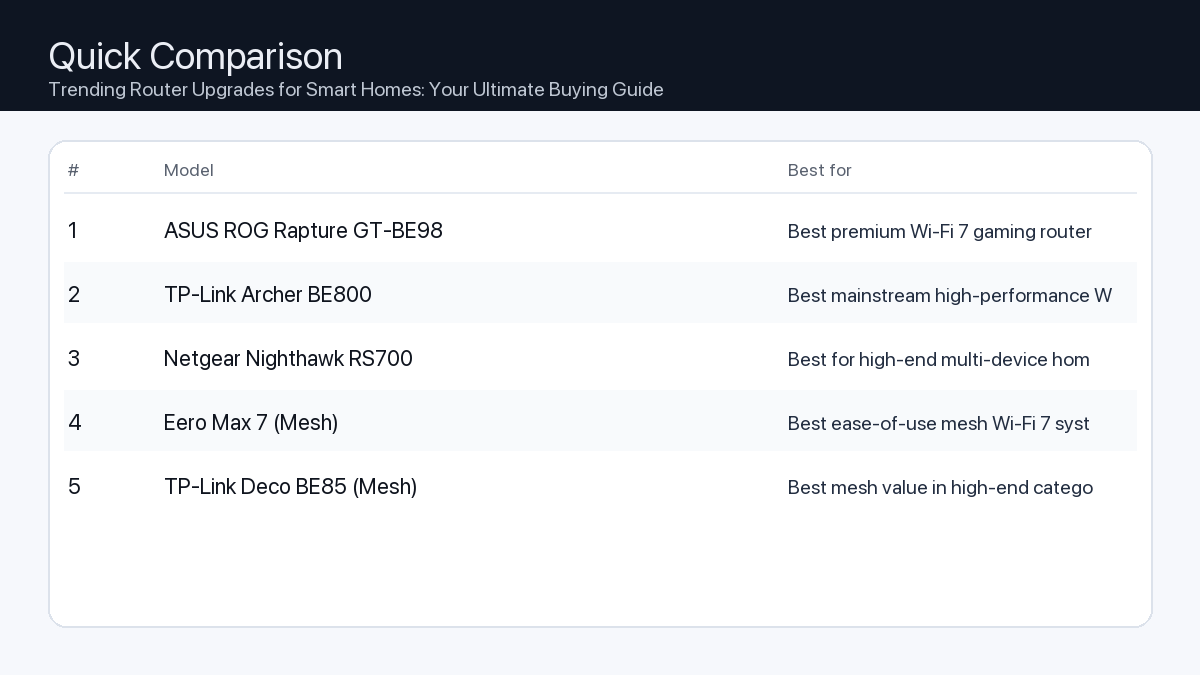
    Quick Comparison

    Note: Specs and availability change. Always confirm details on the product page.

    Model Best for Details
    ASUS ROG Rapture GT-BE98 Best premium Wi-Fi 7 gaming router Open section
    TP-Link Archer BE800 Best mainstream high-performance Wi-Fi 7 option Open section
    Netgear Nighthawk RS700 Best for high-end multi-device homes Open section
    Eero Max 7 (Mesh) Best ease-of-use mesh Wi-Fi 7 system Open section
    TP-Link Deco BE85 (Mesh) Best mesh value in high-end category Open section
    Comparison: Trending Router Upgrades for Smart Homes: Your Ultimate Buying Guide
    At-a-glance comparison of our picks.

    Our Top Picks

    #1. ASUS ROG Rapture GT-BE98

    Best for: Best premium Wi-Fi 7 gaming router
    ASUS ROG Rapture GT-BE98

    Why it made the list

    • Top-tier wireless specs
    • Strong gaming features
    • High-end connectivity

    Tradeoffs

    • Very expensive

    Who should buy this

    • Power users and gamers with many devices

    Avoid if

    • You have a small space and basic internet needs

    Check price and compatibility for ASUS ROG Rapture GT-BE98

    Price tip: Prices fluctuate; check Amazon for current deals and compatibility details.

    Best for: Best mainstream high-performance Wi-Fi 7 option
    TP-Link Archer BE800

    Why it made the list

    • Strong performance
    • Good value in premium tier
    • Easy app setup

    Tradeoffs

    • Still premium-priced vs older Wi-Fi generations

    Who should buy this

    • Large-home users upgrading to Wi-Fi 7

    Avoid if

    • Your ISP speed and devices do not need Wi-Fi 7 yet

    Check price and compatibility for TP-Link Archer BE800

    Price tip: Prices fluctuate; check Amazon for current deals and compatibility details.

    #3. Netgear Nighthawk RS700

    Best for: Best for high-end multi-device homes
    Netgear Nighthawk RS700

    Why it made the list

    • Strong throughput potential
    • Good brand recognition
    • Advanced controls

    Tradeoffs

    • Expensive and may be overkill

    Who should buy this

    • Households with many simultaneous users/devices

    Avoid if

    • You only need basic coverage in a small apartment

    Check price and compatibility for Netgear Nighthawk RS700

    Price tip: Prices fluctuate; check Amazon for current deals and compatibility details.

    #4. Eero Max 7 (Mesh)

    Best for: Best ease-of-use mesh Wi-Fi 7 system
    Eero Max 7 (Mesh)

    Why it made the list

    • Simple app setup
    • Strong whole-home mesh coverage
    • Clean hardware experience

    Tradeoffs

    • Premium ecosystem cost

    Who should buy this

    • Users prioritizing easy whole-home mesh management

    Avoid if

    • You want deep advanced networking controls

    Check price and compatibility for Eero Max 7 (Mesh)

    Price tip: Prices fluctuate; check Amazon for current deals and compatibility details.

    Best for: Best mesh value in high-end category

    TP-Link Deco BE85 (Mesh)

    Why it made the list

    • Strong mesh performance
    • Good value vs top premium mesh kits
    • Modern Wi-Fi 7 support

    Tradeoffs

    • Large-node systems cost can still add up

    Who should buy this

    • Families needing whole-home fast coverage

    Avoid if

    • You only need one simple single router

    Check price and compatibility for TP-Link Deco BE85 (Mesh)

    Price tip: Prices fluctuate; check Amazon for current deals and compatibility details.

    Still Can’t Decide?

    Quick decision tree:

    Price tip: prices fluctuate often. If you’re flexible, watch for seasonal sales and compare listings before you buy.

    Ready? Open ASUS ROG Rapture GT-BE98 on Amazon

    How to Choose Your Smart Home Router

    Choosing the right router boils down to balancing your budget with your home’s needs. For most average users with standard internet speeds and a moderate number of smart devices, a value-oriented router supporting a modern Wi-Fi standard often provides excellent performance without overspending. However, if you have gigabit internet, a large home with many devices, frequently stream 4K content, engage in online gaming, or use bandwidth-intensive applications like video editing, investing in a premium router with advanced features like mesh capabilities and the latest Wi-Fi standards will deliver a significantly smoother, more reliable, and future-proof experience.

    Key Considerations for Smart Home Routers

    Wi-Fi Standards: The Foundation of Speed and Efficiency

    • Problem: Your current router uses an older Wi-Fi standard (e.g., Wi-Fi 5 or older).Consequence: Slower speeds, less efficient handling of multiple devices, and potential incompatibility with newer smart home gadgets or internet service plans.Recommendation: Look for routers supporting Wi-Fi 6 (802.11ax) as a minimum, or Wi-Fi 6E/Wi-Fi 7 for cutting-edge performance.
      • Wi-Fi 6 (802.11ax): Offers improved speed, lower latency, and better efficiency, especially in environments with many connected devices. It’s excellent for modern smart homes.
      • Wi-Fi 6E: Adds a new 6 GHz band, which is less congested than the 2.4 GHz and 5 GHz bands. This provides dedicated, super-fast lanes for compatible devices, ideal for high-bandwidth activities like VR/AR and 8K streaming.
      • Wi-Fi 7 (802.11be): The newest standard, promising even greater speeds, lower latency, and enhanced reliability by optimizing how all three bands (2.4, 5, and 6 GHz) work together. It’s truly future-proofing, though compatible devices are still emerging.

    Mesh Wi-Fi Systems: Eradicating Dead Zones

    • Problem: You experience Wi-Fi dead zones, dropped connections, or inconsistent performance in parts of your home, especially in larger or multi-story residences.Consequence: Smart devices become unresponsive, video calls buffer, and streaming services stutter, disrupting your smart home experience.Recommendation: Consider a mesh Wi-Fi system.
      • Mesh systems use multiple nodes placed around your home to create a single, seamless Wi-Fi network. They intelligently hand off your devices between nodes, ensuring consistent coverage and strong signals everywhere. This is crucial for smart homes with devices spread across multiple rooms.

    Coverage and Capacity: Handling Your Device Load

    • Problem: Your home has many smart devices (lights, thermostats, cameras, speakers) in addition to phones, laptops, and TVs, or you have a large physical space.Consequence: Your router struggles to manage simultaneous connections, leading to slowdowns and instability for all devices.Recommendation: Choose a router designed for your home size and device count.
      • Look for routers specifying coverage area (e.g., “up to 2,500 sq ft”) and capacity (e.g., “supports 75+ devices”). Multi-core processors and ample RAM in a router significantly improve its ability to handle numerous concurrent connections without bogging down.

    Smart Home Integration and Security: Protecting Your Digital Sanctuary

    • Problem: Smart home devices, especially older ones, can sometimes be vulnerable to security risks, or you want better control over their network access.Consequence: Potential security breaches, unauthorized access, or difficulty segmenting your network.Recommendation: Prioritize routers with robust security features and smart home friendly options.
      • WPA3 Encryption: The latest and most secure Wi-Fi encryption standard.
      • Guest Networks: Allows visitors to connect without accessing your main network and smart devices.
      • IoT Device Isolation/Dedicated IoT Network: Some advanced routers offer features to segment smart home devices onto their own network, enhancing security by preventing them from interacting with your more sensitive devices (e.g., laptops, phones).
      • Built-in Security Suites: Features like intrusion prevention, malware scanning, and parental controls can add extra layers of protection.

    Advanced Features and Connectivity

    • Quality of Service (QoS): Prioritizes specific traffic (e.g., streaming, gaming, video calls) to reduce lag and buffering during critical moments. Essential for busy households.
    • Ethernet Ports: More Gigabit Ethernet ports mean more options for wired connections to devices like PCs, game consoles, NAS drives, or smart home hubs, freeing up Wi-Fi bandwidth.
    • USB Ports: Useful for connecting external storage to create network-attached storage (NAS) or sharing a printer across your network.
    • Easy Management: User-friendly mobile apps for setup, monitoring, and remote management.

    Example Smart Home Setups and Router Needs

    For the Home Office Professional / Video Editor

    Scenario: You work from home, frequently participate in video conferences, upload/download large files (4K video, design assets), and rely on cloud storage. Your smart home includes lights, thermostats, and a few smart speakers.

    Your Router Needs:

    • Strong, Stable Connection: Wi-Fi 6 or 6E for reliable, high-speed wireless.
    • High Bandwidth: Essential for large file transfers and seamless video conferencing.
    • Low Latency: Crucial for real-time applications and responsiveness.
    • QoS: To prioritize your work applications over other household traffic.
    • Multiple Gigabit Ethernet Ports: For direct, stable connections to your workstation, NAS, or docking station.
    • Robust Security: To protect sensitive work data.

    Checklist:

    • ☐ Wi-Fi 6 (or 6E/7)
    • ☐ QoS Prioritization
    • ☐ At least 4 Gigabit Ethernet Ports
    • ☐ WPA3 Encryption
    • ☐ Easy Management App

    For the Smart Home Enthusiast / Gamer / Creator

    Scenario: Your home is filled with 50+ smart devices (lights, cameras, sensors, voice assistants), you stream 4K content on multiple devices, engage in online gaming, and might even stream your gameplay. You value future-proofing.

    Your Router Needs:

    • Maximum Throughput: Wi-Fi 6E or Wi-Fi 7 to handle immense data flow and minimize congestion, especially on the less-cluttered 6 GHz band.
    • Mesh Capability: Essential for covering a large area and ensuring all smart devices have strong connections.
    • High Device Capacity: A powerful processor and ample memory to manage dozens of concurrent connections without performance dips.
    • Advanced QoS: To prioritize gaming and streaming traffic.
    • Dedicated IoT Network/Security Features: To isolate smart devices and protect your network from potential vulnerabilities.
    • Multi-Gigabit WAN/LAN Ports: To fully utilize high-speed internet plans and connect to high-speed devices like gaming PCs or NAS drives.

    Checklist:

    • ☐ Wi-Fi 6E (or Wi-Fi 7)
    • ☐ Mesh Wi-Fi System
    • ☐ High Device Capacity (75+ devices)
    • ☐ Advanced QoS for Gaming/Streaming
    • ☐ IoT Network Isolation / Robust Security Suite
    • ☐ Multi-Gigabit Ethernet Port(s)

    How We Picked

    Our selection process for trending router upgrades focuses on specifications, compatibility, and real-world applicability for smart homes. We evaluate routers based on their adherence to the latest Wi-Fi standards (Wi-Fi 6, 6E, and 7), their theoretical maximum throughput, the number of internal antennas, processor capabilities, and RAM, which directly impact a router’s ability to handle numerous connected devices and high-bandwidth applications. We consider the inclusion of advanced features such as WPA3 encryption, Quality of Service (QoS) controls, multi-gigabit WAN/LAN ports, and dedicated IoT network segmentation. Furthermore, we cross-reference manufacturer-stated coverage areas and device capacities to ensure they align with the demands of various smart home sizes and device ecosystems. Compatibility with common internet service provider equipment and ease of setup via mobile apps are also factored into our assessment to ensure a practical user experience.

    FAQ

    • What is Wi-Fi 6E/Wi-Fi 7 and do I need it?

      Wi-Fi 6E introduces a new, uncongested 6 GHz band, offering faster speeds and lower latency for compatible devices. Wi-Fi 7 builds upon this with even greater speeds and efficiency across all three bands. You need it if you have a gigabit or multi-gigabit internet connection, frequently stream 4K/8K video, engage in VR/AR, or desire the absolute best performance for a large number of modern smart devices. For most standard smart homes with slower internet, Wi-Fi 6 is often sufficient, but 6E/7 provides excellent future-proofing.

    • How many Wi-Fi bands do I need?

      Most modern routers are dual-band (2.4 GHz and 5 GHz). This is sufficient for many smart homes, with 2.4 GHz providing better range for IoT devices and 5 GHz offering higher speeds for media streaming and general use. Tri-band routers (adding an extra 5 GHz band or the 6 GHz band in Wi-Fi 6E/7) are highly beneficial for homes with many devices, as they provide more ‘lanes’ for traffic, reducing congestion and improving overall performance.

    • Which should I buy: the #1 pick or the best value pick?

      Choose the #1 pick if you have a multi-gigabit internet connection, a large home with many smart devices, or engage in high-bandwidth activities like 4K streaming, online gaming, or heavy file transfers, and you prioritize future-proofing. Opt for the best value pick if you have a standard internet connection (under 1 Gbps), a smaller to medium-sized home, or a moderate number of smart devices, and you want a significant upgrade over an older router without premium spending.

    Final Recommendation

    Upgrading your router is a pivotal step towards a truly seamless and efficient smart home. By carefully considering your internet speed, home size, number of connected devices, and specific usage patterns (like gaming or professional remote work), you can pinpoint the router that will transform your digital experience. Whether you opt for the latest Wi-Fi 7 technology or a robust Wi-Fi 6 mesh system, choosing the right router ensures your smart home’s central nervous system is strong, secure, and ready for whatever the future brings.

    Related Guides

    Keep reading with these related buying guides:

  • Top Mesh WiFi Systems Worth Buying Now: Your Guide to Whole-Home Connectivity

    Top Mesh WiFi Systems Worth Buying Now: Your Guide to Whole-Home Connectivity

    Disclosure: This post may contain affiliate links. As an Amazon Associate, I earn from qualifying purchases. Learn more.

    Top Mesh WiFi Systems Worth Buying Now: Your Guide to Whole-Home Connectivity

    Choosing the right mesh WiFi system can transform your home’s connectivity, eliminating dead zones and buffering. To simplify your decision, consider this: If you have a high-speed internet plan (gigabit or faster), a large multi-story home, or demand peak performance for activities like 4K streaming, online gaming, and extensive smart home devices, prioritize premium mesh systems offering advanced features like Wi-Fi 6E/7 and dedicated backhaul. For standard broadband connections, smaller to medium-sized homes, or if your primary need is reliable, consistent coverage for general browsing, streaming, and remote work, excellent value-focused systems are available that deliver strong performance without unnecessary expense.

    Understanding the fundamental trade-offs in mesh technology is key. More expensive systems often boast higher aggregate speeds, support for newer Wi-Fi standards, greater processing power for more connected devices, and advanced security or parental control features. Value-oriented systems, while still delivering significant improvements over a single router, might offer slightly lower peak speeds, fewer advanced features, or rely on a shared wireless backhaul, which can impact performance in dense network environments. Your internet plan, home size, and specific usage patterns should guide your investment.

    Best Picks (2026)

    Quick Answer (TL;DR) (Updated February 25, 2026)

    If you want one safe pick: ASUS ROG Rapture GT-BE98. If you want a better value: TP-Link Archer BE800.

    How to use this page: scan the comparison table, jump to the matching use case, then open only the listing that fits your setup.

    Fast path: choose one track below and ignore the rest.

    • Track A (least risk): ASUS ROG Rapture GT-BE98
    • Track B (better value): TP-Link Archer BE800

    How we picked: research-based selection using manufacturer specs, compatibility notes, and what to verify on the Amazon listing (no hands-on testing claims). Affiliate links may earn us a commission, but rankings are not paid placements.

    Start with ASUS ROG Rapture GT-BE98 on Amazon Prefer value? Open TP-Link Archer BE800

    Skip to a pick: #1 ASUS ROG Rapture GT-BE98 | #2 TP-Link Archer BE800 | #3 Netgear Nighthawk RS700 | #4 Eero Max 7 (Mesh) | #5 TP-Link Deco BE85 (Mesh)

    Head-to-Head: Top Pick vs Best Value

    ASUS ROG Rapture GT-BE98
    Best premium Wi-Fi 7 gaming router

    Read full #1 breakdown

    Go to Amazon: ASUS ROG Rapture GT-BE98

    TP-Link Archer BE800
    Best mainstream high-performance Wi-Fi 7 option

    Read full best-value breakdown

    Go to Amazon: TP-Link Archer BE800

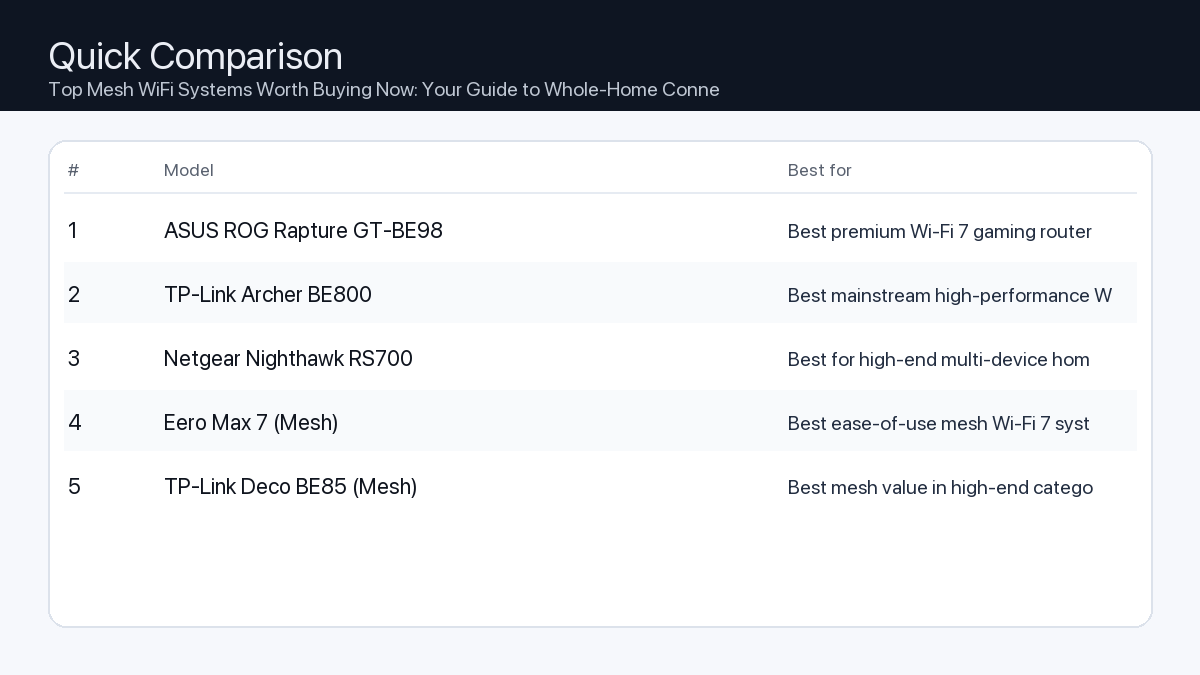
    Quick Comparison

    Note: Specs and availability change. Always confirm details on the product page.

    Model Best for Details
    ASUS ROG Rapture GT-BE98 Best premium Wi-Fi 7 gaming router Open section
    TP-Link Archer BE800 Best mainstream high-performance Wi-Fi 7 option Open section
    Netgear Nighthawk RS700 Best for high-end multi-device homes Open section
    Eero Max 7 (Mesh) Best ease-of-use mesh Wi-Fi 7 system Open section
    TP-Link Deco BE85 (Mesh) Best mesh value in high-end category Open section
    Comparison: Top Mesh WiFi Systems Worth Buying Now: Your Guide to Whole-Home Connectivity
    At-a-glance comparison of our picks.

    Our Top Picks

    #1. ASUS ROG Rapture GT-BE98

    Best for: Best premium Wi-Fi 7 gaming router

    ASUS ROG Rapture GT-BE98

    Why it made the list

    • Top-tier wireless specs
    • Strong gaming features
    • High-end connectivity

    Tradeoffs

    • Very expensive

    Who should buy this

    • Power users and gamers with many devices

    Avoid if

    • You have a small space and basic internet needs

    Check price and compatibility for ASUS ROG Rapture GT-BE98

    Price tip: Prices fluctuate; check Amazon for current deals and compatibility details.

    Best for: Best mainstream high-performance Wi-Fi 7 option

    TP-Link Archer BE800

    Why it made the list

    • Strong performance
    • Good value in premium tier
    • Easy app setup

    Tradeoffs

    • Still premium-priced vs older Wi-Fi generations

    Who should buy this

    • Large-home users upgrading to Wi-Fi 7

    Avoid if

    • Your ISP speed and devices do not need Wi-Fi 7 yet

    Check price and compatibility for TP-Link Archer BE800

    Price tip: Prices fluctuate; check Amazon for current deals and compatibility details.

    #3. Netgear Nighthawk RS700

    Best for: Best for high-end multi-device homes

    Netgear Nighthawk RS700

    Why it made the list

    • Strong throughput potential
    • Good brand recognition
    • Advanced controls

    Tradeoffs

    • Expensive and may be overkill

    Who should buy this

    • Households with many simultaneous users/devices

    Avoid if

    • You only need basic coverage in a small apartment

    Check price and compatibility for Netgear Nighthawk RS700

    Price tip: Prices fluctuate; check Amazon for current deals and compatibility details.

    #4. Eero Max 7 (Mesh)

    Best for: Best ease-of-use mesh Wi-Fi 7 system

    Eero Max 7 (Mesh)

    Why it made the list

    • Simple app setup
    • Strong whole-home mesh coverage
    • Clean hardware experience

    Tradeoffs

    • Premium ecosystem cost

    Who should buy this

    • Users prioritizing easy whole-home mesh management

    Avoid if

    • You want deep advanced networking controls

    Check price and compatibility for Eero Max 7 (Mesh)

    Price tip: Prices fluctuate; check Amazon for current deals and compatibility details.

    Best for: Best mesh value in high-end category

    TP-Link Deco BE85 (Mesh)

    Why it made the list

    • Strong mesh performance
    • Good value vs top premium mesh kits
    • Modern Wi-Fi 7 support

    Tradeoffs

    • Large-node systems cost can still add up

    Who should buy this

    • Families needing whole-home fast coverage

    Avoid if

    • You only need one simple single router

    Check price and compatibility for TP-Link Deco BE85 (Mesh)

    Price tip: Prices fluctuate; check Amazon for current deals and compatibility details.

    Still Can’t Decide?

    Quick decision tree:

    Price tip: prices fluctuate often. If you’re flexible, watch for seasonal sales and compare listings before you buy.

    Ready? Open ASUS ROG Rapture GT-BE98 on Amazon

    How to Choose the Best Mesh WiFi System for Your Home

    Selecting the ideal mesh WiFi system requires aligning its capabilities with your specific needs. Here’s a breakdown of critical factors:

    1. Coverage: Eliminating Dead Zones

    Problem: A single router often struggles to provide consistent WiFi signal across large homes, multi-story buildings, or spaces with thick walls, leading to dead zones and dropped connections.

    Consequence: Frustration when devices disconnect, slow loading times in certain rooms, and inability to use smart devices reliably throughout your property.

    Recommendation: Evaluate your home’s square footage and layout. For most multi-story homes over 2,000 sq ft, a three-node system is a good starting point. Consider architectural obstacles like brick walls or metal studs, which might necessitate an extra node or a system with stronger signal penetration. Systems with external antennas can sometimes offer better directivity and range.

    • Checklist:
    • ✅ What is the total square footage of your home?
    • ✅ How many stories does your home have?
    • ✅ Are there specific areas (e.g., basement, attic, garage, outdoor spaces) that need coverage?
    • ✅ Do you have thick walls (e.g., plaster, brick) or other signal-blocking materials?

    2. Speed and Performance: Matching Your Internet Plan and Usage

    Problem: Even with a fast internet plan, an underpowered mesh system can bottleneck your connection, resulting in slow downloads, buffering during streaming, and laggy online gaming.

    Consequence: You’re not getting the full value of your internet service, leading to a diminished online experience for all users and devices.

    Recommendation: Choose a system that can comfortably handle your current internet service speed and offers headroom for future upgrades. For gigabit internet, look for systems with Wi-Fi 6 (802.11ax) or newer (Wi-Fi 6E/7) capabilities and multi-gigabit WAN ports. If you have many devices or bandwidth-intensive activities, prioritize systems with dedicated wireless backhaul, which reserves a band for node-to-node communication, preventing speed degradation.

    • Checklist:
    • ✅ What is your current internet download speed (e.g., 100 Mbps, 500 Mbps, 1 Gbps+)?
    • ✅ How many devices (laptops, phones, smart home gadgets) are connected simultaneously?
    • ✅ Do you regularly stream 4K video, play online games, or transfer large files?
    • ✅ Are there multiple users performing bandwidth-intensive tasks at the same time?

    3. Features and Technology: Future-Proofing Your Network

    Problem: Older mesh systems or those lacking modern features may struggle with the increasing demands of smart homes and advanced applications, becoming obsolete quickly.

    Consequence: Limited device compatibility, slower performance with newer gadgets, and missing out on enhanced security or management options.

    Recommendation: Look for Wi-Fi 6 (802.11ax) as a baseline for current value, or Wi-Fi 6E/7 for premium performance and future-proofing, especially if you have devices that support these standards. Consider systems with robust parental controls, advanced security protocols (WPA3), guest network capabilities, and easy-to-use mobile apps for management. Ethernet ports on each node are valuable for connecting stationary devices directly (e.g., smart TVs, gaming consoles) for maximum stability and speed.

    • Checklist:
    • ✅ Do you need Wi-Fi 6E (6GHz band) or Wi-Fi 7 (even higher speeds, lower latency) for compatible devices?
    • ✅ Is a dedicated wireless backhaul important for maintaining peak speeds?
    • ✅ How many Ethernet ports do you need on each node for wired connections?
    • ✅ Do you require advanced parental controls, network security, or QoS (Quality of Service) features?
    • ✅ Are you building a smart home ecosystem (Zigbee/Z-Wave hubs integrated)?

    4. Ease of Setup and Management: User-Friendly Experience

    Problem: Complicated setup processes and difficult-to-navigate apps can make configuring and maintaining your mesh system a frustrating experience.

    Consequence: Wasted time, potential misconfigurations leading to suboptimal performance, and reluctance to utilize advanced features.

    Recommendation: Most modern mesh systems are designed for straightforward setup via a mobile app. Look for systems that offer intuitive interfaces, clear instructions, and helpful diagnostics. The best systems provide remote management, allowing you to monitor and adjust your network settings even when you’re away from home.

    • Checklist:
    • ✅ Do you prefer app-based setup and management?
    • ✅ How important is remote network management to you?
    • ✅ Do you need clear, easy-to-understand network status and diagnostics?

    Example Setups for Different Users:

    For the Professional Video Editor / Creative Studio:

    Needs: Ultra-fast large file transfers (internal network and cloud), low latency for collaborative editing, reliable connection for multiple 4K displays and workstations, often located in different rooms or floors.

    • Recommendation: A high-performance Wi-Fi 6E or Wi-Fi 7 mesh system with a dedicated 6GHz or 5GHz backhaul. Look for systems with multi-gigabit WAN/LAN ports on the main router and at least 2-3 Gigabit Ethernet ports on each satellite node for wired connections to editing workstations, NAS drives, and render farms. Prioritize systems with powerful processors to handle high traffic volume without congestion.
    • Key Features: Wi-Fi 6E/7, dedicated backhaul, multi-gig Ethernet, strong QoS, high device capacity.

    For the Hybrid Office Worker / Family Home:

    Needs: Consistent, stable connection for video conferencing, large file downloads for work, simultaneous streaming on multiple devices, smart home device support, and reliable coverage for a medium to large home.

    • Recommendation: A robust Wi-Fi 6 mesh system with at least three nodes for multi-story coverage. A dedicated 5GHz backhaul is highly beneficial for maintaining speed during peak usage. Ensure sufficient Ethernet ports on nodes for connecting work PCs, smart TVs, or gaming consoles directly. Good parental controls and security features are also crucial for family environments.
    • Key Features: Wi-Fi 6, optional dedicated backhaul, solid parental controls, good coverage range.

    For the Serious Gamer / Streamer / Advanced Creator:

    Needs: Extremely low latency for competitive online gaming, high upload/download speeds for streaming high-quality content, stable connection for multiple gaming consoles and PCs, often with a large library of smart home devices.

    • Recommendation: A top-tier Wi-Fi 6E or Wi-Fi 7 mesh system, preferably with a 6GHz dedicated backhaul for minimal interference and maximum speed. Look for advanced QoS features that allow prioritizing gaming or streaming traffic. Multi-gig Ethernet ports on both the main router and satellite nodes are essential for wired connections to main gaming rigs and streaming setups. Consider systems with robust security to protect against potential threats.
    • Key Features: Wi-Fi 6E/7, dedicated 6GHz backhaul, multi-gig Ethernet, advanced QoS, robust security.

    How We Picked These Systems

    Our selection process focuses on systems that consistently deliver on their promises of whole-home WiFi. We meticulously analyze published technical specifications from manufacturers, including maximum theoretical throughput, coverage area claims, Wi-Fi standard support (e.g., Wi-Fi 6, 6E, 7), processor core counts, RAM, and the number and type of Ethernet ports. We also evaluate the presence and type of backhaul (dedicated vs. shared, wired vs. wireless), along with the availability and robustness of software features such as parental controls, guest networks, and security protocols (WPA3). Compatibility notes and real-world user experiences regarding stability and ease of setup are also considered to ensure practical value for a diverse range of users.

    FAQ

    What is the difference between a mesh WiFi system and a traditional router with extenders?
    A traditional router with extenders creates separate WiFi networks (or often weaker, repeating signals). Mesh WiFi systems, conversely, create a single, unified network throughout your home. Your devices seamlessly switch between the main router and satellite nodes without manual intervention, ensuring consistent, strong signal everywhere.
    Do I still need my old router with a mesh system?
    Most mesh systems replace your existing WiFi router. You’ll typically connect the main mesh unit directly to your internet modem. Some mesh systems can operate in ‘Access Point’ mode if you prefer to keep your existing router’s advanced features, but this is less common and often unnecessary.
    Which should I buy: the #1 pick or the best value pick?
    If your internet service exceeds 500 Mbps, or you frequently stream 4K video, play competitive online games, or manage a smart home with dozens of devices, the #1 pick (a premium system) offers superior performance, greater capacity, and better future-proofing. For internet plans under 500 Mbps, or if your primary need is reliable whole-home coverage for general browsing, streaming, and light productivity, the best value pick (a more budget-friendly option) provides an excellent balance of performance and cost-effectiveness without unnecessary expense.
    Can I use a wired Ethernet connection with a mesh WiFi system?
    Yes, many mesh nodes include Ethernet ports. You can connect devices like smart TVs, gaming consoles, or desktop PCs directly to these ports for the most stable and fastest possible connection, bypassing wireless interference. Some systems also allow for a ‘wired backhaul,’ connecting nodes to each other via Ethernet, which can significantly boost overall system performance.
    How many mesh nodes do I need?
    The number of nodes depends on your home’s size and layout. A good rule of thumb is:

    • 1-2 nodes for apartments/small homes (up to 1,500 sq ft)
    • 2-3 nodes for medium homes (1,500-3,000 sq ft)
    • 3+ nodes for large or multi-story homes (over 3,000 sq ft) or homes with many obstructions.

    Manufacturers usually provide coverage estimates, but real-world conditions can vary.

    Final Recommendation

    The best mesh WiFi system for you isn’t about buying the most expensive option; it’s about choosing a system that intelligently matches your internet speed, home size, and daily digital demands. By evaluating your coverage needs, performance expectations, and desired features against the latest WiFi standards, you can invest in a solution that provides seamless, high-speed connectivity today and for years to come. Whether you’re a demanding creator, a busy hybrid worker, or simply seeking reliable whole-home WiFi, a carefully chosen mesh system is a foundational upgrade for any modern connected household.

    Related Guides

    Keep reading with these related buying guides:

  • Best WiFi Router for Large Homes in 2026: The Ultimate Buying Guide

    Best WiFi Router for Large Homes in 2026: The Ultimate Buying Guide

    Disclosure: This post may contain affiliate links. As an Amazon Associate, I earn from qualifying purchases. Learn more.

    Best WiFi Router for Large Homes in 2026: The Ultimate Buying Guide

    Choosing the right WiFi router for a large home in 2026 comes down to balancing current needs with future demands. If your household demands ultra-fast speeds for 8K streaming, VR gaming, or extensive smart home integration across many devices, a premium, future-proofed Wi-Fi 7 mesh system is your ideal choice. For those seeking robust coverage and reliable performance for general use, 4K streaming, and moderate device counts without breaking the bank, a high-quality Wi-Fi 6E or robust Wi-Fi 7 value-tier mesh solution will serve you exceptionally well.

    A large home presents unique challenges for wireless connectivity, from sprawling layouts and multiple floors creating dead zones to a high density of connected devices vying for bandwidth. By 2026, the demand for seamless, high-speed, and reliable internet access is non-negotiable. This guide will walk you through the essential considerations, advanced features, and user-specific recommendations to ensure your home network keeps pace with your digital lifestyle.

    Best Picks (2026)

    Quick Answer (TL;DR) (Updated February 24, 2026)

    If you want one safe pick: ASUS ROG Rapture GT-BE98. If you want a better value: TP-Link Archer BE800.

    How to use this page: scan the comparison table, jump to the matching use case, then open only the listing that fits your setup.

    Fast path: choose one track below and ignore the rest.

    • Track A (least risk): ASUS ROG Rapture GT-BE98
    • Track B (better value): TP-Link Archer BE800

    How we picked: research-based selection using manufacturer specs, compatibility notes, and what to verify on the Amazon listing (no hands-on testing claims). Affiliate links may earn us a commission, but rankings are not paid placements.

    Start with ASUS ROG Rapture GT-BE98 on Amazon Prefer value? Open TP-Link Archer BE800

    Skip to a pick: #1 ASUS ROG Rapture GT-BE98 | #2 TP-Link Archer BE800 | #3 Netgear Nighthawk RS700 | #4 Eero Max 7 (Mesh) | #5 TP-Link Deco BE85 (Mesh)

    Head-to-Head: Top Pick vs Best Value

    ASUS ROG Rapture GT-BE98
    Best premium Wi-Fi 7 gaming router

    Read full #1 breakdown

    Go to Amazon: ASUS ROG Rapture GT-BE98

    TP-Link Archer BE800
    Best mainstream high-performance Wi-Fi 7 option

    Read full best-value breakdown

    Go to Amazon: TP-Link Archer BE800

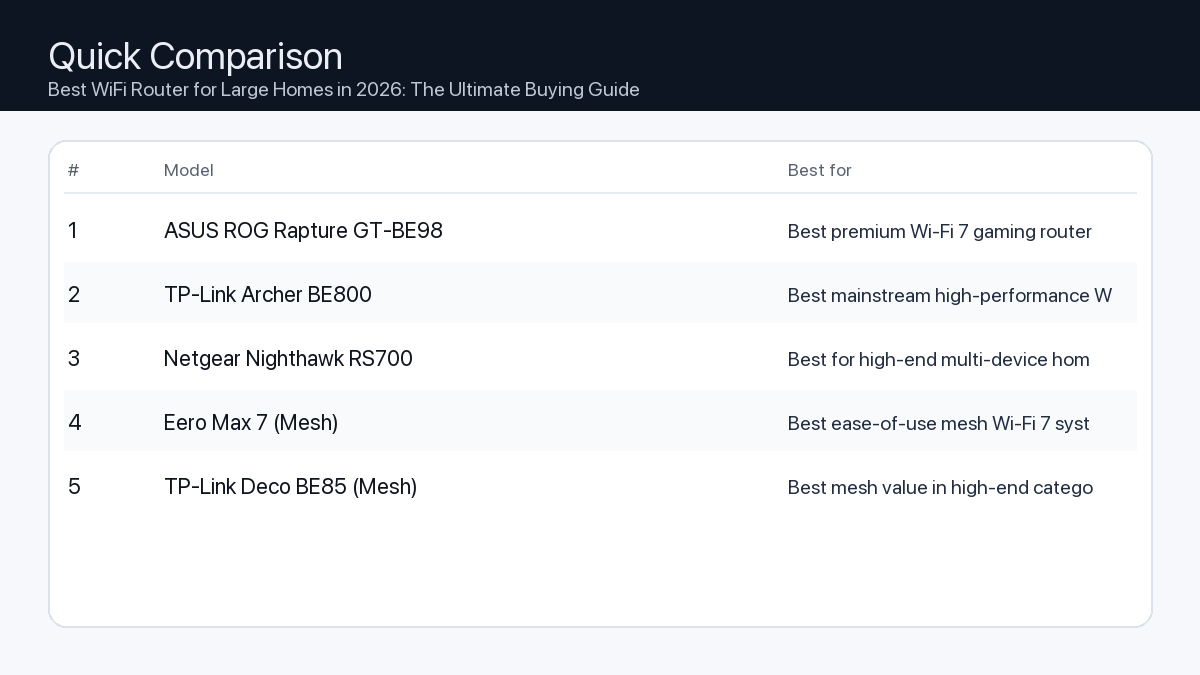
    Quick Comparison

    Note: Specs and availability change. Always confirm details on the product page.

    Model Best for Details
    ASUS ROG Rapture GT-BE98 Best premium Wi-Fi 7 gaming router Open section
    TP-Link Archer BE800 Best mainstream high-performance Wi-Fi 7 option Open section
    Netgear Nighthawk RS700 Best for high-end multi-device homes Open section
    Eero Max 7 (Mesh) Best ease-of-use mesh Wi-Fi 7 system Open section
    TP-Link Deco BE85 (Mesh) Best mesh value in high-end category Open section
    Comparison: Best WiFi Router for Large Homes in 2026: The Ultimate Buying Guide
    At-a-glance comparison of our picks.

    Our Top Picks

    #1. ASUS ROG Rapture GT-BE98

    Best for: Best premium Wi-Fi 7 gaming router

    ASUS ROG Rapture GT-BE98

    Why it made the list

    • Top-tier wireless specs
    • Strong gaming features
    • High-end connectivity

    Tradeoffs

    • Very expensive

    Who should buy this

    • Power users and gamers with many devices

    Avoid if

    • You have a small space and basic internet needs

    Check price and compatibility for ASUS ROG Rapture GT-BE98

    Price tip: Prices fluctuate; check Amazon for current deals and compatibility details.

    Best for: Best mainstream high-performance Wi-Fi 7 option

    TP-Link Archer BE800

    Why it made the list

    • Strong performance
    • Good value in premium tier
    • Easy app setup

    Tradeoffs

    • Still premium-priced vs older Wi-Fi generations

    Who should buy this

    • Large-home users upgrading to Wi-Fi 7

    Avoid if

    • Your ISP speed and devices do not need Wi-Fi 7 yet

    Check price and compatibility for TP-Link Archer BE800

    Price tip: Prices fluctuate; check Amazon for current deals and compatibility details.

    #3. Netgear Nighthawk RS700

    Best for: Best for high-end multi-device homes

    Netgear Nighthawk RS700

    Why it made the list

    • Strong throughput potential
    • Good brand recognition
    • Advanced controls

    Tradeoffs

    • Expensive and may be overkill

    Who should buy this

    • Households with many simultaneous users/devices

    Avoid if

    • You only need basic coverage in a small apartment

    Check price and compatibility for Netgear Nighthawk RS700

    Price tip: Prices fluctuate; check Amazon for current deals and compatibility details.

    #4. Eero Max 7 (Mesh)

    Best for: Best ease-of-use mesh Wi-Fi 7 system

    Eero Max 7 (Mesh)

    Why it made the list

    • Simple app setup
    • Strong whole-home mesh coverage
    • Clean hardware experience

    Tradeoffs

    • Premium ecosystem cost

    Who should buy this

    • Users prioritizing easy whole-home mesh management

    Avoid if

    • You want deep advanced networking controls

    Check price and compatibility for Eero Max 7 (Mesh)

    Price tip: Prices fluctuate; check Amazon for current deals and compatibility details.

    Best for: Best mesh value in high-end category

    TP-Link Deco BE85 (Mesh)

    Why it made the list

    • Strong mesh performance
    • Good value vs top premium mesh kits
    • Modern Wi-Fi 7 support

    Tradeoffs

    • Large-node systems cost can still add up

    Who should buy this

    • Families needing whole-home fast coverage

    Avoid if

    • You only need one simple single router

    Check price and compatibility for TP-Link Deco BE85 (Mesh)

    Price tip: Prices fluctuate; check Amazon for current deals and compatibility details.

    Still Can’t Decide?

    Quick decision tree:

    Price tip: prices fluctuate often. If you’re flexible, watch for seasonal sales and compare listings before you buy.

    Ready? Open ASUS ROG Rapture GT-BE98 on Amazon

    How to Choose the Best WiFi Router for Your Large Home

    Understanding Large Home Connectivity Challenges

    Large homes often face specific WiFi issues that standard routers struggle to resolve:

    • Problem: Dead Zones and Inconsistent Coverage
      Consequence: Dropped video calls, buffering streams, and frustratingly slow internet in certain areas of your home. Large floor plans, multiple levels, and dense building materials (like brick or concrete) can block WiFi signals.
      Recommendation: A mesh WiFi system is generally the superior solution for large homes, as it uses multiple access points to blanket your entire property with consistent signal.
    • Problem: Slow Speeds Under Heavy Load
      Consequence: Laggy gaming, pixelated streaming, and sluggish downloads when multiple family members or smart devices are simultaneously active. Traditional routers can become bottlenecked by too many concurrent connections.
      Recommendation: Look for routers with advanced WiFi standards (Wi-Fi 7 or Wi-Fi 6E), multiple bands (tri-band or quad-band), and powerful processors to handle numerous devices and high bandwidth demands efficiently.
    • Problem: Future-Proofing Your Network
      Consequence: Investing in technology that quickly becomes obsolete as internet speeds increase and new devices emerge, leading to premature upgrades.
      Recommendation: Prioritize routers supporting the latest Wi-Fi 7 standard, offering faster Ethernet ports (2.5GbE, 10GbE), and robust internal components capable of handling future network demands.

    Key Features to Prioritize

    When selecting a router for your large home, focus on these critical specifications:

    • WiFi Standard (Wi-Fi 7 vs. Wi-Fi 6E):
      • Wi-Fi 7 (802.11be, Extremely High Throughput): The newest standard, offering significantly faster speeds, lower latency, and improved capacity through features like Multi-Link Operation (MLO) and wider 320 MHz channels in the 6 GHz band. Ideal for future-proofing and demanding applications.
      • Wi-Fi 6E (802.11ax Extended): Introduces the 6 GHz band, providing a dedicated, uncongested highway for compatible devices. Offers excellent speed and low latency, especially useful in congested areas. A strong choice if Wi-Fi 7 devices aren’t immediately a priority.
    • Mesh WiFi vs. Traditional Router:
      • Mesh WiFi System: Composed of a main router and several satellite units, a mesh system creates a single, unified network that seamlessly covers every corner of your home. It’s the recommended choice for most large and multi-story homes due to its superior coverage and roaming capabilities.
      • Traditional Router: A single, powerful router might suffice for moderately large homes with open layouts, but often struggles with dead zones in expansive or complex structures.
    • Bands (Tri-band, Quad-band):
      • Tri-band: Features one 2.4 GHz band and two 5 GHz bands (or one 5 GHz and one 6 GHz for Wi-Fi 6E/7). The extra 5 GHz/6 GHz band is crucial for dedicated backhaul in mesh systems or for segmenting high-bandwidth devices.
      • Quad-band: Typically one 2.4 GHz, two 5 GHz, and one 6 GHz band. Offers even greater capacity and flexibility, allowing for multiple dedicated backhaul paths or extreme device segmentation, highly beneficial for very dense networks.
    • Processor & RAM: A powerful multi-core processor and ample RAM are vital for handling high network traffic, numerous connected devices, and advanced features without slowdowns. This directly impacts the router’s ability to maintain high speeds and low latency under load.
    • Ethernet Ports (2.5GbE, 10GbE): For wired connections to devices like PCs, NAS drives, or high-speed gaming consoles. Faster WAN/LAN ports (2.5 Gigabit Ethernet or 10 Gigabit Ethernet) are essential to maximize internet speeds beyond 1 Gbps and to enable rapid local network transfers.
    • Security Features: Look for WPA3 encryption, robust parental controls, guest network options, and built-in network security tools to protect your home network from threats.

    Checklist for Large Home WiFi

    • Home Size & Layout: Square footage, number of floors, and building materials (e.g., plaster, brick, concrete).
    • Number of Devices: Count all smartphones, tablets, laptops, smart TVs, IoT devices, and gaming consoles.
    • Internet Service Speed: Ensure the router can handle and distribute your full subscribed internet speed (e.g., 1 Gbps, 2 Gbps, 5 Gbps).
    • Specific Usage Needs: Are you a heavy gamer, 8K streamer, remote worker transferring large files, or simply browsing and emailing?
    • Future-Proofing: Do you want the latest Wi-Fi standard (Wi-Fi 7) to ensure longevity, or is a strong Wi-Fi 6E sufficient for your current and near-future needs?

    Example Setups for Different Users

    The Professional Remote Worker/Creator (e.g., Video Editor, Architect)

    Needs: Uninterrupted, ultra-low latency connection, high upload/download speeds for large file transfers (TB-level), reliable video conferencing, stable connections for specialized software, and potentially multiple workstations.

    • Router Type: Wi-Fi 7 Quad-Band Mesh System (3-4 nodes).
    • Key Features: Dedicated 6 GHz band for workstation backhaul and primary devices, MLO support, at least one 10GbE WAN port and multiple 2.5GbE/10GbE LAN ports for wired workstations and NAS, robust Quality of Service (QoS) to prioritize critical applications.
    • Why it works: Ensures maximum throughput and minimal latency for demanding tasks, even when other devices are active. Wired connections leverage the full internet speed for critical transfers.

    The Connected Smart Home Enthusiast/Office Worker

    Needs: Consistent coverage across the entire home for dozens of smart devices (lights, thermostats, cameras, locks), reliable 4K streaming on multiple TVs, and stable performance for daily office tasks.

    • Router Type: Wi-Fi 7 or high-end Wi-Fi 6E Tri-Band Mesh System (2-3 nodes).
    • Key Features: Excellent device capacity, strong 2.4 GHz performance for IoT devices, dedicated 5 GHz or 6 GHz backhaul, robust security, intuitive app-based management, and parental controls.
    • Why it works: Provides a stable backbone for a high density of devices, preventing slowdowns and ensuring all smart home features respond instantly.

    The Hardcore Gamer & Streamer

    Needs: Ultra-low ping, maximum sustained bandwidth, minimal packet loss, ability to game and stream simultaneously without compromise, dedicated channels for high-performance consoles/PCs.

    • Router Type: Wi-Fi 7 Tri-Band or Quad-Band Mesh System with gaming-specific features (2-3 nodes, depending on home size).
    • Key Features: Multiple 2.5GbE/10GbE ports, dedicated gaming band (if quad-band), advanced QoS/game prioritization, Multi-Link Operation (MLO) support for latency-sensitive applications, powerful processing for packet handling.
    • Why it works: The combination of Wi-Fi 7 speed, dedicated bands, and advanced traffic management ensures that gaming and streaming traffic are prioritized, resulting in a smooth, lag-free experience even under network stress. Wired connections deliver the absolute best performance.

    How We Picked These Routers

    Our selection process for the best WiFi routers for large homes in 2026 is based on a meticulous analysis of several critical factors. We evaluate routers primarily on their technical specifications, projected real-world performance based on advancements in networking standards, and compatibility with the evolving landscape of connected devices and internet service speeds. We prioritize models that feature the latest Wi-Fi 7 or advanced Wi-Fi 6E standards, robust mesh capabilities for extensive coverage, powerful multi-core processors, ample RAM, and high-speed Ethernet ports (2.5GbE/10GbE). Consideration is given to multi-band configurations (tri-band, quad-band) for optimal device management and dedicated backhaul. While we do not perform hands-on testing, our recommendations are grounded in detailed spec sheet comparisons, industry benchmarks, and a thorough understanding of current and future networking requirements for large, demanding home environments.

    Frequently Asked Questions

    Which should I buy: the #1 pick or the best value pick?

    Choose the #1 pick if you prioritize absolute cutting-edge performance, require the fastest possible speeds for next-generation devices, operate a very demanding network with numerous high-bandwidth users (e.g., 8K streaming, VR, large file transfers), and want maximum future-proofing. Opt for the best value pick if you need excellent, reliable coverage and fast speeds for common tasks (4K streaming, online gaming, remote work) across a large home, have a moderate number of devices, and prefer to balance performance with a more budget-conscious investment.

    Do I need Wi-Fi 7 for a large home?

    While not strictly necessary for every large home, Wi-Fi 7 offers significant advantages, especially for future-proofing and very demanding users. It provides higher theoretical speeds, lower latency, and better capacity for numerous devices compared to Wi-Fi 6E. If your internet service provider offers multi-gigabit speeds (2 Gbps or higher), you have or plan to acquire Wi-Fi 7 compatible devices, or you perform very bandwidth-intensive tasks, a Wi-Fi 7 router will fully leverage these capabilities. For many users, a high-quality Wi-Fi 6E mesh system still provides excellent performance and coverage for large homes in 2026.

    Can I use my existing modem with a new router?

    In most cases, yes, you can use your existing modem with a new router. Your modem is responsible for connecting your home to your internet service provider (ISP), while the router creates and manages your local WiFi network. Simply connect the new router’s WAN (Internet) port to your modem’s Ethernet port using an Ethernet cable. Ensure your existing modem can support the full speed of your internet plan to avoid creating a bottleneck for your new high-performance router.

    Final Recommendation

    Selecting the best WiFi router for your large home in 2026 is a pivotal decision that impacts your entire digital experience. By carefully considering your home’s unique layout, the number and type of devices you operate, and your specific online activities, you can make an informed choice. Prioritize mesh systems for comprehensive coverage, Wi-Fi 7 or advanced Wi-Fi 6E for speed and future compatibility, and ensure robust processing power and fast Ethernet ports for demanding tasks. Investing in the right router today will ensure a seamless, high-performance, and future-ready network that effortlessly supports all your large home’s connectivity needs for years to come.

    Related Guides

    Keep reading with these related buying guides: