Etiket: remote work

  • Best Webcam for Remote Meetings & Zoom Calls (2026): A Comprehensive Buying Guide

    Best Webcam for Remote Meetings & Zoom Calls (2026): A Comprehensive Buying Guide

    Disclosure: This post may contain affiliate links. As an Amazon Associate, I earn from qualifying purchases. Learn more.
    Best Webcam for Remote Meetings & Zoom Calls (2026): A Comprehensive Buying Guide

    In the evolving landscape of remote work and virtual collaboration, a high-quality webcam is more than a luxury—it’s an essential tool. While many laptops include integrated cameras, dedicated webcams offer superior image clarity, better low-light performance, and advanced features crucial for making a strong impression in 2026. This guide will help you understand the core aspects of webcam technology so you can make an informed decision.

    For those who frequently engage in client meetings, virtual presentations, or content creation, investing in a premium webcam is often justified by its enhanced professional presence and robust feature set. These users benefit from superior resolution, advanced low-light capabilities, and precise control over their video output. Conversely, if your primary use involves casual team check-ins or occasional family calls, a value-oriented webcam offering solid 1080p performance in well-lit conditions can comfortably meet your needs without overspending.

    Best Picks (2026)

    Quick Answer (TL;DR) (Updated March 08, 2026)

    If you want one safe pick: Logitech MX Brio. If you want a better value: Logitech Brio 4K.

    How to use this page: scan the comparison table, jump to the matching use case, then open only the listing that fits your setup.

    Fast path: choose one track below and ignore the rest.

    • Track A (least risk): Logitech MX Brio
    • Track B (better value): Logitech Brio 4K

    How we picked: research-based selection using manufacturer specs, compatibility notes, and what to verify on the Amazon listing (no hands-on testing claims). Affiliate links may earn us a commission, but rankings are not paid placements.

    Start with Logitech MX Brio on Amazon Prefer value? Open Logitech Brio 4K

    Skip to a pick: #1 Logitech MX Brio | #2 Logitech Brio 4K | #3 Razer Kiyo Pro Ultra | #4 Elgato Facecam Pro | #5 Anker PowerConf C200

    Head-to-Head: Top Pick vs Best Value

    Logitech MX Brio
    Best premium webcam for professionals

    Read full #1 breakdown

    Go to Amazon: Logitech MX Brio

    Logitech Brio 4K
    Best mainstream 4K webcam

    Read full best-value breakdown

    Go to Amazon: Logitech Brio 4K

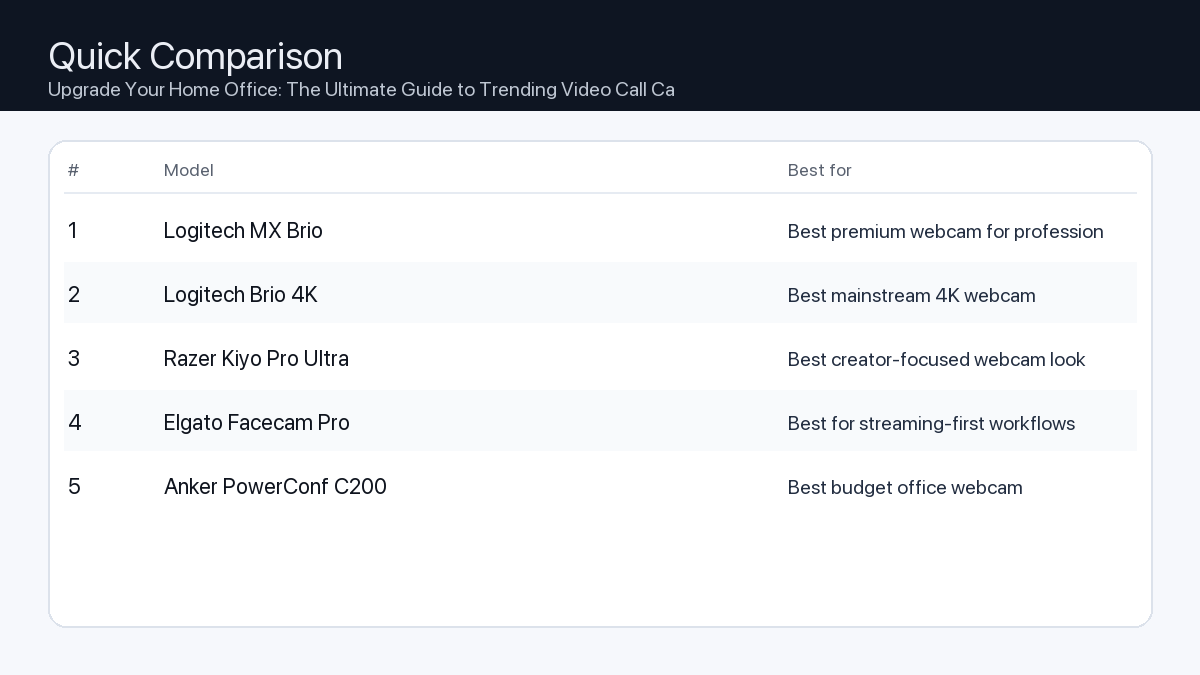
    Quick Comparison

    Note: Specs and availability change. Always confirm details on the product page.

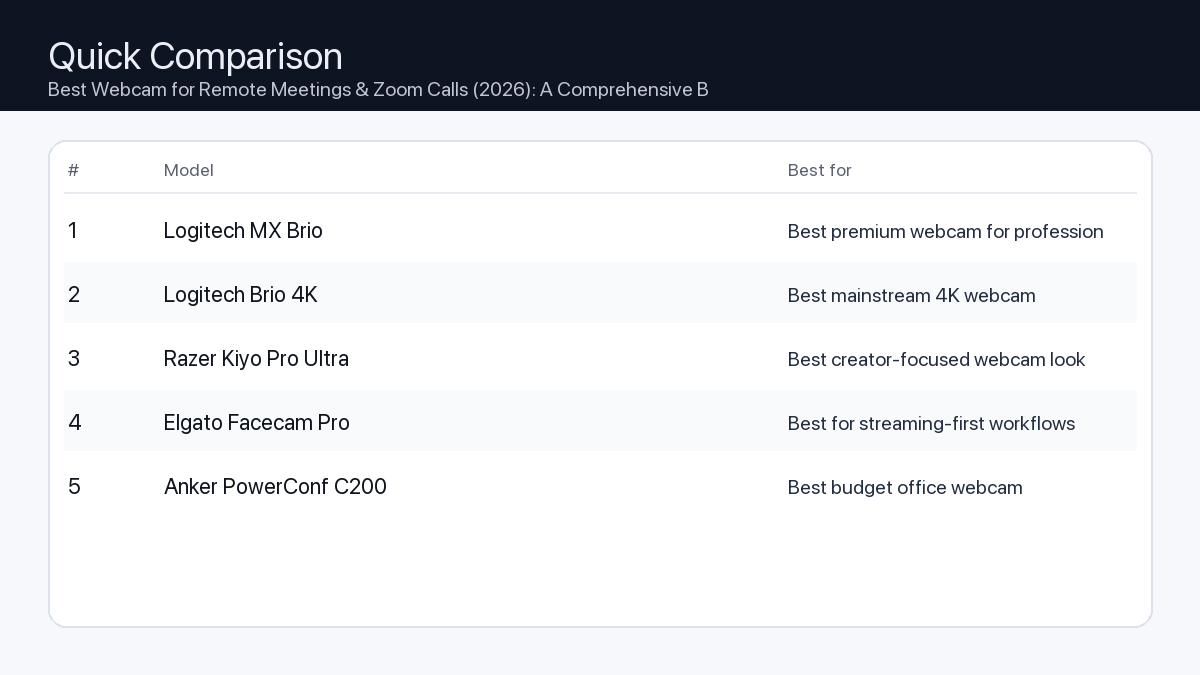
    Model Best for Details
    Logitech MX Brio Best premium webcam for professionals Open section
    Logitech Brio 4K Best mainstream 4K webcam Open section
    Razer Kiyo Pro Ultra Best creator-focused webcam look Open section
    Elgato Facecam Pro Best for streaming-first workflows Open section
    Anker PowerConf C200 Best budget office webcam Open section
    Comparison: Best Webcam for Remote Meetings & Zoom Calls (2026): A Comprehensive Buying Guide
    At-a-glance comparison of our picks.

    Our Top Picks

    #1. Logitech MX Brio

    Best for: Best premium webcam for professionals
    Logitech MX Brio

    Why it made the list

    • Excellent image quality
    • Strong low-light handling
    • Reliable software controls

    Tradeoffs

    • Premium price

    Who should buy this

    • Remote professionals and creators
    • Users prioritizing image quality

    Avoid if

    • You need a basic budget webcam only

    Check price and compatibility for Logitech MX Brio

    Price tip: Prices fluctuate; check Amazon for current deals and compatibility details.

    #2. Logitech Brio 4K

    Best for: Best mainstream 4K webcam

    Logitech Brio 4K

    Why it made the list

    • 4K capability
    • Widely available
    • Good call quality

    Tradeoffs

    • Can require tuning for best results

    Who should buy this

    • Users wanting a known 4K webcam option

    Avoid if

    • You are happy with simple 1080p quality

    Check price and compatibility for Logitech Brio 4K

    Price tip: Prices fluctuate; check Amazon for current deals and compatibility details.

    #3. Razer Kiyo Pro Ultra

    Best for: Best creator-focused webcam look

    Razer Kiyo Pro Ultra

    Why it made the list

    • Large sensor style output
    • Great for streaming setups
    • Strong detail

    Tradeoffs

    • Costly vs mainstream webcams

    Who should buy this

    • Streamers and content creators

    Avoid if

    • You want low-cost business meeting camera

    Check price and compatibility for Razer Kiyo Pro Ultra

    Price tip: Prices fluctuate; check Amazon for current deals and compatibility details.

    #4. Elgato Facecam Pro

    Best for: Best for streaming-first workflows

    Elgato Facecam Pro

    Why it made the list

    • Creator software ecosystem
    • Strong video detail
    • Stable desktop setup use

    Tradeoffs

    • Premium niche pricing

    Who should buy this

    • Creators already using Elgato tools

    Avoid if

    • You do only occasional video calls

    Check price and compatibility for Elgato Facecam Pro

    Price tip: Prices fluctuate; check Amazon for current deals and compatibility details.

    #5. Anker PowerConf C200

    Best for: Best budget office webcam
    Anker PowerConf C200

    Why it made the list

    • Strong value
    • Good for meetings
    • Simple setup

    Tradeoffs

    • Not a premium creator camera

    Who should buy this

    • Remote workers on a budget

    Avoid if

    • You need pro-level creator quality

    Check price and compatibility for Anker PowerConf C200

    Price tip: Prices fluctuate; check Amazon for current deals and compatibility details.

    Still Can’t Decide?

    Quick decision tree:

    Price tip: prices fluctuate often. If you’re flexible, watch for seasonal sales and compare listings before you buy.

    Ready? Open Logitech MX Brio on Amazon

    How to Choose Your Webcam

    Selecting the right webcam involves balancing your specific use case with key technical specifications. Here’s what to consider:

    Resolution & Frame Rate

    Problem: Blurry, pixelated video or choppy motion can create a poor impression during important calls.

    Consequence: Your professionalism may be undermined, and subtle visual cues can be missed, leading to communication breakdowns.

    Recommendation: For crisp, clear video, prioritize 1080p (Full HD) as a minimum standard. If you require exceptional detail for presentations or large screen viewing, consider 4K (Ultra HD) webcams. Frame rate dictates smoothness; 30 frames per second (fps) is standard and adequate for most meetings, while 60fps offers noticeably fluid motion, ideal for dynamic presentations or streaming.

    • 1080p Full HD resolution (minimum)
    • 4K Ultra HD resolution (for maximum detail)
    • 30fps frame rate (standard smoothness)
    • 60fps frame rate (smoother motion for dynamic use)

    Low-Light Performance

    Problem: Appearing dark, grainy, or poorly lit, especially in dimly lit rooms or late-day meetings.

    Consequence: Your face might be obscured, making it harder for others to engage with you visually and potentially affecting how you’re perceived.

    Recommendation: Look for webcams with larger sensors and advanced auto-exposure features. These cameras can capture more light, reducing graininess and producing a brighter, more natural image even without perfect lighting. Some models include AI-powered light correction.

    • Automatic low-light correction
    • Larger image sensor (implies better light gathering)

    Field of View (FOV)

    Problem: Your camera captures too little (cutting off your head) or too much (showing clutter in your room).

    Consequence: An awkward frame can distract from your message or reveal unwanted background elements.

    Recommendation: A field of view between 78 and 90 degrees is suitable for most individual users, capturing you and a small portion of your immediate surroundings. Some webcams offer adjustable FOV, allowing you to switch between a narrow view for solo calls and a wider view for whiteboarding or group discussions. Ensure the FOV matches how much of your background you intend to show.

    • Adjustable Field of View
    • Fixed FOV appropriate for your setup (e.g., 78-90 degrees for single person)

    Autofocus vs. Fixed Focus

    Problem: Constantly appearing out of focus, especially if you move even slightly during a call.

    Consequence: Viewers might perceive you as unprofessional, and your image can become distracting.

    Recommendation: Autofocus webcams continuously adjust to keep you sharp, even if you lean in or move around. This is ideal for dynamic presenters. Fixed-focus cameras, while simpler, are suitable if you remain relatively stationary and are positioned within the camera’s fixed focal plane.

    • Reliable autofocus (for movement)
    • Fixed focus (if you stay still within optimal distance)

    Microphone Quality

    Problem: Your voice sounds muffled, distorted, or is overridden by background noise.

    Consequence: Colleagues or clients struggle to hear you, leading to repeated questions, frustration, and a less productive meeting.

    Recommendation: While a dedicated external microphone is always superior, many webcams include dual stereo microphones with noise-reduction technology. These can be perfectly adequate for general meeting use. However, if audio clarity is paramount, consider using an external USB microphone or headset.

    • Dual stereo microphones
    • Noise-reducing technology
    • Considered external microphone for critical audio

    Mounting & Portability

    Problem: Inability to position the webcam optimally, leading to awkward angles or instability.

    Consequence: You might appear less engaged or present a less professional visual.

    Recommendation: Most webcams come with an integrated clip for monitor mounting. Ensure it’s sturdy and compatible with your display thickness. For more flexible placement, look for models with a standard tripod thread (1/4-inch), allowing use with tripods or desk stands. If you travel frequently, a compact and durable design is a plus.

    • Secure monitor clip
    • Standard tripod mounting thread
    • Compact design (if portability is key)

    Privacy Features

    Problem: Concerns about the camera being inadvertently active when not in use.

    Consequence: A feeling of unease or a breach of personal privacy.

    Recommendation: Many webcams now include a physical privacy shutter that slides over the lens. This provides absolute visual security. An LED indicator light that clearly signals when the camera is active is also a valuable feature.

    • Physical privacy shutter
    • Clear activity LED indicator

    Software & Compatibility

    Problem: The webcam isn’t recognized by your operating system, or you lack control over its settings.

    Consequence: Frustration during setup and inability to optimize your video feed.

    Recommendation: Ensure the webcam is compatible with your operating system (Windows, macOS, Linux, ChromeOS). Many manufacturers offer companion software that allows you to adjust settings like brightness, contrast, white balance, and FOV, often saving profiles for different scenarios. Check for UVC (USB Video Class) compliance for broad plug-and-play support.

    • Broad OS compatibility (Windows, macOS)
    • User-friendly customization software
    • UVC compliant for plug-and-play

    Webcam Setups for Different Users

    The Remote Office Worker

    Needs: Reliable, clear video for daily team meetings, client calls, and virtual presentations. Good low-light performance is a plus for varied working hours.

    Recommended Features:

    • 1080p resolution at 30fps (minimum)
    • Good auto-exposure and light correction
    • Fixed or adjustable FOV (78-90 degrees)
    • Physical privacy shutter
    • Sturdy monitor mount

    The Professional Video Editor / Online Coach

    Needs: Exceptional video quality for high-stakes virtual sessions, recording tutorials, or one-on-one coaching where image clarity directly impacts perceived value. Requires fine control over image settings.

    Recommended Features:

    • 4K resolution at 30fps or 1080p at 60fps
    • Excellent low-light performance with advanced image processing
    • Accurate autofocus
    • Adjustable FOV and granular software controls
    • Tripod mounting option for flexible setup
    • Consider pairing with an external microphone and dedicated lighting

    The Gamer / Content Creator

    Needs: Smooth, high-fidelity video for live streaming, recording gameplay, or creating engaging video content. May require background removal features and strong integration with streaming software.

    Recommended Features:

    • 1080p at 60fps (minimum) or 4K at 30fps
    • Wide or adjustable FOV to capture more of the environment or guest
    • Fast and reliable autofocus
    • Integration with streaming platforms (e.g., OBS Studio)
    • Software for background removal/blur (if green screen not used)
    • Tripod mount essential for varied setups

    How We Picked

    Our selection process for identifying top webcams focuses on a thorough analysis of technical specifications and reported user experiences. We meticulously review product spec sheets for key features such as sensor size, lens aperture, native resolution and frame rates, autofocus capabilities, and microphone arrays. Compatibility with major operating systems (Windows and macOS) and popular video conferencing platforms is a primary consideration. We also evaluate privacy features like physical shutters and activity LEDs, as well as mounting flexibility. While we do not conduct hands-on testing, our recommendations are informed by compiling verifiable product data, assessing general market trends for 2026, and noting common user feedback patterns regarding reliability and performance across diverse usage scenarios.

    FAQ

    Which should I buy: the #1 pick or the best value pick?

    Choose the #1 pick if you demand the absolute best in video quality, advanced features (like superior low-light handling or precise software controls), and are willing to invest for an uncompromising professional presence. Opt for the best value pick if you need reliable, clear video for everyday remote meetings and Zoom calls, perform well in standard lighting conditions, and seek excellent performance without exceeding a moderate budget.

    Final Recommendation

    Choosing the right webcam for your remote meetings and Zoom calls in 2026 is a pivotal decision that impacts your professional image and communication effectiveness. By understanding the core features—from resolution and low-light performance to field of view and microphone quality—you can confidently select a model that aligns with your specific needs and usage patterns. Whether you prioritize cutting-edge performance or excellent value, a well-chosen webcam will significantly enhance your virtual interactions, ensuring you look and sound your best every time.

    Related Guides

    Keep reading with these related buying guides:

  • Best WiFi Router for Large Homes in 2026: The Ultimate Buying Guide

    Best WiFi Router for Large Homes in 2026: The Ultimate Buying Guide

    Disclosure: This post may contain affiliate links. As an Amazon Associate, I earn from qualifying purchases. Learn more.

    Best WiFi Router for Large Homes in 2026: The Ultimate Buying Guide

    Choosing the right WiFi router for a large home in 2026 comes down to balancing current needs with future demands. If your household demands ultra-fast speeds for 8K streaming, VR gaming, or extensive smart home integration across many devices, a premium, future-proofed Wi-Fi 7 mesh system is your ideal choice. For those seeking robust coverage and reliable performance for general use, 4K streaming, and moderate device counts without breaking the bank, a high-quality Wi-Fi 6E or robust Wi-Fi 7 value-tier mesh solution will serve you exceptionally well.

    A large home presents unique challenges for wireless connectivity, from sprawling layouts and multiple floors creating dead zones to a high density of connected devices vying for bandwidth. By 2026, the demand for seamless, high-speed, and reliable internet access is non-negotiable. This guide will walk you through the essential considerations, advanced features, and user-specific recommendations to ensure your home network keeps pace with your digital lifestyle.

    Best Picks (2026)

    Quick Answer (TL;DR) (Updated February 24, 2026)

    If you want one safe pick: ASUS ROG Rapture GT-BE98. If you want a better value: TP-Link Archer BE800.

    How to use this page: scan the comparison table, jump to the matching use case, then open only the listing that fits your setup.

    Fast path: choose one track below and ignore the rest.

    • Track A (least risk): ASUS ROG Rapture GT-BE98
    • Track B (better value): TP-Link Archer BE800

    How we picked: research-based selection using manufacturer specs, compatibility notes, and what to verify on the Amazon listing (no hands-on testing claims). Affiliate links may earn us a commission, but rankings are not paid placements.

    Start with ASUS ROG Rapture GT-BE98 on Amazon Prefer value? Open TP-Link Archer BE800

    Skip to a pick: #1 ASUS ROG Rapture GT-BE98 | #2 TP-Link Archer BE800 | #3 Netgear Nighthawk RS700 | #4 Eero Max 7 (Mesh) | #5 TP-Link Deco BE85 (Mesh)

    Head-to-Head: Top Pick vs Best Value

    ASUS ROG Rapture GT-BE98
    Best premium Wi-Fi 7 gaming router

    Read full #1 breakdown

    Go to Amazon: ASUS ROG Rapture GT-BE98

    TP-Link Archer BE800
    Best mainstream high-performance Wi-Fi 7 option

    Read full best-value breakdown

    Go to Amazon: TP-Link Archer BE800

    Quick Comparison

    Note: Specs and availability change. Always confirm details on the product page.

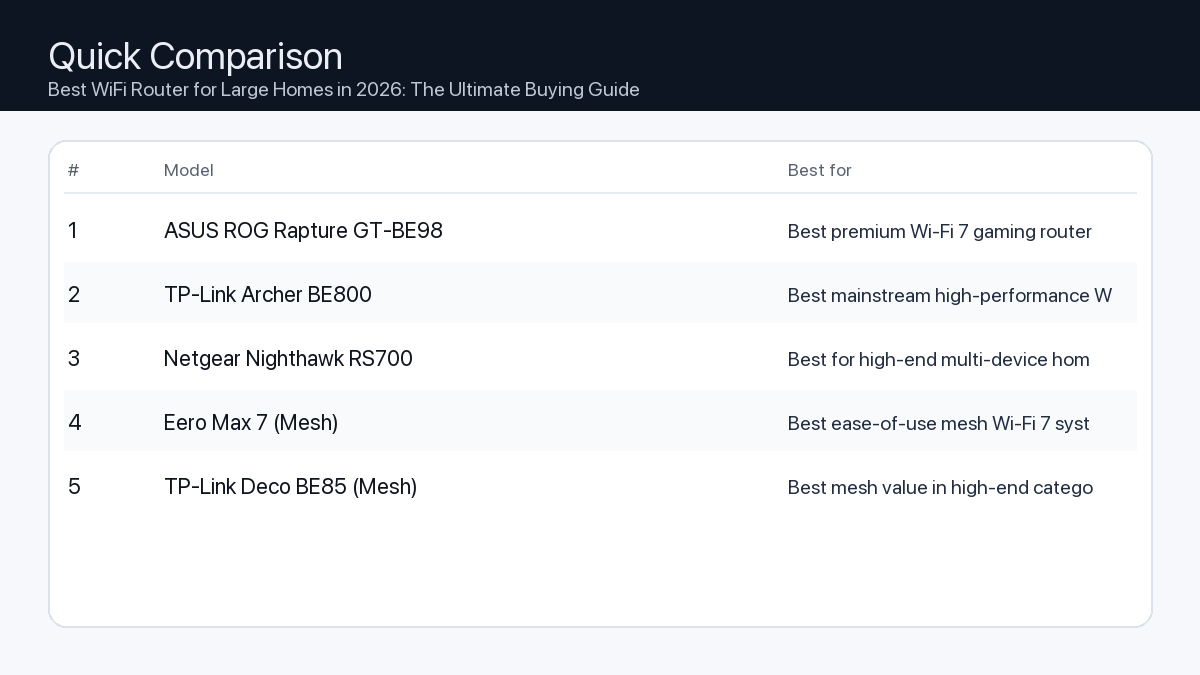
    Model Best for Details
    ASUS ROG Rapture GT-BE98 Best premium Wi-Fi 7 gaming router Open section
    TP-Link Archer BE800 Best mainstream high-performance Wi-Fi 7 option Open section
    Netgear Nighthawk RS700 Best for high-end multi-device homes Open section
    Eero Max 7 (Mesh) Best ease-of-use mesh Wi-Fi 7 system Open section
    TP-Link Deco BE85 (Mesh) Best mesh value in high-end category Open section
    Comparison: Best WiFi Router for Large Homes in 2026: The Ultimate Buying Guide
    At-a-glance comparison of our picks.

    Our Top Picks

    #1. ASUS ROG Rapture GT-BE98

    Best for: Best premium Wi-Fi 7 gaming router

    ASUS ROG Rapture GT-BE98

    Why it made the list

    • Top-tier wireless specs
    • Strong gaming features
    • High-end connectivity

    Tradeoffs

    • Very expensive

    Who should buy this

    • Power users and gamers with many devices

    Avoid if

    • You have a small space and basic internet needs

    Check price and compatibility for ASUS ROG Rapture GT-BE98

    Price tip: Prices fluctuate; check Amazon for current deals and compatibility details.

    Best for: Best mainstream high-performance Wi-Fi 7 option

    TP-Link Archer BE800

    Why it made the list

    • Strong performance
    • Good value in premium tier
    • Easy app setup

    Tradeoffs

    • Still premium-priced vs older Wi-Fi generations

    Who should buy this

    • Large-home users upgrading to Wi-Fi 7

    Avoid if

    • Your ISP speed and devices do not need Wi-Fi 7 yet

    Check price and compatibility for TP-Link Archer BE800

    Price tip: Prices fluctuate; check Amazon for current deals and compatibility details.

    #3. Netgear Nighthawk RS700

    Best for: Best for high-end multi-device homes

    Netgear Nighthawk RS700

    Why it made the list

    • Strong throughput potential
    • Good brand recognition
    • Advanced controls

    Tradeoffs

    • Expensive and may be overkill

    Who should buy this

    • Households with many simultaneous users/devices

    Avoid if

    • You only need basic coverage in a small apartment

    Check price and compatibility for Netgear Nighthawk RS700

    Price tip: Prices fluctuate; check Amazon for current deals and compatibility details.

    #4. Eero Max 7 (Mesh)

    Best for: Best ease-of-use mesh Wi-Fi 7 system

    Eero Max 7 (Mesh)

    Why it made the list

    • Simple app setup
    • Strong whole-home mesh coverage
    • Clean hardware experience

    Tradeoffs

    • Premium ecosystem cost

    Who should buy this

    • Users prioritizing easy whole-home mesh management

    Avoid if

    • You want deep advanced networking controls

    Check price and compatibility for Eero Max 7 (Mesh)

    Price tip: Prices fluctuate; check Amazon for current deals and compatibility details.

    Best for: Best mesh value in high-end category

    TP-Link Deco BE85 (Mesh)

    Why it made the list

    • Strong mesh performance
    • Good value vs top premium mesh kits
    • Modern Wi-Fi 7 support

    Tradeoffs

    • Large-node systems cost can still add up

    Who should buy this

    • Families needing whole-home fast coverage

    Avoid if

    • You only need one simple single router

    Check price and compatibility for TP-Link Deco BE85 (Mesh)

    Price tip: Prices fluctuate; check Amazon for current deals and compatibility details.

    Still Can’t Decide?

    Quick decision tree:

    Price tip: prices fluctuate often. If you’re flexible, watch for seasonal sales and compare listings before you buy.

    Ready? Open ASUS ROG Rapture GT-BE98 on Amazon

    How to Choose the Best WiFi Router for Your Large Home

    Understanding Large Home Connectivity Challenges

    Large homes often face specific WiFi issues that standard routers struggle to resolve:

    • Problem: Dead Zones and Inconsistent Coverage
      Consequence: Dropped video calls, buffering streams, and frustratingly slow internet in certain areas of your home. Large floor plans, multiple levels, and dense building materials (like brick or concrete) can block WiFi signals.
      Recommendation: A mesh WiFi system is generally the superior solution for large homes, as it uses multiple access points to blanket your entire property with consistent signal.
    • Problem: Slow Speeds Under Heavy Load
      Consequence: Laggy gaming, pixelated streaming, and sluggish downloads when multiple family members or smart devices are simultaneously active. Traditional routers can become bottlenecked by too many concurrent connections.
      Recommendation: Look for routers with advanced WiFi standards (Wi-Fi 7 or Wi-Fi 6E), multiple bands (tri-band or quad-band), and powerful processors to handle numerous devices and high bandwidth demands efficiently.
    • Problem: Future-Proofing Your Network
      Consequence: Investing in technology that quickly becomes obsolete as internet speeds increase and new devices emerge, leading to premature upgrades.
      Recommendation: Prioritize routers supporting the latest Wi-Fi 7 standard, offering faster Ethernet ports (2.5GbE, 10GbE), and robust internal components capable of handling future network demands.

    Key Features to Prioritize

    When selecting a router for your large home, focus on these critical specifications:

    • WiFi Standard (Wi-Fi 7 vs. Wi-Fi 6E):
      • Wi-Fi 7 (802.11be, Extremely High Throughput): The newest standard, offering significantly faster speeds, lower latency, and improved capacity through features like Multi-Link Operation (MLO) and wider 320 MHz channels in the 6 GHz band. Ideal for future-proofing and demanding applications.
      • Wi-Fi 6E (802.11ax Extended): Introduces the 6 GHz band, providing a dedicated, uncongested highway for compatible devices. Offers excellent speed and low latency, especially useful in congested areas. A strong choice if Wi-Fi 7 devices aren’t immediately a priority.
    • Mesh WiFi vs. Traditional Router:
      • Mesh WiFi System: Composed of a main router and several satellite units, a mesh system creates a single, unified network that seamlessly covers every corner of your home. It’s the recommended choice for most large and multi-story homes due to its superior coverage and roaming capabilities.
      • Traditional Router: A single, powerful router might suffice for moderately large homes with open layouts, but often struggles with dead zones in expansive or complex structures.
    • Bands (Tri-band, Quad-band):
      • Tri-band: Features one 2.4 GHz band and two 5 GHz bands (or one 5 GHz and one 6 GHz for Wi-Fi 6E/7). The extra 5 GHz/6 GHz band is crucial for dedicated backhaul in mesh systems or for segmenting high-bandwidth devices.
      • Quad-band: Typically one 2.4 GHz, two 5 GHz, and one 6 GHz band. Offers even greater capacity and flexibility, allowing for multiple dedicated backhaul paths or extreme device segmentation, highly beneficial for very dense networks.
    • Processor & RAM: A powerful multi-core processor and ample RAM are vital for handling high network traffic, numerous connected devices, and advanced features without slowdowns. This directly impacts the router’s ability to maintain high speeds and low latency under load.
    • Ethernet Ports (2.5GbE, 10GbE): For wired connections to devices like PCs, NAS drives, or high-speed gaming consoles. Faster WAN/LAN ports (2.5 Gigabit Ethernet or 10 Gigabit Ethernet) are essential to maximize internet speeds beyond 1 Gbps and to enable rapid local network transfers.
    • Security Features: Look for WPA3 encryption, robust parental controls, guest network options, and built-in network security tools to protect your home network from threats.

    Checklist for Large Home WiFi

    • Home Size & Layout: Square footage, number of floors, and building materials (e.g., plaster, brick, concrete).
    • Number of Devices: Count all smartphones, tablets, laptops, smart TVs, IoT devices, and gaming consoles.
    • Internet Service Speed: Ensure the router can handle and distribute your full subscribed internet speed (e.g., 1 Gbps, 2 Gbps, 5 Gbps).
    • Specific Usage Needs: Are you a heavy gamer, 8K streamer, remote worker transferring large files, or simply browsing and emailing?
    • Future-Proofing: Do you want the latest Wi-Fi standard (Wi-Fi 7) to ensure longevity, or is a strong Wi-Fi 6E sufficient for your current and near-future needs?

    Example Setups for Different Users

    The Professional Remote Worker/Creator (e.g., Video Editor, Architect)

    Needs: Uninterrupted, ultra-low latency connection, high upload/download speeds for large file transfers (TB-level), reliable video conferencing, stable connections for specialized software, and potentially multiple workstations.

    • Router Type: Wi-Fi 7 Quad-Band Mesh System (3-4 nodes).
    • Key Features: Dedicated 6 GHz band for workstation backhaul and primary devices, MLO support, at least one 10GbE WAN port and multiple 2.5GbE/10GbE LAN ports for wired workstations and NAS, robust Quality of Service (QoS) to prioritize critical applications.
    • Why it works: Ensures maximum throughput and minimal latency for demanding tasks, even when other devices are active. Wired connections leverage the full internet speed for critical transfers.

    The Connected Smart Home Enthusiast/Office Worker

    Needs: Consistent coverage across the entire home for dozens of smart devices (lights, thermostats, cameras, locks), reliable 4K streaming on multiple TVs, and stable performance for daily office tasks.

    • Router Type: Wi-Fi 7 or high-end Wi-Fi 6E Tri-Band Mesh System (2-3 nodes).
    • Key Features: Excellent device capacity, strong 2.4 GHz performance for IoT devices, dedicated 5 GHz or 6 GHz backhaul, robust security, intuitive app-based management, and parental controls.
    • Why it works: Provides a stable backbone for a high density of devices, preventing slowdowns and ensuring all smart home features respond instantly.

    The Hardcore Gamer & Streamer

    Needs: Ultra-low ping, maximum sustained bandwidth, minimal packet loss, ability to game and stream simultaneously without compromise, dedicated channels for high-performance consoles/PCs.

    • Router Type: Wi-Fi 7 Tri-Band or Quad-Band Mesh System with gaming-specific features (2-3 nodes, depending on home size).
    • Key Features: Multiple 2.5GbE/10GbE ports, dedicated gaming band (if quad-band), advanced QoS/game prioritization, Multi-Link Operation (MLO) support for latency-sensitive applications, powerful processing for packet handling.
    • Why it works: The combination of Wi-Fi 7 speed, dedicated bands, and advanced traffic management ensures that gaming and streaming traffic are prioritized, resulting in a smooth, lag-free experience even under network stress. Wired connections deliver the absolute best performance.

    How We Picked These Routers

    Our selection process for the best WiFi routers for large homes in 2026 is based on a meticulous analysis of several critical factors. We evaluate routers primarily on their technical specifications, projected real-world performance based on advancements in networking standards, and compatibility with the evolving landscape of connected devices and internet service speeds. We prioritize models that feature the latest Wi-Fi 7 or advanced Wi-Fi 6E standards, robust mesh capabilities for extensive coverage, powerful multi-core processors, ample RAM, and high-speed Ethernet ports (2.5GbE/10GbE). Consideration is given to multi-band configurations (tri-band, quad-band) for optimal device management and dedicated backhaul. While we do not perform hands-on testing, our recommendations are grounded in detailed spec sheet comparisons, industry benchmarks, and a thorough understanding of current and future networking requirements for large, demanding home environments.

    Frequently Asked Questions

    Which should I buy: the #1 pick or the best value pick?

    Choose the #1 pick if you prioritize absolute cutting-edge performance, require the fastest possible speeds for next-generation devices, operate a very demanding network with numerous high-bandwidth users (e.g., 8K streaming, VR, large file transfers), and want maximum future-proofing. Opt for the best value pick if you need excellent, reliable coverage and fast speeds for common tasks (4K streaming, online gaming, remote work) across a large home, have a moderate number of devices, and prefer to balance performance with a more budget-conscious investment.

    Do I need Wi-Fi 7 for a large home?

    While not strictly necessary for every large home, Wi-Fi 7 offers significant advantages, especially for future-proofing and very demanding users. It provides higher theoretical speeds, lower latency, and better capacity for numerous devices compared to Wi-Fi 6E. If your internet service provider offers multi-gigabit speeds (2 Gbps or higher), you have or plan to acquire Wi-Fi 7 compatible devices, or you perform very bandwidth-intensive tasks, a Wi-Fi 7 router will fully leverage these capabilities. For many users, a high-quality Wi-Fi 6E mesh system still provides excellent performance and coverage for large homes in 2026.

    Can I use my existing modem with a new router?

    In most cases, yes, you can use your existing modem with a new router. Your modem is responsible for connecting your home to your internet service provider (ISP), while the router creates and manages your local WiFi network. Simply connect the new router’s WAN (Internet) port to your modem’s Ethernet port using an Ethernet cable. Ensure your existing modem can support the full speed of your internet plan to avoid creating a bottleneck for your new high-performance router.

    Final Recommendation

    Selecting the best WiFi router for your large home in 2026 is a pivotal decision that impacts your entire digital experience. By carefully considering your home’s unique layout, the number and type of devices you operate, and your specific online activities, you can make an informed choice. Prioritize mesh systems for comprehensive coverage, Wi-Fi 7 or advanced Wi-Fi 6E for speed and future compatibility, and ensure robust processing power and fast Ethernet ports for demanding tasks. Investing in the right router today will ensure a seamless, high-performance, and future-ready network that effortlessly supports all your large home’s connectivity needs for years to come.

    Related Guides

    Keep reading with these related buying guides:

  • Upgrade Your Home Office: The Ultimate Guide to Trending Video Call Cameras

    Upgrade Your Home Office: The Ultimate Guide to Trending Video Call Cameras

    Disclosure: This post may contain affiliate links. As an Amazon Associate, I earn from qualifying purchases. Learn more.

    Upgrade Your Home Office: The Ultimate Guide to Trending Video Call Cameras

    In today’s remote-first world, your video call camera is more than just a peripheral; it’s your window to colleagues, clients, friends, and family. A high-quality camera can significantly enhance your professional image, improve communication clarity, and make a lasting impression. Gone are the days when a basic built-in laptop camera sufficed; the market is now rich with innovative, trending video call cameras designed to elevate your home office experience.

    But with so many options available, how do you choose the right one for your needs? This comprehensive buying guide will walk you through the essential features, practical considerations, and ideal setups to help you make an informed decision and find the perfect video call camera that aligns with your specific home office demands.

    Best Picks (2026)

    Quick Answer (TL;DR) (Updated February 23, 2026)

    If you want one safe pick: Logitech MX Brio. If you want a better value: Logitech Brio 4K.

    How to use this page: scan the comparison table, jump to the matching use case, then open only the listing that fits your setup.

    Fast path: choose one track below and ignore the rest.

    • Track A (least risk): Logitech MX Brio
    • Track B (better value): Logitech Brio 4K

    How we picked: research-based selection using manufacturer specs, compatibility notes, and what to verify on the Amazon listing (no hands-on testing claims). Affiliate links may earn us a commission, but rankings are not paid placements.

    Start with Logitech MX Brio on Amazon Prefer value? Open Logitech Brio 4K

    Skip to a pick: #1 Logitech MX Brio | #2 Logitech Brio 4K | #3 Razer Kiyo Pro Ultra | #4 Elgato Facecam Pro | #5 Anker PowerConf C200

    Head-to-Head: Top Pick vs Best Value

    Logitech MX Brio
    Best premium webcam for professionals

    Read full #1 breakdown

    Go to Amazon: Logitech MX Brio

    Logitech Brio 4K
    Best mainstream 4K webcam

    Read full best-value breakdown

    Go to Amazon: Logitech Brio 4K

    Quick Comparison

    Note: Specs and availability change. Always confirm details on the product page.

    Model Best for Details
    Logitech MX Brio Best premium webcam for professionals Open section
    Logitech Brio 4K Best mainstream 4K webcam Open section
    Razer Kiyo Pro Ultra Best creator-focused webcam look Open section
    Elgato Facecam Pro Best for streaming-first workflows Open section
    Anker PowerConf C200 Best budget office webcam Open section
    Comparison: Upgrade Your Home Office: The Ultimate Guide to Trending Video Call Cameras
    At-a-glance comparison of our picks.

    Our Top Picks

    #1. Logitech MX Brio

    Best for: Best premium webcam for professionals

    Logitech MX Brio

    Why it made the list

    • Excellent image quality
    • Strong low-light handling
    • Reliable software controls

    Tradeoffs

    • Premium price

    Who should buy this

    • Remote professionals and creators
    • Users prioritizing image quality

    Avoid if

    • You need a basic budget webcam only

    Check price and compatibility for Logitech MX Brio

    Price tip: Prices fluctuate; check Amazon for current deals and compatibility details.

    #2. Logitech Brio 4K

    Best for: Best mainstream 4K webcam

    Logitech Brio 4K

    Why it made the list

    • 4K capability
    • Widely available
    • Good call quality

    Tradeoffs

    • Can require tuning for best results

    Who should buy this

    • Users wanting a known 4K webcam option

    Avoid if

    • You are happy with simple 1080p quality

    Check price and compatibility for Logitech Brio 4K

    Price tip: Prices fluctuate; check Amazon for current deals and compatibility details.

    #3. Razer Kiyo Pro Ultra

    Best for: Best creator-focused webcam look

    Razer Kiyo Pro Ultra

    Why it made the list

    • Large sensor style output
    • Great for streaming setups
    • Strong detail

    Tradeoffs

    • Costly vs mainstream webcams

    Who should buy this

    • Streamers and content creators

    Avoid if

    • You want low-cost business meeting camera

    Check price and compatibility for Razer Kiyo Pro Ultra

    Price tip: Prices fluctuate; check Amazon for current deals and compatibility details.

    #4. Elgato Facecam Pro

    Best for: Best for streaming-first workflows

    Elgato Facecam Pro

    Why it made the list

    • Creator software ecosystem
    • Strong video detail
    • Stable desktop setup use

    Tradeoffs

    • Premium niche pricing

    Who should buy this

    • Creators already using Elgato tools

    Avoid if

    • You do only occasional video calls

    Check price and compatibility for Elgato Facecam Pro

    Price tip: Prices fluctuate; check Amazon for current deals and compatibility details.

    #5. Anker PowerConf C200

    Best for: Best budget office webcam

    Anker PowerConf C200

    Why it made the list

    • Strong value
    • Good for meetings
    • Simple setup

    Tradeoffs

    • Not a premium creator camera

    Who should buy this

    • Remote workers on a budget

    Avoid if

    • You need pro-level creator quality

    Check price and compatibility for Anker PowerConf C200

    Price tip: Prices fluctuate; check Amazon for current deals and compatibility details.

    Still Can’t Decide?

    Quick decision tree:

    Price tip: prices fluctuate often. If you’re flexible, watch for seasonal sales and compare listings before you buy.

    Ready? Open Logitech MX Brio on Amazon

    FAQ

    Which should I buy: the #1 pick or the best value pick?
    If your budget allows and you prioritize the absolute best image quality, advanced features, and a future-proof solution for all your video communication needs, the #1 pick is likely your ideal choice. It typically offers a premium experience with superior optics and robust software. However, if you need a reliable, high-performance camera that delivers excellent video quality for most daily tasks without breaking the bank, the best value pick provides an outstanding balance of features and affordability, often exceeding basic expectations for its price point. Choose based on whether your primary driver is uncompromised quality or optimal performance per dollar.

    Final Recommendation

    Choosing the right trending video call camera for your home office is an investment in your professional presence and personal connections. By understanding the key features, considering your specific use case, and reviewing the practical checklists, you can confidently select a camera that not only meets but exceeds your expectations. Remember to prioritize resolution, low-light performance, autofocus, and connectivity to ensure a seamless and high-quality video experience. Elevate your virtual interactions and make every call count.

    Related Guides

    Keep reading with these related buying guides: